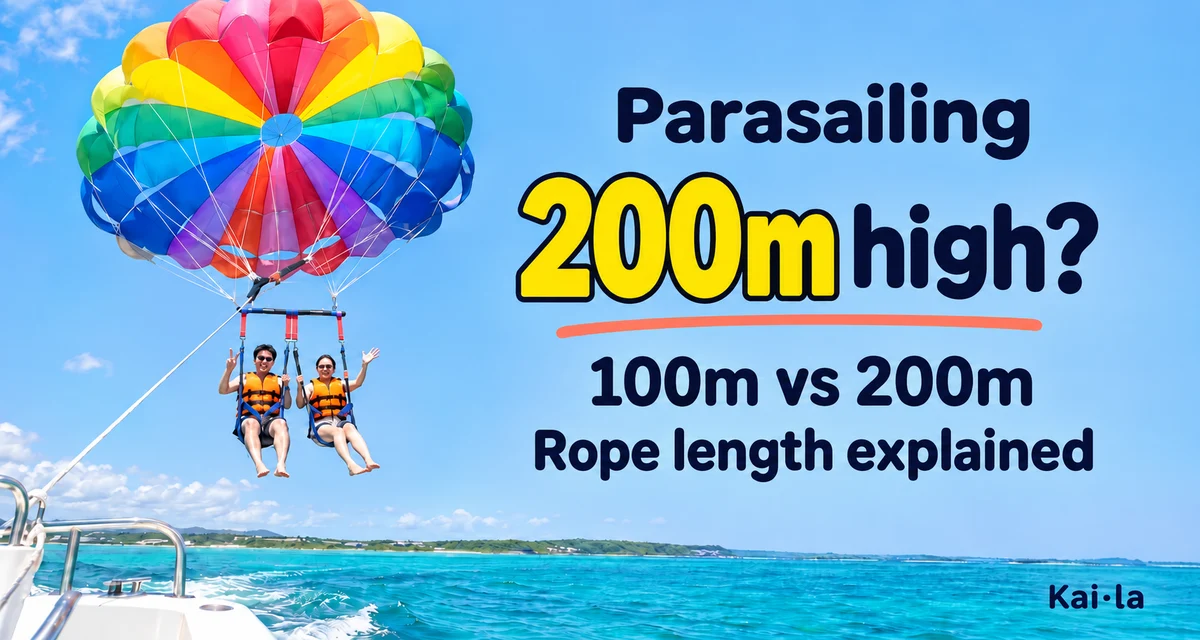
While researching parasailing, the numbers “100m” and “200m” can catch your eye. Does that mean going 200 meters above the sea? Would 100m feel less frightening? Does a longer option mean more time in the air? It is natural to wonder.
First, check what the number measures. If “200m” refers to rope length, it does not mean a height of 200 meters above the sea. To understand a comparison with 100m, establish whether both figures describe rope length or both describe altitude.
This guide uses a simple diagram to explain the difference, then looks at plan descriptions, the information in Kai・la's menu and questions to ask before booking. Rather than letting one number shape your whole impression, think about the experience you would like to enjoy together.
With a “200m” parasailing description, first identify what is being measured
“200m rope length” describes the line between the boat and parasail
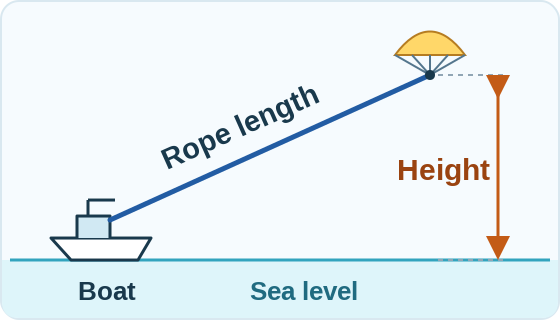
A rope connects the boat and the parasail in the air. A figure labeled “rope length” or “towline length” describes that line. It is different from the vertical distance between a person in the air and the sea surface.
Even when “200m” appears prominently on a page, smaller text or the plan details may explain that it refers to the rope. Read the words around the figure as well as the headline. Look for qualifications such as “maximum,” “approximately” or “subject to conditions on the day.”
The wording may still leave you unsure whether a rope figure means the maximum available length or the name of a bookable option. Ask how that number should be understood for the departure you are considering, so that your expectations match the explanation.
For “200m altitude,” check where the measurement begins and ends
If a description explicitly says “altitude” or “height above the sea,” it is discussing something different from rope length. Still check whether the figure is an estimate and which position it describes. The top of the parasail and the seated passenger are not at the same point.
You can ask two questions: “Does 200m describe the rope or the height above the sea?” and “If it is altitude, which point is that estimate referring to?” A shared unit does not establish that two measurements describe the same thing.
When the page does not identify length or height, contact the booking team instead of making your own assumption. Read what is being measured alongside the number: that is the starting point for choosing a plan.
| Wording on a page | What to consider | Example question |
|---|---|---|
| Rope length | Not the same measurement as height above the sea | Is this a maximum length or a bookable plan category? |
| Altitude or height | Check the reference point and whether it is an estimate | Height above the sea to which position? |
| A number alone | The figure does not establish a meaningful comparison | Do both numbers describe the same measurement? |
See why rope length and height differ
The rope runs diagonally; height is measured vertically
The rope from the boat to the parasail extends at an angle to the sea. Height above the sea is measured upward from the sea surface. Because these measurements run in different directions, you cannot read rope length directly as altitude.
Think of a string held diagonally: its length and the height of its end above the floor are different measurements. Keeping length and height separate makes the figures used in parasailing easier to understand too.
The diagram illustrates this difference in measurement direction. Use it to distinguish the diagonal rope from height above the sea, rather than reading an angle from the drawing to calculate an actual flight altitude.
There is no fixed conversion from rope length to flight altitude
The US National Transportation Safety Board's 2014 parasailing investigation report explains that deployed towline length, wind and vessel speed are involved in the parasail's altitude. This is background on the mechanism, not a statement of current Japanese rules or Kai・la's operating conditions.
A rope figure alone therefore does not let a visitor conclude that altitude is always half the length, or that 200m of rope always produces one particular height. The flight's angle and state cannot be determined solely from a number on a booking page.
Do not convert rope length into altitude using a fixed percentage; confirm the actual explanation for your chosen course. An estimate in a blog or review is not a guarantee of the same experience.
Looking up or down in a photograph changes the impression of height
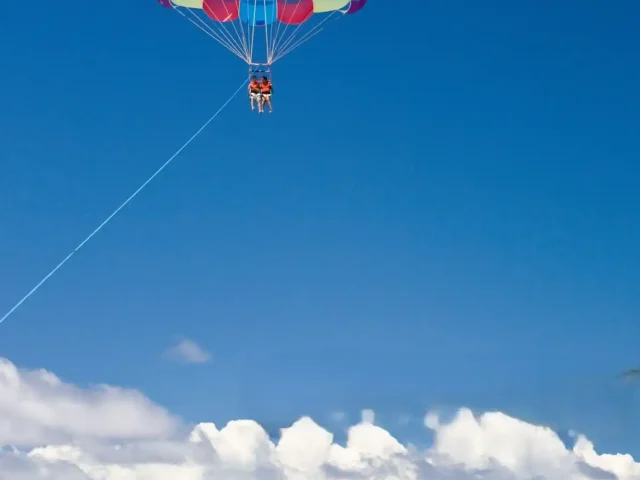
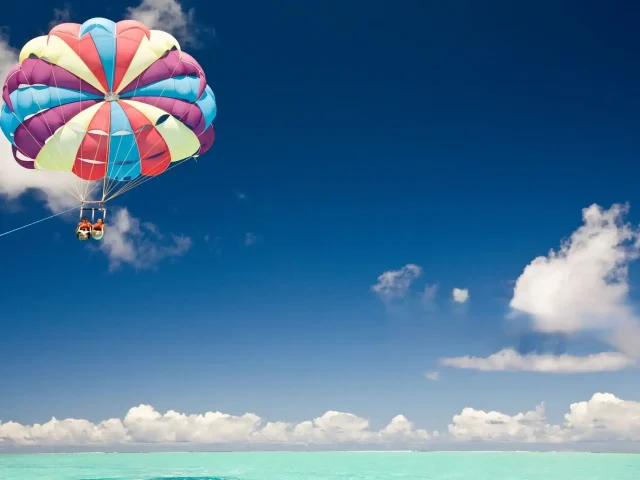
A picture taken upward from a boat may include lots of sky and make the parasail seem very high. An aerial photograph looking down may emphasize a small-looking boat or the sea beneath it. Direction and framing change how even the same scene appears.
Do not determine actual altitude from the size of people or the apparent rope angle in a photograph. If the sea is not visible, the reference for height is missing too. Camera angle of view and the photographer's position also affect the picture.
When sharing a reference photograph, describe what appeals to you rather than treating it as an altitude specification. “I like the wide view of the sea” or “Looking down worries me a little” makes your question easier to discuss.
What should you match when comparing 100m and 200m?
Compare rope with rope, or altitude with altitude
If you find “100m” and “200m” plans, first check whether both figures refer to the same measurement. If one describes rope length and the other altitude, placing the numbers side by side does not provide the comparison you intended.
Even when both describe rope length, the location, course and conditions may differ. If you are looking at different operators or harbors, make a note of the venue and meeting point as well to avoid mixing them up.
Keep three notes: what the number measures, whether it represents a selectable option, and what may change on the day. Matching the explanations before choosing by price or numbers helps you identify the differences that matter to your preferences.
Twice the length does not automatically mean twice the flight time
200m is twice the length of 100m, but that does not establish twice as much time in the air. Rope length and flight duration are separate items to check. A description of a longer rope does not automatically mean a longer, more leisurely flight.
Likewise, an “approximately one-hour” duration may not mean an hour continuously airborne. Ask whether it refers to the complete outing, including check-in, boarding, travel and waiting, or to the flight itself. That distinction also helps with your itinerary.
Check rope length, flight time and total tour duration separately. If you have sightseeing or airport travel afterward, discuss the margin you need too.
A larger number need not mean a better view or a better experience for you
Choosing the larger number does not guarantee that it will suit you better. Some people want a wide coastal view; others are most excited about their first experience of floating above the sea with a companion.
Sea colors and scenery also vary with location, weather and the direction you look. Avoid fixed expectations such as a particular island always being visible at 200m, or 100m necessarily being disappointing. Put the view or experience you hope for into words.
“We would like to enjoy the sea and sky” or “It is our first time, and we would like to hear the explanation first” is enough. Consider what everyone could enjoy rather than using the largest figure as your only criterion.
After reading the numbers, clarify your group's preferences
For scenery, explain what you would like to see
Think of a few things that interest you: the blue sea, a boat's wake or the distant coastline. Identifying what you want to see can clarify your wishes better than simply saying you want to fly high.
Ask which directions or views the course commonly offers and whether the day's conditions affect them. Do not assume a particular island or animal will appear; listen to the local guidance.
If photographs matter to you, altitude need not be the whole focus. Whether you want the sea as a background or a memory of flying together changes the questions you might ask about photography.
If heights worry you, name the moment that concerns you
If “200m” makes you nervous, first check what the label means. Then explain whether you are worried about your feet leaving the deck, looking down at the sea or feeling far from the boat.
No one can state that 100m will definitely feel comfortable or that a lower flight will have no movement. People experience height differently, and the same scene can raise different concerns. Asking about suitable participation conditions is different from a promise that all fear will disappear.
Ask before booking how far height preferences can be discussed and how to speak up if you become more anxious during preparation. For the sequence of the experience and the floating sensation, see Is parasailing scary?.
Check whether everyone in the group wants the same thing
The organizer may favor the option with the largest number while someone else feels nervous about their first flight. Before booking, ask each person what they look forward to and what concerns them.
If you want to fly together, share that preference with the necessary numbers and weights. A companion may feel reassuring, but the proposed combination is not automatically possible. Understanding what happens if you fly separately can help too.
Our parasailing weight-limit guide covers grouping and weights. Discuss your height preferences and the people flying together as separate questions rather than treating one number as an answer to both.
What Kai・la's parasailing menu tells you, and ways to enjoy the outing
Separate the published course details from questions about height
Kai・la's Scenic Parasailing is listed as a course meeting at Miegusuku Port in Naha, lasting approximately one hour in total, for healthy guests aged four and over, with bookings starting from two people.
The public menu does not list selectable 100m or 200m rope categories or a specific altitude above the sea. The numbers discussed in this article should not be read as a guarantee of a particular Kai・la altitude or a choice between those two options.
If you have a height preference for Kai・la's course, check the official participation requirements and discuss it directly before booking. You can simply explain that you understand the distinction between rope length and altitude and would like to hear how the actual course works.
Combine a Miegusuku Port outing with time around Naha
Kai・la's parasailing meets at Miegusuku Port in Naha. Its location makes it convenient to consider a sea-view outing on a day spent around the airport or Kokusai Street. Fitting the experience into your wider trip is another reason to consider the course alongside flight specifications.
Treat approximately one hour as an overall tour estimate, allowing for travel, waiting and the day's circumstances. Mention any fixed rental-car return or flight schedule beforehand.
The menu says there is no shuttle service, so guests arrange their own travel to the meeting point. Allow for traffic, parking and movement within the port so that you can listen to the explanation without rushing.
Discuss flights for up to three adults with everyone's numbers and weights
Kai・la's menu states that up to three adults may fly together depending on group size and weight. Being able to discuss sharing the view with friends or family is an appealing part of planning the experience.
That maximum does not mean every combination can necessarily fly together. Provide accurate participant information and follow guidance that takes account of conditions on the day. When asking about height preferences, say who hopes to fly together as well.
Looking forward to a shared experience is part of the holiday. Rather than persuading each person with the size of a number, talk about the scenery you would like to see together.
Enjoy the possibility of taking pictures with your own smartphone
Kai・la's parasailing menu says guests can take their own photographs with their smartphones. If you look forward to recording the view as well as enjoying it, ask how to bring the phone and when to use it.
A rope-length figure does not guarantee a specific photograph. Direction, camera angle of view and conditions change what fits into the image. Do not significantly change your posture or let go of something you need to hold just for a shot; follow staff instructions.
If you would also like underwater scenery, Kai・la offers Blue Cave Snorkeling + Scenic Parasailing. Blue Cave Core in Onna Village and Miegusuku Port in Naha are separate meeting locations, with guests arranging their own transport between them. Confirm both locations, meeting times and operating updates when planning.
What to check on the booking page, and how to ask
Read the details, selection fields and conditions beyond the large number
After noticing a headline, read the plan details. Check what 100m or 200m measures, whether the selection field gives the same explanation, and where estimates or conditions for changes are described.
Note the page name and the date you checked it so that you can refer to the relevant wording later. Tell the booking team which course and label you mean. If you saw an old screenshot or a short search-result description, reread the current official menu too.
Once a booking reply arrives, check the course name, date, party size and meeting point against your conversation. Keep answers about the figures in a form you can share with companions.
Turn “How many meters will we fly?” into two clearer questions
First ask what the label means, then explain your preference. For example:
We are considering parasailing for two adults. Do the meter figures describe rope length or altitude above the sea? It is our first time and height is a concern, so could you explain the course and whether we can discuss our preferences?
After clarifying the number, ask separately about flight time and total tour duration. Separate the meaning of the figure, your preferences and the arrangements on the day to make the conversation easier to follow.
| What to clarify | Questions before booking | What to share with companions |
|---|---|---|
| Meter figures | Rope length or altitude; estimate or maximum? | Make sure everyone understands the same meaning |
| Preferences and eligibility | Whether height preferences can be discussed and the grouping conditions | Everyone's wishes, numbers and weights |
| Time | Flight duration and the overall tour estimate | Time needed for sightseeing and transport |
| Changes on the day | Updates and contact methods if conditions change | Who receives messages and when to check |
Follow the actual guidance if conditions change on the day
With a sea activity, you may receive an updated explanation on the day even after discussing the plan when booking. Kai・la's menu also notes possible cancellation due to sea conditions or equipment issues.
If the update differs from your preference, ask what it means. Contact the booking team before cancelling on your own or failing to attend without notice. Check the current menu and booking reply for course-change and cancellation terms.
Clarifying questions, including how charges are handled, can make a changing itinerary easier to manage. If height worries you, do not assume a changed number resolves it; explain again what concerns you.
Frequently asked questions about 100m and 200m parasailing descriptions
What height does Kai・la's parasailing actually reach?
The public menu does not specify altitude above the sea or rope-length options, so this blog cannot promise a particular height. Contact us with your preferred date and party size if you would like to discuss it.
Keep published information such as total duration and simultaneous-flight numbers separate from questions about height. The search term “200m” is not a statement of Kai・la's actual altitude.
Can I assume altitude is about half the rope length?
There is no universal half-length conversion. Other conditions affect the flight, and a booking page does not establish a constant angle.
Separate a mathematical illustration from the actual explanation for the day. If height is hard to imagine, asking the booking team about the experience and view is more useful than calculating your own altitude from a rope figure.
Does bringing a child automatically mean a lower flight?
Do not assume that flights with children are always lower. Provide ages, weights and the preferred group and ask what is possible. Kai・la's standalone parasailing course is for healthy participants aged four and over.
Meeting the age requirement does not guarantee a preferred height or grouping. Check how your child feels too, and mention any first-time nerves when booking.
Can a smartphone's altitude display measure the height during the outing?
Device displays have reference points and measurement conditions, so do not assume a figure on a phone represents exactly the same height as the tour explanation. You do not need to make operating or measuring with a smartphone the purpose of the activity.
Follow staff explanations and the instructions for belongings first. Even when taking pictures, leave time to enjoy Okinawa's sea with your own eyes instead of concentrating only on the device.
Can I change or lower the height myself once airborne?
Parasailing is not an activity in which guests pilot themselves to a chosen position. Discuss height preferences and worries before flying.
Also clarify beforehand how to communicate a problem in the air and what responses are possible. Do not try to alter altitude through a pose or improvised movement; follow the posture and signals you are taught. Our guide for guests concerned about parasailing accidents covers other safety questions to ask.
Understand the numbers, then enjoy Okinawa's sky with Kai・la
With 100m and 200m descriptions, first identify what the number measures. Rope length and height above the sea are different items. Reading flight time and total duration separately also helps you choose around your group's preferences.
Kai・la's Scenic Parasailing meets at Miegusuku Port in Naha for an approximately one-hour outing to enjoy sea and sky. You can discuss flying together or a Blue Cave combination to fit your itinerary.
If you would like a clearer explanation of height descriptions or have questions before your first visit, please contact Kai・la for reservations and enquiries. Share your preferred date, party size and concerns, and let's plan something to look forward to in Okinawa.