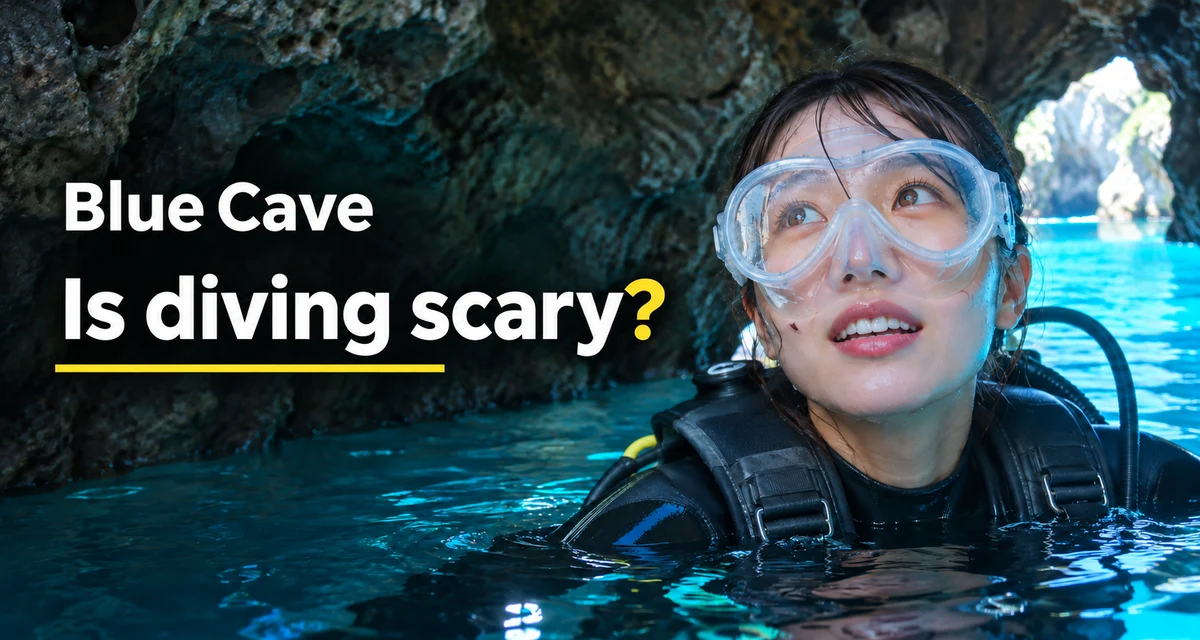
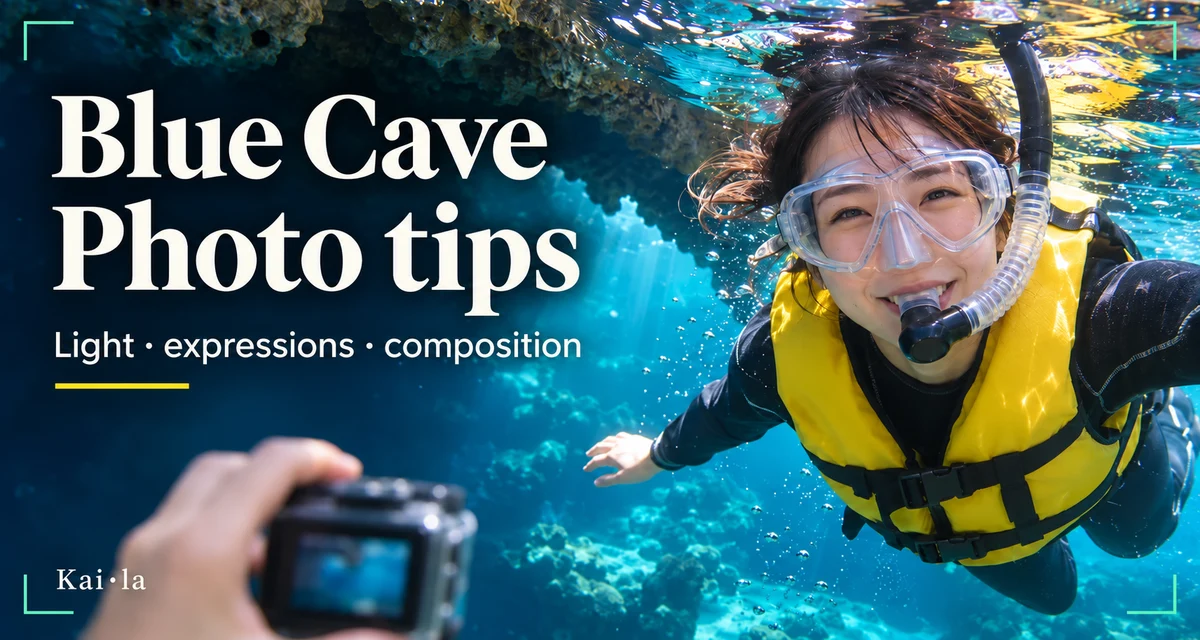
Floating in blue water, happy eyes behind a mask, fish passing right in front of you: a visit to Okinawa's Blue Cave is the sort of experience you may want to remember in photographs with family or friends.
Underwater pictures do not always work like holiday portraits on land. A beautifully blue background can leave people looking dark, or a hand raised for a pose can accidentally hide a face. Understanding a few of these differences makes it easier to explain what you would like when someone photographs you.
Start by thinking of a portrait with recognizable faces and a silhouette against blue light as two different photographs. Neither has to be the only “right” picture. This guide covers light, expressions and composition, along with Kai・la's photography service and receiving your pictures, for guests trying it for the first time.
Think in three kinds of Blue Cave photographs: people, blue scenery and the experience
Enjoy both recognizable faces and silhouettes
Imagine your holiday album: you probably want pictures showing everyone clearly as well as photographs that make the blue scenery the main subject. At the Blue Cave, separating “a picture of us” from “a picture of the cave's light” makes your wishes easier to explain than trying to put everything into one image.
A recognizable portrait reminds you who shared the day. A silhouette against the blue surface or underwater scenery recalls the atmosphere. Add a moment of discovering fish or looking relieved after getting comfortable in the water, and a sequence of pictures begins to tell the story of the outing.
Instead of simply asking for beautiful photographs, try “We would love a picture where both our faces are recognizable, and another with the blue scenery.” Conditions may not allow every requested photograph, but this helps you share the memory you hope to keep.
Snorkeling and introductory diving create different views
Snorkeling lets you enjoy the sea while floating at the surface. Introductory diving uses diving equipment to experience the underwater scenery. Even on a visit to the same Blue Cave, a photograph near the surface and a picture of you underwater will have different moods.
Choose your course around the experience you want as well as a photograph you have seen on social media. You might prefer watching the sea from the surface with family, or hope to record yourself underwater using diving equipment. Each participant's feelings matter too.
You do not need to choose an unfamiliar movement or an uncomfortable activity just for a photograph. Discuss both the pictures you would like and the kind of experience you feel you could enjoy. Follow the chosen course's instructions for actual positions and posture during photography.
Capturing blue light: understand how the background affects people
A dark face can still make an atmospheric silhouette
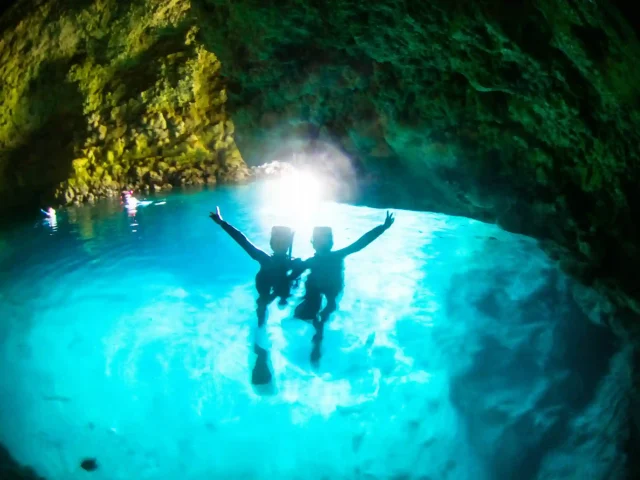
When someone is in front of a bright background, the person can look dark by comparison. A figure outlined against blue light uses that contrast as part of the photograph. A face that is not clearly visible does not automatically make a picture a failure.
The outline of two people together, or the scale of a person within the blue space, can convey the atmosphere beautifully. If you also want to show your family how happy you looked, a recognizable portrait serves a different purpose. Let the photographs do different jobs instead of asking one image to do everything.
Do not swim toward a brighter area or farther into the cave yourself to make your face brighter. Ask staff what direction and position are possible in the circumstances. Before the activity, you can say, “Could we also have a picture where our expressions are visible?”
Skin and clothing can look different underwater
In underwater photographs, skin and clothing can take on a blue cast. The different components of light do not remain equally strong as it travels through water. Canon's explanation of underwater light and color describes how red components decrease with the distance light passes through water, leaving a bluer appearance.
Colors differing from their appearance on land do not necessarily mean the camera is faulty. How a picture records a person's color and the blue background varies with light, distance and camera settings. Put your preferences into words: “I would love to keep the cave's blue,” or “It would be nice to recognize our expressions too.”
Rather than explaining the whole science of the cave's light here, the useful point is that a photograph's colors and the impression you see with your own eyes will not always match. Enjoy the memory of the scenery you actually saw as well as the finished photographs.
Do not expect an identical photograph at a particular time
The sea's appearance and the places or moments available for photography vary with sea conditions, light and the surroundings. A friend joining at the same time of day does not establish that you will get the same colors or composition.
If you bring a reference image, identify what you like about it. “I like the wide blue background” is easier to discuss than asking for an exact copy. Also consider any differences in participant numbers or the course shown in your reference.
The photograph you hope for and whether the Blue Cave can be visited are separate questions. Our guide to today's Blue Cave conditions, webcam, flags and tour updates explains what to check before leaving. Confirm the actual plan first, then ask about the scenery available at that destination.
Expressions and poses that convey enjoyment through a mask
Check the camera and your gaze rather than forcing a big smile
A mask and breathing equipment mean you cannot show your whole mouth in the same way as in a portrait on land. Instead of trying to smile broadly, simply finding the camera and looking toward it when instructed can change the impression of a picture.
There is no need to remove your mask, snorkel or regulator for a photograph. Keep your equipment as instructed and breathe calmly while being photographed. Do not hold your breath to pose underwater; follow the actual breathing instructions for your activity.
If you cannot find the camera, or your mask is bothering you too much to think about a picture, tell staff first. Getting comfortable matters more than performing an expression. Happy eyes or the pleasure of being beside someone you came with can also make a memorable portrait.
Keep hands away from faces and movements small
A peace sign can accidentally hide a mask in the finished photograph. When a pose is appropriate, think about leaving the face unobstructed. A hand very close to the lens can also appear disproportionately large in the frame.
Underwater hand signals have meanings, so do not confuse a photographic pose with communication to staff. Ask beforehand which poses are suitable, and enjoy them only when the photography instructions allow, within a comfortable range.
If you need to hold equipment or a float, do not let go just to pose. A clear face in the instructed position is more useful than a dramatic movement. Not every photograph needs camera contact: simply looking at the sea can capture the feeling of your trip.
For couples and families, explain that you want everyone's face visible
When people line up behind one another, the person farther back may be hidden. If your priority is a photograph of everyone, mention that at the start.
Follow staff guidance about how to arrange yourselves. Rather than suddenly swimming closer or pulling someone's equipment to get into the frame, ask whether a change is possible. “We would like our child's face to be visible” or “We would love both of us in the picture” makes the request specific.
You do not have to aim for everyone looking perfectly at the lens at the same instant. Someone spotting a fish or turning toward a friend can make a picture you enjoy talking about later. With children, prioritize their feelings and comfort rather than making everyone copy a pose.
Composition: balance the people and the blue scenery
A closer portrait and a picture with space around you
Larger figures make expressions easier to see. More blue space around a person conveys the feeling of being in the sea. If you would like both, discuss them as separate requests: one showing faces and one with a wider view.
You can also think about how you will use the photograph. A family album may benefit from recognizable faces, while a cover image for the trip might suit a spacious scene. If you hope to use a vertical image on social media, mention that preference beforehand too.
Neither orientation nor a particular composition is automatically available as part of the photography service. Discuss your desired composition in advance, then follow staff guidance for actual positions and movements. Do not block a passage through the cave or obstruct other people for a photograph.
With fish, record the experience rather than chasing them
If you hope for fish in a picture, think about recording yourself enjoying the sea rather than pursuing the animals. A photograph of you watching fish and another of a school of fish can make a lovely album without insisting that both your face and the fish be perfectly clear in one shot.
Avoid catching animals or bracing yourself on coral or rocks to take a picture; enjoy the area you are guided to. OM SYSTEM's underwater photography introduction also cautions against stirring up sand with fins or damaging coral.
If fish do not come to the place you hoped, do not remain fixed on one composition. Discovering a small fish or looking into the water can still record your experience. Animal numbers and appearances in a photograph are not promised; enjoy the scenery you encounter.
Give an album variety beyond similar close-ups
Pictures of scenery, companions and moments during the activity help you remember the outing alongside close-up portraits. Excited faces before entering the sea and a quiet look at the water afterward are also worthwhile holiday photographs.
You do not have to record every possible scene. Choose one or two preferences and leave time to enjoy what is in front of you. Think of photographs as a way to revisit an experience you enjoyed, rather than making the whole experience serve the camera.
| Picture you would like | What it shows | Example of how to express your wish |
|---|---|---|
| A portrait together | Eyes through masks and everyone's face | We would like both our faces to be recognizable. |
| A blue-light picture | Outlines of people within blue space | We like the atmosphere of a wide blue background. |
| Enjoying fish | Watching fish and the underwater scene | A picture of us watching fish would be lovely if possible. |
| Before and after the outing | Anticipation and relaxed smiles | We can also take our own pictures before and after entering the sea. |
With Kai・la, leave underwater photography to staff and enjoy the activity
GoPro photography on snorkeling and introductory diving courses
Kai・la's Blue Cave Snorkeling and Blue Cave Introductory diving menus include staff photography with a GoPro and underwater photographs given to guests. This is a useful feature if you would like pictures of your experience without bringing your own camera.
On a first sea activity, managing equipment and operating a camera at the same time can feel like a lot. Letting staff take the underwater pictures leaves you free to concentrate on the sea and the experience. You can also discuss photographs together instead of making one companion the permanent photographer.
The photography listing does not guarantee a particular number of pictures, composition or shooting location. If you would also like video or have a special-occasion request, ask before booking rather than assuming it is included in the listed photography service.
Shallow-water breathing practice also prepares you to enjoy photographs
Both Kai・la courses describe equipment explanations and breathing practice in shallow water where you can stand. Even when photographs are something you particularly look forward to, start by listening and getting used to your equipment and breathing.
Tell staff during preparation if being photographed makes you nervous, or if you are worried that you cannot look toward the camera because swimming feels difficult. Getting comfortable with the activity and discussing those concerns matters more than focusing only on the photograph.
If putting your face in the water worries you, see our guide for guests nervous about Blue Cave snorkeling. Thinking about the camera can wait until you feel ready.
Check the small-group arrangements and share wishes before the activity
Kai・la describes its snorkeling as a small-group experience. Families and first-time participants can organize concerns and preferences to discuss from the booking stage.
The menu also states that parties of three or fewer join a shared tour. Small-group operation does not mean that a private location or time for your photography is reserved. Check the actual arrangements for your party size.
Rather than preparing a long list, summarize who you want photographed and the picture you hope to keep in one short request. For example:
We are considering snorkeling together for the first time. We would love a picture where both our faces are recognizable and another with the blue scenery, if possible. Could you also explain how we receive the photographs?
Ask how and when to check your photographs
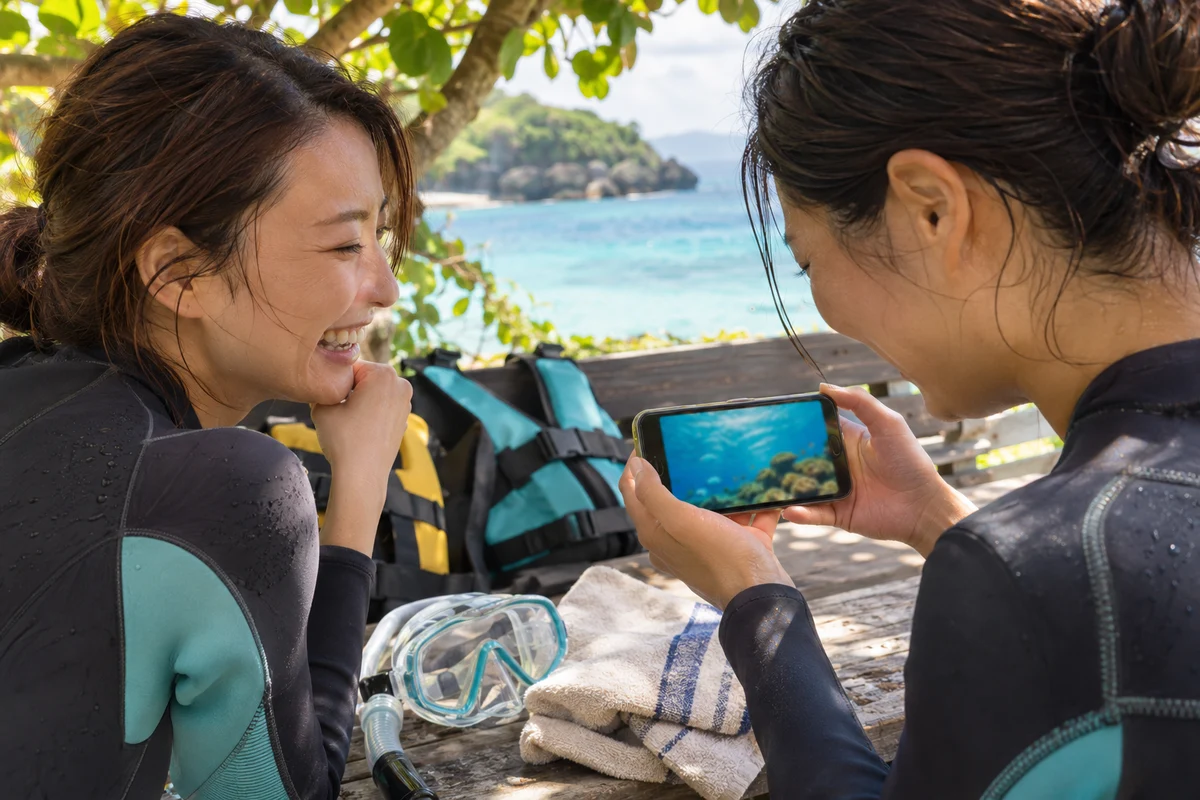
Kai・la's menu says guests can check their underwater photographs on a smartphone by that evening. At reception or another suitable time, confirm how you will receive them and whose device will be used.
If the group organizer receives the files, plan how to share them with everyone else. Make a note of the contact details used and the instructions so that you can find them during your trip.
If you are unsure how to access the pictures that evening, reread the instructions and contact Kai・la if needed rather than searching for an unrelated website. Ask beforehand about any unlisted terms you need to know, such as file availability periods or whether resending is possible.
| What to check | What to ask | What to arrange within your group |
|---|---|---|
| Photography content | What underwater photographs the course includes | One or two scenes you especially hope to keep |
| Additional wishes | Whether unlisted requests such as video are possible | Whether photographs or video matter more to you |
| Receiving files | How to access them, contact details and timing | Who receives the group's photographs |
| Saving and sharing | Any relevant conditions, such as an availability deadline | Sharing with companions and keeping a backup |
Bringing your own camera: confirm permission before concentrating on settings
Check operation and waterproofing before entering the sea
First ask whether you may bring a camera on your chosen course and when it can be used. A smartphone, waterproof case and action camera require different handling, so provide the model and case rather than only saying you want to bring a camera.
Even with permission, water-use conditions and waterproofing differ by device. Read the manual about underwater use and fitting the case, and check battery charge, storage and the shutter controls before departure. Do not plan to open the case or swap parts underwater.
Some cameras offer underwater settings, but their names and operation are not universal. For example, OM SYSTEM's official TG-7 FAQ describes several underwater modes for different scenes. Read your own camera's instructions instead of applying one setting to every model.
Stay with the group and keep following instructions
When you see something you want to photograph, it can be tempting to follow it through the screen. During the tour, stay with your group and prioritize staff instructions. If the camera distracts you from equipment explanations or directions to move, take a break from photographing.
Separate moments for using your camera from moments when staff photograph you. You might leave the group portrait to staff and use your own camera for scenery before and after the sea activity. That can be enough to enjoy both approaches.
Time without photographs still leaves memories: looking up at the blue surface or seeing fish pass close by is part of what you experienced with your own eyes. Before buying more equipment, consider the course's included photography and the balance that would let you enjoy the activity.
Enjoy your photographs through selection and finishing
Open pictures properly before deciding they are unsuccessful
When the photographs arrive, open an interesting image rather than judging it only from a small thumbnail. A small figure may work beautifully within a wide blue scene. A picture with little background may instead capture a companion's eyes particularly well.
Select images for reasons you like: everyone is included, you love the expression, or the blue light looks beautiful. With similar pictures, mark favorites and compare them before immediately deleting anything.
Receive and save the original files using the provided instructions, and keep another copy where appropriate. Keeping only a screenshot of the display is less useful than also having the original if you later want a different crop or a print.
Edit copies, and check before sharing people's pictures
A little brightness adjustment or trimming an edge can make your subject easier to see. Keep the original and experiment on a copy. If boosting blue makes skin look unnatural too, compare the result with the original again.
Save the original first, then adjust brightness and cropping gradually so that you can change your choice later. With a silhouette, you may prefer to preserve the outline and blue background instead of trying to make the face bright.
Before posting on social media, ask companions whether they are happy for the photograph to appear, and check whether other participants are recognizable. Let everyone enjoy remembering the experience comfortably. A private album or sharing within your group is another option.
Frequently asked questions about Blue Cave photographs
Can I take underwater pictures just because I have a smartphone?
Having a smartphone does not mean it is ready for underwater photography. Check the device and case conditions and permission to bring it on the course. Do not assume an everyday water-resistance description makes it suitable for the sea.
Kai・la lists staff GoPro underwater photography on its snorkeling and introductory diving menus. If camera operation worries you, discuss leaving underwater pictures to staff and using your phone to receive them and take photographs by the shore.
Can I ask for photographs if I am not a confident swimmer?
Yes, you can share that wish. Discuss any worries about swimming or putting your face in the water at the same time. First get used to the equipment and breathing, then follow the day's guidance about what you can comfortably enjoy.
Do not force yourself into something difficult just for a picture. “It is my first time, so I would appreciate photographs after I feel settled” is enough to start the conversation. Tell staff about anxiety or discomfort before prioritizing photography.
If the Blue Cave is closed, are photographs impossible too?
Kai・la's menus explain that when sea conditions close the cave, the destination may change to another site with coral and fish. Pictures there show different scenery from photographs with a blue cave behind you.
Ask what the activity and photography would involve at the alternative location. Check your desired cave photographs separately from the photographs possible if the destination changes. Sea conditions or equipment issues can also lead to cancellation, so follow the booking team's operating guidance rather than deciding from photo expectations alone.
Keep blue scenery and a photograph that feels like you with Kai・la
Enjoy Blue Cave pictures by treating a blue-light scene and a recognizable portrait as different photographs. Knowing a little about gaze, hands that do not hide faces, and the balance of people and scenery makes your wishes easier to share.
Kai・la's snorkeling and introductory diving menus include GoPro underwater photography and photographs given to guests. Leave photography to staff and make time to enjoy the blue scenery in front of you too.
Whether you hope for a family memory or want to ask about photography before your first visit, please contact Kai・la for reservations and enquiries. Tell us the course you are considering, your party size and the kind of picture you hope to keep, and let's plan something to look forward to in Okinawa.