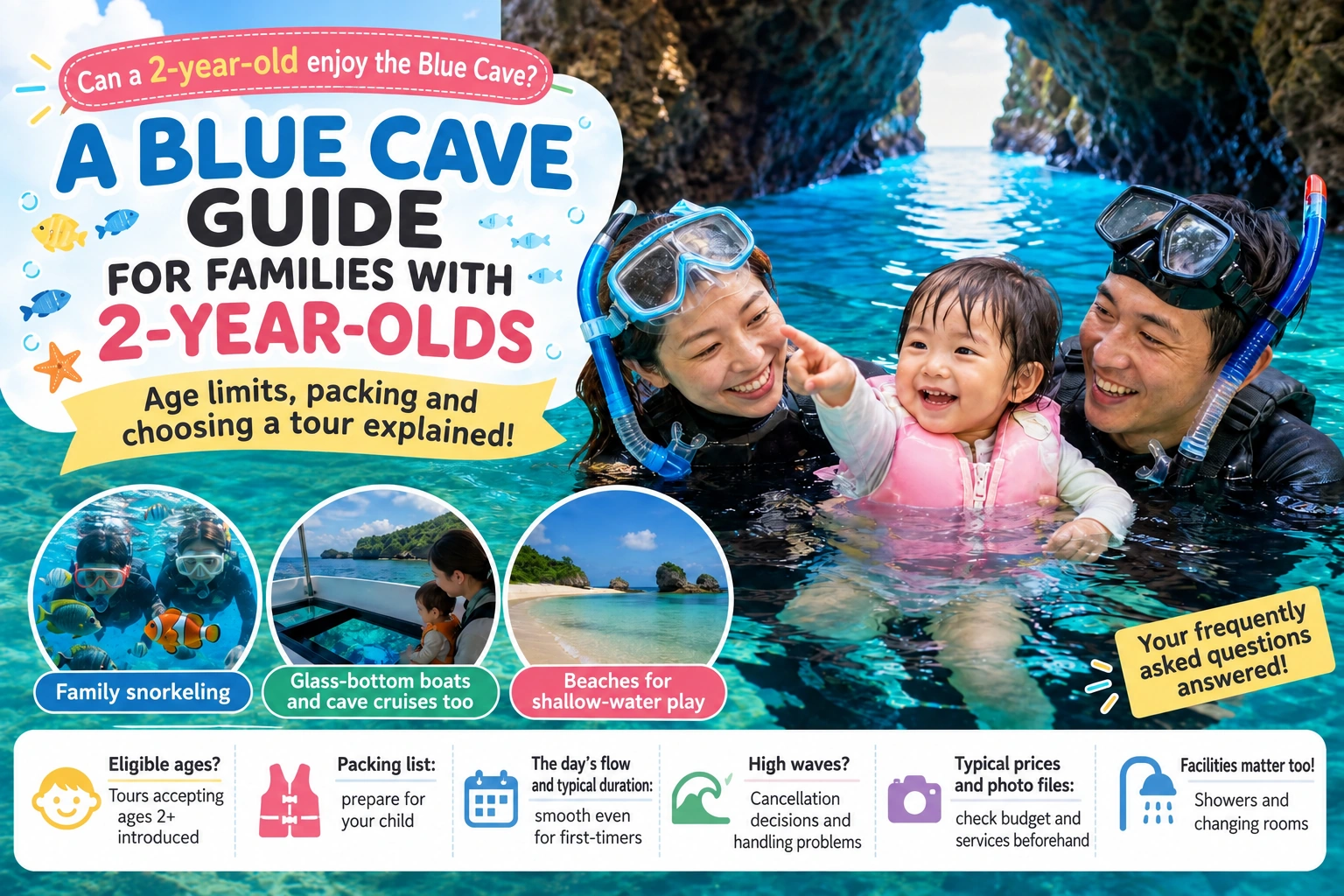
"We want the whole family to see the Blue Cave on our Okinawa trip, but can a 2-year-old join a snorkeling tour?" For moms and dads asking that question, this article gathers everything you need to enjoy the Blue Cave at Cape Maeda in Onna Village with a 2-year-old. The short answer: most shops set the minimum age for Blue Cave snorkeling at 3 or older, or at elementary school age, but Okinawa also has family plans open to 2-year-olds, private tours with no age limit, and glass-bottom boats and cave cruises that let you see the sea from the deck, so there are several ways to enjoy the blue water with a small child. In other words, you don't have to give up just because your child is 2. Depending on how you choose your tour, making a family memory is entirely possible. By the end of this article you will know everything you need before booking: the difference between boat entry and beach entry and why boat entry suits 2-year-olds, ways to take part while holding your child or using a float ring, children's life jacket and wetsuit sizes, the flow of the day and how long it takes, a packing list (spare clothes, diapers, marine shoes, a waterproof phone case and more), how decisions to cancel for high waves are made, how to handle seasickness or a crying child, typical prices, whether photo data is included, and facilities to check such as warm-water showers. We also introduce backup plans that don't depend on the weather, such as shallow beaches around Onna Village and a combination with the Churaumi Aquarium. The FAQ answers worries like "What if my child can't swim?", "Can my child join if they're not out of diapers yet?" and "When do cancellation fees start?", so even if this is your first marine activity in Okinawa with kids, you can plan with confidence.
Can a 2-year-old join Blue Cave snorkeling in Okinawa?
The "Blue Cave" at Cape Maeda in Onna Village on the main island of Okinawa is a popular snorkeling spot. The question we hear most from families with small children is whether a 2-year-old can join. The short answer is that if you choose the right shop and plan, there are Blue Cave snorkeling tours that accept 2-year-olds. However, not every tour accepts 2-year-olds, so it is essential to understand the participation conditions before you book. Here we go over the reality of age limits and the basic conditions to keep in mind when joining with a 2-year-old.
The usual minimum age for Blue Cave snorkeling is 3
The most common requirement for Blue Cave snorkeling tours is "age 3 and up" or "age 4 and up." Snorkeling means floating on the surface and breathing through a mask and snorkel, so the minimum age is set with the assumption that a child can understand and follow an instructor's directions. Some shops also require elementary school age or set minimum height and weight, so even among tours with the same "Blue Cave tour" name, the conditions vary widely from shop to shop.
That is why, if you are bringing a 2-year-old, booking a plan that says "age 3 and up" could still get you turned away on the day. The first thing to do is choose a plan whose participation conditions on the booking site clearly say "2-year-olds welcome" or "no age limit".
| Example age requirement | What to expect | Suitable for a 2-year-old? |
|---|---|---|
| No age limit / from age 0 | Mostly private boats and cruises. Riding while held in your arms is assumed | Easy to join |
| Age 2 and up | Boat entry, using a float ring or being held, with the option of waiting on the boat | Can join |
| Age 3 and up / age 4 and up | The standard setting for regular snorkeling tours | Generally not possible |
| Elementary school age and up / age 6 and up | Full-scale plans with beach entry or swimming inside the cave | Not possible |
Why more shops and tours now accept 2-year-olds
In recent years, more family plans around Onna Village and Cape Maeda have started accepting 2-year-olds and toddlers. Behind this is the fact that Okinawa has become a go-to trip for families with kids, and more families want everyone to share the same experience.
Specific reasons why shops are now able to accept them include the following.
- Boat entry plans, which take you by boat to near the cave entrance, have become more common, so there is no longer any need to swim long distances
- More shops now stock small-sized gear such as toddler life jackets, wetsuits and children's masks
- Private, one-group-at-a-time and small-group tours have become common, making it possible to guide at the family's own pace
- Participation styles such as waiting on the boat or simply looking at the sea from the surface without swimming are now accepted
In other words, whether a 2-year-old can join is decided not by "whether the child can swim" but by whether the shop has the right gear, boats and guide setup. Looking for shops that specialize in families, or that clearly say children are welcome, makes it easier to find candidates.
Can you bring a 0- or 1-year-old baby?
For babies aged 0 or 1, the realistic option is not to go into the water for snorkeling but to ride along on the boat held by a parent, or to enjoy the scenery from the deck on a glass-bottom boat or cave cruise. Whether the shop can provide an infant life jacket can be a deciding factor, so it is safest to tell them your baby's age in months, height and weight and ask in advance.
If you are bringing a baby, be sure to check the following points as well.
- Whether infant-sized life jackets are available, and the rental fee
- Whether you are still charged if one parent waits on the boat or on land
- Whether there is a space for nursing and changing diapers
- Whether there is shade from direct sunlight, or whether the boat has a roof
A 2-year-old can splash with their feet in the water or ride a float ring and look at fish from the surface, but with 0- to 1-year-olds it is safer not to force them into the sea and instead build the day around watching from the boat. The younger the child, the more important it is to choose a plan with the goal of "seeing" rather than "swimming".
The difference between tours with and without age limits
Even at the same Blue Cave, some tours have strict age limits and others are more relaxed. The difference comes down mainly to three things: the entry method, the travel distance and the group size.
| Comparison | Tours with strict age limits | Tours easier for 2-year-olds to join |
|---|---|---|
| Entry method | Beach entry, going down stairs and swimming from the shore | Boat entry, going by boat to the front of the cave |
| Swimming distance | Swim to the cave and back on your own | Float on the surface from the boat for a short time only |
| Group size | Large groups shared with other parties | Private for your family or small groups |
| Number of guides | One guide for many participants | A dedicated guide for your family |
| Participation style | Everyone swims the same course | You can choose to be held, use a float ring or wait on the boat |
Beach entry at Cape Maeda involves climbing up and down a long staircase, which is a heavy burden when carrying a 2-year-old and is also affected by wave conditions. Boat entry, on the other hand, lets you board at the harbor and travel straight to the cave area, so it is physically easier and realistic even with a toddler. If you are aiming for the Blue Cave with a 2-year-old, a boat entry plan that you can book as a private family tour is your best option.
Note that the presence or absence of an age limit is part of the shop's safety standards itself, not something to negotiate loosely. Before booking, tell them your child's age and the number of people accurately, and get an answer on whether you can participate in writing or by email to prevent trouble on the day. The content of the day may also change depending on sea conditions or the guide's judgment, so it is reassuring to ask about alternative plans for that case too.
What kind of place is the Blue Cave in Okinawa?
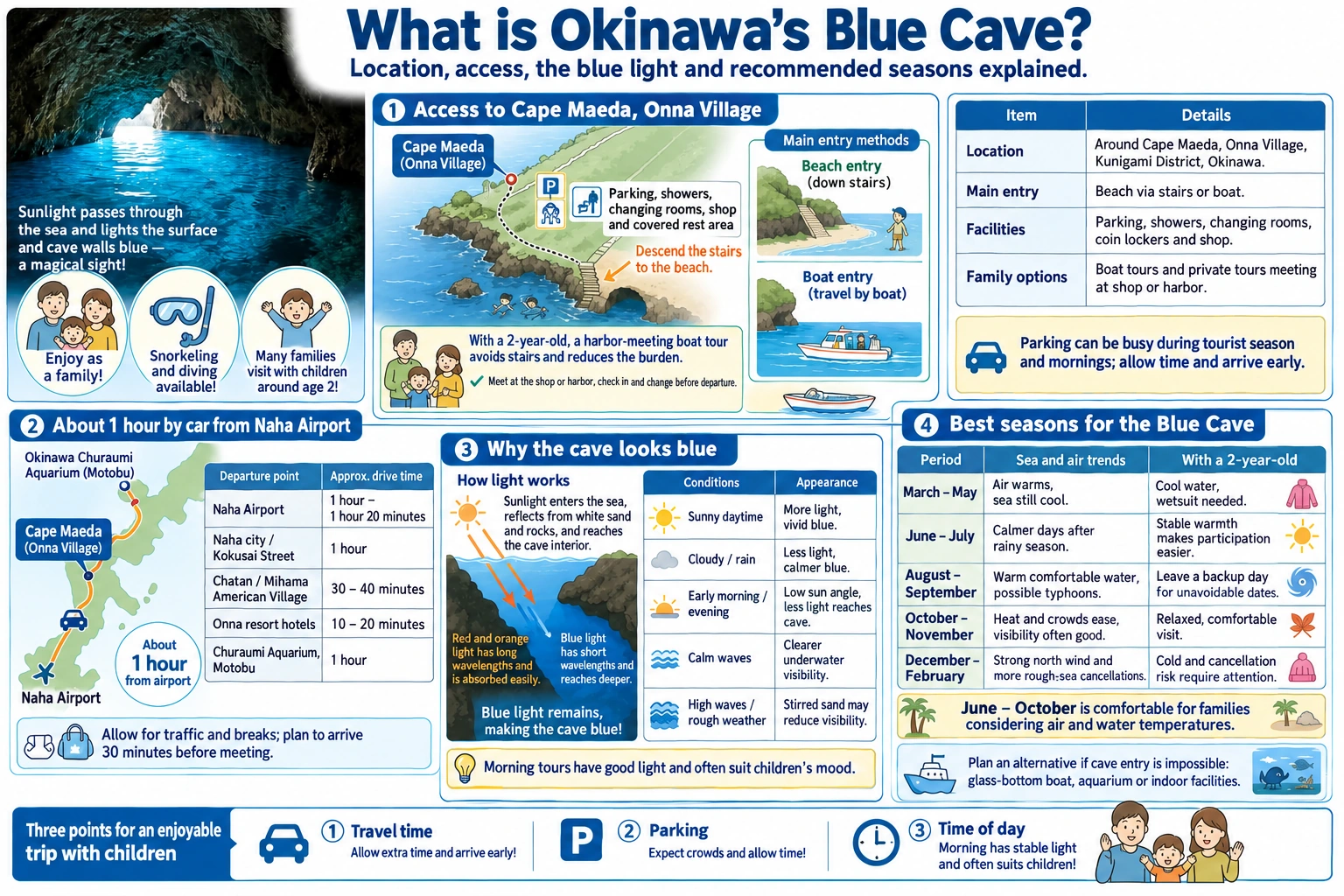
In Okinawa, the "Blue Cave" refers to the sea cave at Cape Maeda in Onna Village, in the central part of the main island. Named after the Blue Grotto on the island of Capri in Italy, it is known for the sight of the water inside the cave glowing a magical blue. You can go inside the cave while snorkeling or diving, which has made it one of the most popular marine activity spots on the main island of Okinawa, and many families with small children around 2 years old visit as well.
Here we cover the basics: where the Blue Cave is and how to get there, why it looks blue, and when is the best time to go. When visiting with kids, keeping three points in mind, "travel time," "parking" and "time of day," makes it easier to plan the day.
Getting to Cape Maeda in Onna Village, where the Blue Cave is
The entrance to the Blue Cave is at Cape Maeda, in Maeda, Onna Village, Kunigami District, in central Okinawa Island. The cape area is developed as a tourist spot with a parking lot, paid showers and changing rooms, shops and viewing areas. To reach the entry point at the foot of the cliff you have to go down stairs, so be aware that going up and down while carrying your gear and a 2-year-old is a heavy burden.
For that reason, many shops have guests meet at their own nearby store or harbor instead of the Cape Maeda parking lot, then finish check-in and changing there before heading to the sea. If you have a 2-year-old, choosing a "meet at the harbor, depart by boat" tour that takes you to the cave by boat without using the stairs greatly reduces the burden of getting around.
| Item | Details |
|---|---|
| Location | Around Cape Maeda, Onna Village, Kunigami District, Okinawa Prefecture |
| Main entry methods | Beach entry down the stairs / boat entry by boat |
| Facilities on site | Parking, showers, changing rooms, coin lockers, shops and more |
| Options for families with kids | Boat tours that meet at the shop or harbor, private tours |
Also, the Cape Maeda parking lot tends to fill up in the morning during the tourist season and peak season, and you may have to wait for a space. If you are driving a rental car straight there, leave plenty of time so that you can arrive earlier than the meeting time.
About 1 hour by car from Naha Airport, a convenient location
Cape Maeda in Onna Village, where the Blue Cave is, is roughly an hour by rental car from Naha Airport. You can take either the Okinawa Expressway (toll road) toward the Ishikawa or Yaka interchanges, or Route 58 north along the west coast, depending on traffic. It is also easy to fit in on the afternoon of your arrival day or the morning of your departure day, which is one reason it is popular with families.
Onna Village is also a resort area on the west coast of Okinawa Island, with many large hotels nearby. If you stay at a resort in Onna Village, the trip to the Blue Cave often takes only about 10 to 20 minutes by car, and when traveling with a 2-year-old who is prone to naps and fussiness, planning activities close to your hotel is the key to success.
| Starting point | Approximate travel time by car |
|---|---|
| Naha Airport | About 1 hour to 1 hour 20 minutes |
| Naha city / around Kokusai-dori | About 1 hour |
| Chatan / around Mihama American Village | About 30 to 40 minutes |
| Around resort hotels in Onna Village | About 10 to 20 minutes |
| Churaumi Aquarium (Motobu) | About 1 hour |
Travel times are only a guide, and Route 58 gets congested during tourist season and commuting hours. When traveling with small children, allow time for restroom breaks and changing, and plan to arrive at least 30 minutes before the meeting time to leave some breathing room.
Why the inside of the cave glows blue
The blue glow inside the cave is a natural phenomenon created by the combination of the properties of light and the shape of the cave. Sunlight entering from outside the cave goes into the water, reflects off white sand and rocks, and travels deeper into the cave. Light with longer wavelengths, such as red and orange, is easily absorbed by water, and only blue light reaches far, so the water surface and walls inside the cave look blue.
Because this phenomenon depends on the amount of light, the way it looks changes even at the same spot. From the morning to early afternoon on a sunny day, when the sun is high, plenty of light comes in and the conditions are right for the most vivid blue. In contrast, on cloudy or rainy days and late in the evening, the amount of light drops and the blue tends to be more subdued.
| Conditions | How the blue tends to look |
|---|---|
| Clear skies, daytime | Plenty of light comes in and the blue tends to look vivid |
| Cloudy or rainy weather | Less light, giving the blue a calmer impression |
| Early morning, evening | The sun is low, so light has trouble reaching the back of the cave |
| Calm-wave days | Clarity is maintained and you can see well underwater |
| High waves, after rough weather | Sand can be stirred up and clarity may drop |
If you are joining with a 2-year-old, morning departures are strong candidates because the light conditions are good and a child's mood tends to be more stable. Mornings let you avoid nap time, and the sea is often relatively calm too, which is another advantage.
The best season for the Blue Cave
Blue Cave snorkeling is an activity you can enjoy all year round by wearing a wetsuit. That said, considering sea conditions, air temperature and water temperature, early summer through autumn is the easiest time to join with small children.
| Period | Sea conditions and climate | How easy it is to join with a 2-year-old |
|---|---|---|
| March to May | Air temperatures start to rise and the sea calms down | Water is still cool. Wearing a wetsuit is assumed |
| June to July | After the rainy season ends, sunny days continue and there are many calm-sea days | Water and air temperatures are both stable, making this the easiest time to join |
| August to September | The water is warm and comfortable, but typhoons may affect your plans | Easy to join, but it is best to keep a spare day in your schedule |
| October to November | The heat eases and water clarity tends to improve | Crowds thin out, so you can take it easy |
| December to February | Strong north winds make the sea rough, and more days are canceled | Cold and the risk of cancellation make it more difficult |
In terms of both water and air temperature, June through around October is the most comfortable season for families with a 2-year-old. On the other hand, bookings fill up quickly during summer vacation and long holiday weekends, so it is a good idea to secure a spot early once your dates are set.
In winter, north winds tend to make the sea around Cape Maeda rough, and some days tours are canceled altogether. Depending on the wind direction, though, some days are calm, and you can take part even in winter if you keep warm with a wetsuit or a hooded vest. If you are planning for winter, think in advance about backup plans in case you can't enter the cave (a glass-bottom boat, an aquarium, indoor facilities and so on), so the whole family can enjoy the Okinawa trip without worry.
How to join Blue Cave snorkeling with a 2-year-old
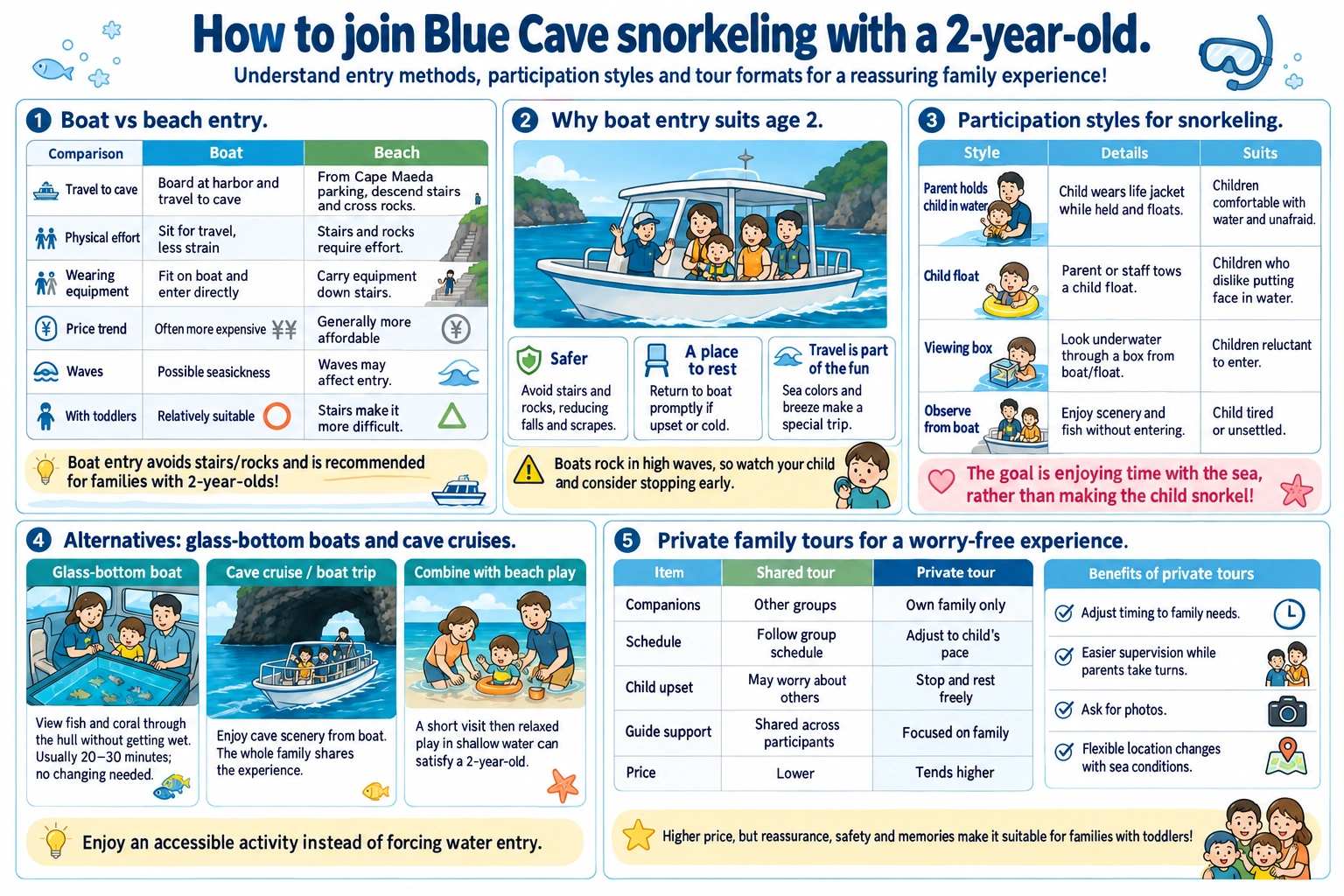
When you think, "I want to enjoy the Blue Cave with my 2-year-old," the first thing to know is your options for how to take part. How you get to the Blue Cave, whether you go into the water and which shop's plan you choose make a big difference in whether you can enjoy it comfortably with a toddler. Here we explain concrete ways to experience the Blue Cave area with a 2-year-old from three angles: entry method, participation style and tour format.
The difference between boat entry and beach entry
Blue Cave snorkeling comes in two main types: "boat entry" and "beach entry." Both end up at the same Blue Cave, but the way to get there is very different. With small children, understanding this difference affects how satisfying the experience will be.
| Comparison | Boat entry | Beach entry |
|---|---|---|
| Getting to the cave | Board a boat at the harbor and travel across the sea to the front of the cave | Go down the stairs from the Cape Maeda parking lot and walk over the rocks |
| Physical burden | Light, because you travel sitting down | Heavy, with stairs to climb up and down and rocks to walk over |
| Moving while wearing gear | Put on your gear on the boat and go straight into the sea | You have to carry your gear down the stairs |
| Price tendency | Often higher than beach entry | Relatively reasonable |
| Effect of waves | Seasickness is possible | You are easily knocked around by waves when entering |
| Suitability for toddlers | Relatively well suited | Difficult because of the stairs |
Cape Maeda, used for beach entry, has a long staircase from the parking lot down to the water. Even for adults, going back and forth with gear is quite a workout, and the reality is that moving while carrying a 2-year-old who needs to be held is hard to call practical. With boat entry, by contrast, you board a boat at the harbor, travel across the sea for a few minutes to a dozen or so minutes, and arrive at a spot in front of the cave. You only have to sit during the trip, and for kids, "riding a boat" is an attraction in itself.
Why boat entry is recommended for 2-year-olds
When heading to the Blue Cave area with a 2-year-old, many shops recommend boat entry. The reason is not simply that it is "easier."
With boat entry, there is no need to have your child walk on stairs or rocks, which greatly reduces the risk of falls and injuries. The stairs at Cape Maeda are slippery when wet, and just carrying gear while holding the handrail is all an adult can manage. Even with a baby carrier, going down stairs with both hands full is dangerous.
Also, with boat entry the boat works as a "safe waiting place." When your child gets fussy, cold or bored, being able to return to the boat right away and rest is a big comfort. With staff always on board, one parent can wait with the child while the other takes a turn in the water.
On top of that, the trip to the cave itself becomes part of the fun. The changing colors of the Okinawan sea as seen from the boat and the feeling of the wind as you cruise make for a memorable experience for a toddler. However, on days with high waves the boat rocks a lot, so you also need to be ready to cut things short early depending on how your child is doing.
Note that even with boat entry, the cave is surrounded by rock, so whether you actually go inside depends on the sea conditions and the shop's judgment that day. Please understand in advance that in some cases you may only approach the cave entrance by boat and look at it from there.
Participation styles: being held or using a float ring
When a 2-year-old takes part in snorkeling, it is nearly impossible for them to hold a mask and snorkel in their mouth and swim like an adult. In practice, the following participation styles are used.
| Participation style | Details | Best for |
|---|---|---|
| Parent holds the child in the water | The child wears a life jacket and the parent holds them while floating on the surface | Children who are used to water and not afraid |
| Riding a float ring or float | The child sits in a children's float ring or float and a staff member or parent tows them | Children who don't like putting their face in the water |
| Looking underwater with a water viewer | Look into the water through a water viewer (a box with a clear bottom) from the boat or from a float ring | Children who are reluctant to go into the water |
| Watching from the boat only | Don't enter the water; look at the scenery and fish from the boat | When the child is unwell or in a bad mood |
The most common style is floating on the surface while a parent holds the child. Always put a toddler life jacket on your child, and with adults also wearing life jackets, look into the water from the surface without forcing your child to dive. If your child dislikes the mask, simply floating without putting their face in the water is still plenty of fun in the clear waters around the Blue Cave.
What matters is not making "snorkeling" the goal, but enjoying the time your child spends interacting with the sea. A 2-year-old's mood swings a lot from day to day, and it is not unusual for a child who was thrilled at the pool the day before to be afraid of the water on the day. Going in with an "it's a bonus if they get in" attitude lets the whole family finish with smiles.
Also, some shops do not allow toddlers into the water at all and only allow them to join as "boat viewing only." When you book, ask specific questions such as "Can my 2-year-old go into the water?" and "Is it possible to enter the water while holding my child?"
Glass-bottom boats and cave cruises as options
If you feel it may be too early for your child to go into the sea, or if you have an even younger child with you, there are plans that let you enjoy the Blue Cave area without getting in the water.
Glass-bottom boats
These are sightseeing boats with part of the hull made of glass, so you can watch coral and tropical fish underwater without getting wet. Because you sit and look through the windows at your feet, even a 2-year-old can take part comfortably on a parent's lap. Many rides last about 20 to 30 minutes, which suits children who can't concentrate for long. You don't need to change clothes, and the risks of sunburn and getting too cold are also small.
Cave cruises and boat cruising
In this plan, a boat takes you from the sea up to the area around the entrance of the Blue Cave, and you enjoy the view from the boat. Because you don't enter the water, there is no need to change or put on gear, and the whole family can share the same time. The gradations of Okinawa's sea seen from the boat are an impressive experience in themselves.
Combining it with water play at the beach
Another realistic option is to keep the Blue Cave experience short and then play freely in the shallows of a calm beach afterward. For a 2-year-old, time spent moving around freely in shallow water where they can touch the bottom can sometimes be far more satisfying than the deep sea.
Private tours let you relax and enjoy
When experiencing the Blue Cave with a 2-year-old, the format that gives the most peace of mind is a "private family tour" or "private tour." This refers to a style in which you are not grouped with other guests and a guide is dedicated to a single family.
| Item | Regular shared tour | Private tour |
|---|---|---|
| Companions | Together with other groups | Only your own family |
| Schedule | You have to follow the overall pace | Easy to adjust to your child's pace |
| When your child gets fussy | You may need to be considerate of those around you | You can pause and rest without worrying |
| Guide support | Divided among all participants | Focused on your family |
| Price | Relatively low | Tends to be higher |
The biggest advantage of a private tour is that you can flexibly change how you use your time to match your family's situation. If your child doesn't want to go into the water, you can return to the boat early; if they are having fun, you can play a bit longer. With shared tours, doing so would make other participants wait, so that kind of flexibility is hard to come by.
Also, having a guide dedicated to your family makes it easier to have your child looked after while the adults take turns in the water. Being able to easily take turns, with "Dad goes first, then Mom," is of great value when you have a toddler.
Even if a tour is not private, shops that set limits such as "small groups" or "up to X people per guide" can offer a fairly similar environment. When booking, check how many people one guide is responsible for and use that to judge whether your child will be properly watched.
Prices are higher than for regular tours, but given that the whole family can relax, the guide can focus on taking photos, and you can expect flexible changes of spot depending on that day's sea conditions, it is an option worth considering for a trip with a 2-year-old.
The flow of a snorkeling tour with a 2-year-old
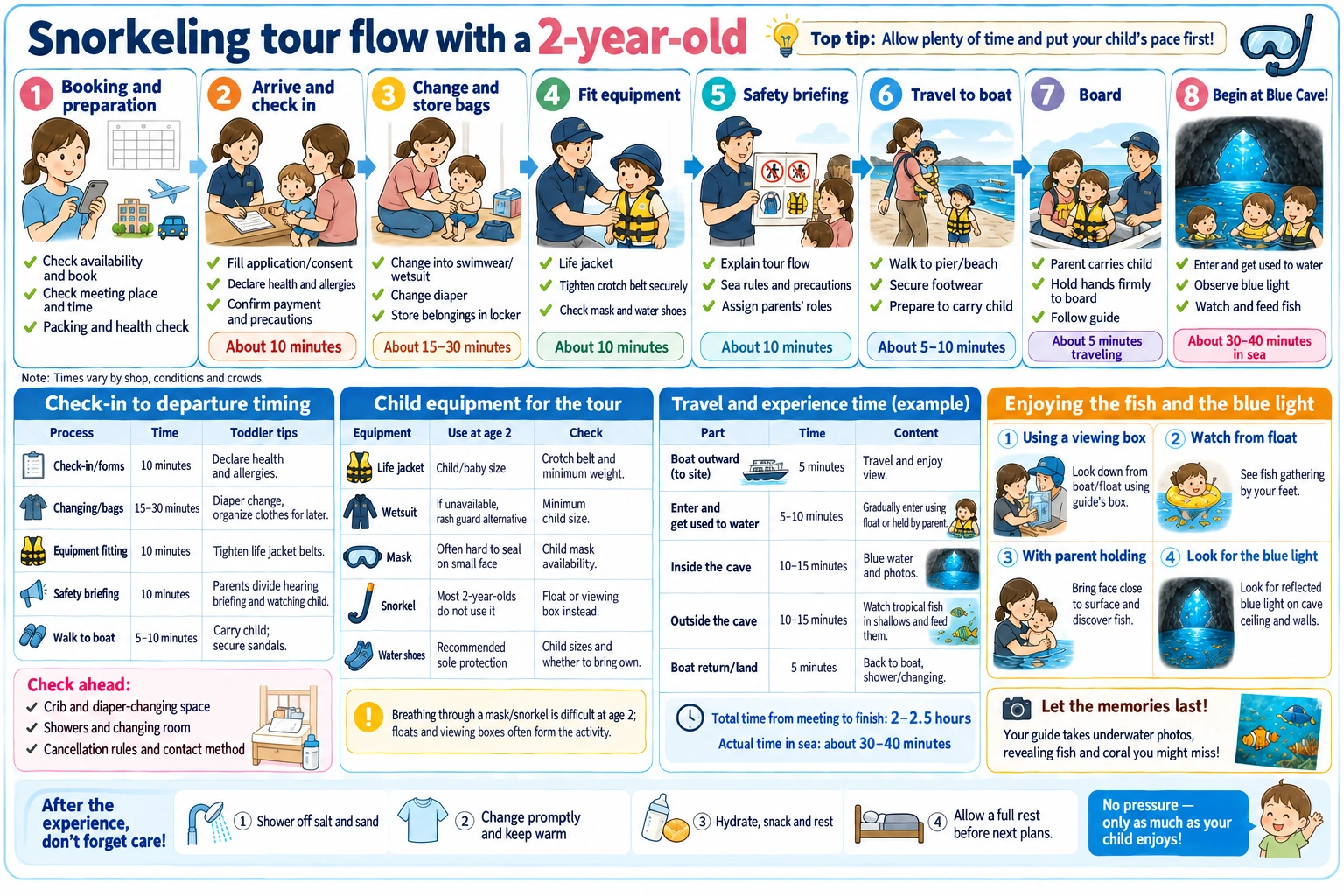
Blue Cave snorkeling follows a single flow: booking, check-in on site, putting on gear, traveling to the cave, and then observing underwater. When you join with a 2-year-old, changing and resting take longer than with adults only, so it is important to get a sense of the whole schedule beforehand. Here we walk through the day step by step, assuming a typical family tour around Cape Maeda in Onna Village.
Preparing from booking to the day
Plans that accept 2-year-olds have limited spots at many shops. Especially in the high season from July to September and during long holiday weekends, they fill up early, so it is reassuring to check tour availability first, as soon as your flights and accommodations are decided. Booking forms often ask for the name, age, height, weight and shoe size of every participant, which is information needed so that the shop can prepare children's wetsuits and life jackets. For a 2-year-old, also be honest about things like "can't swim" or "can't put their face in the water."
After booking, confirm the meeting place, meeting time and the location of the parking lot. The roads around Cape Maeda are narrow and the parking lots fill up easily, so if you are driving a rental car, allow time to arrive 20 to 30 minutes before the meeting time so you can get ready calmly. Also, you may receive a message about whether the tour will run, based on sea conditions, the night before or the morning of, so make sure your mobile phone is reachable. It also goes more smoothly if you work backward from the schedule and take care of diaper changes and nursing once before leaving.
Time needed for check-in and changing
When you arrive at the shop, first fill out the application form (waiver) at the reception. A parent fills it out on behalf of the child, noting any past medical conditions, allergies and the child's health that day. Then you change into swimwear in the changing room and put on a rash guard or wetsuit. Changing may take only about 10 minutes for adults alone, but with a 2-year-old, it is stress-free to assume it will take 20 to 30 minutes.
Standard times from check-in to departure are as follows.
| Step | Approximate time | Points for a 2-year-old |
|---|---|---|
| Check-in and filling out the application form | About 10 minutes | Be sure to report your child's health and any allergies |
| Changing and leaving belongings | About 15 to 30 minutes | Change the diaper beforehand and keep spare clothes in separate bags |
| Fitting the gear | About 10 minutes | Make sure to fasten the life jacket all the way down to the crotch strap |
| Safety briefing and precautions | About 10 minutes | Split the roles: one parent listens while the other watches the child |
| Walking to the boat | About 5 to 10 minutes | You will be carrying your child, so wear sandals that won't slip off |
Some shops have baby beds or diaper-changing spaces. Checking whether such facilities are available when you book makes it easier to plan the day.
Children's life jacket and wetsuit sizes
When a 2-year-old goes into the sea, the gear is the most important factor for safety. Many shops keep kids' life jackets in stock, but there are minimum height and weight requirements, so checking in advance is essential. Choose a life jacket that fits your child's body size and has a crotch strap, which prevents the jacket from riding up in the water.
Here is a summary of the general approach to children's gear.
| Gear | How it is handled for a 2-year-old | What to check |
|---|---|---|
| Life jacket | Use a kids or baby size | Whether it has a crotch strap, and the minimum weight it supports |
| Wetsuit | A rash guard is used instead if there is no stock | Which kids' sizes the shop carries |
| Mask (goggles) | The face is small, so it often doesn't seal well | Whether kids' masks are available to rent |
| Snorkel | Most 2-year-olds can't use one | Whether you can switch to watching from a float ring or with a water viewer |
| Marine shoes | Recommended to protect the soles of the feet | Whether kids' sizes can be rented, and whether you need to bring your own |
Breathing with a mask and snorkel in the mouth is difficult at age 2, so in practice it is common to "get in a float ring and look in from the surface" or "look at fish through a water viewer held by the guide." The key is not to force your child to use the gear, but to let them enjoy the sea within what they can do.
Getting to the cave and how long the experience lasts
With boat entry, you board a small boat from a pier or a sandy beach and reach the Blue Cave in a few minutes to about 10 minutes. The boat ride is only a few minutes each way, so the burden is small even for young children who tend to get seasick, which is a big advantage. During the ride, a parent should always hold the child or sit them down holding their hand firmly, and follow the guide's instructions.
Once you arrive at the cave, you enter the water from the boat or near the cave entrance and move through while looking inside, led by the guide. With a 2-year-old, flexible approaches are used depending on the situation, such as not going deep into the cave and just looking at the blue water near the entrance. The overall flow and approximate times are as follows.
| Part | Approximate time | Details |
|---|---|---|
| Boat ride (outbound) | About 5 minutes | Travel across the sea to the front of the cave and enjoy the view |
| Entering the water and getting used to it | About 5 to 10 minutes | Gradually get used to the water with a float ring or being held |
| Observing inside the cave | About 10 to 15 minutes | Look up at the glowing blue water and take photos |
| Watching fish outside the cave | About 10 to 15 minutes | Watch tropical fish in the shallows, including a fish-feeding experience |
| Boat ride (return) and landing | About 5 minutes | Return by boat, then head to the shower and changing area |
From meeting up to dispersal, the total is about 2 hours to 2 hours 30 minutes for many plans. Of that, the time you are actually in the water is around 30 to 40 minutes, which is designed to stay within a 2-year-old's attention span. If your child doesn't like it partway through, you can cut it short and spend the time playing on the boat or in the shallows.
What kids love about fish feeding and fish watching
For a 2-year-old, the experience of "lots of fish gathering around" tends to leave a stronger impression than the blue of the cave. Many tours provide feeding food, and when the guide scatters it, tropical fish such as the blue devil damselfish and the sixbar damselfish swarm in all at once. The moment fish come right up next to their hands is a classic highlight that even a 2-year-old who can't swim loves.
Here are some ways to make it fun even for children who can't put their face in the water.
- Look into the water from the boat using a water viewer (viewing box) prepared by the guide
- Keep your child seated in a float ring and watch the fish gathering at their feet from above
- While holding your child, bring your faces close to the surface together
- Look up at the ceiling and walls inside the cave and watch the blue reflected light
Also, the underwater photos the guide takes often capture fish and coral you didn't notice at the time, and they make great keepsakes of the trip. After the experience, rinse off the seawater and sand thoroughly in the shower and change your child right away so they don't get cold. If you plan a schedule that includes time for nursing, a snack and a rest, you will have more breathing room for the sightseeing that follows.
Packing list for going with a 2-year-old
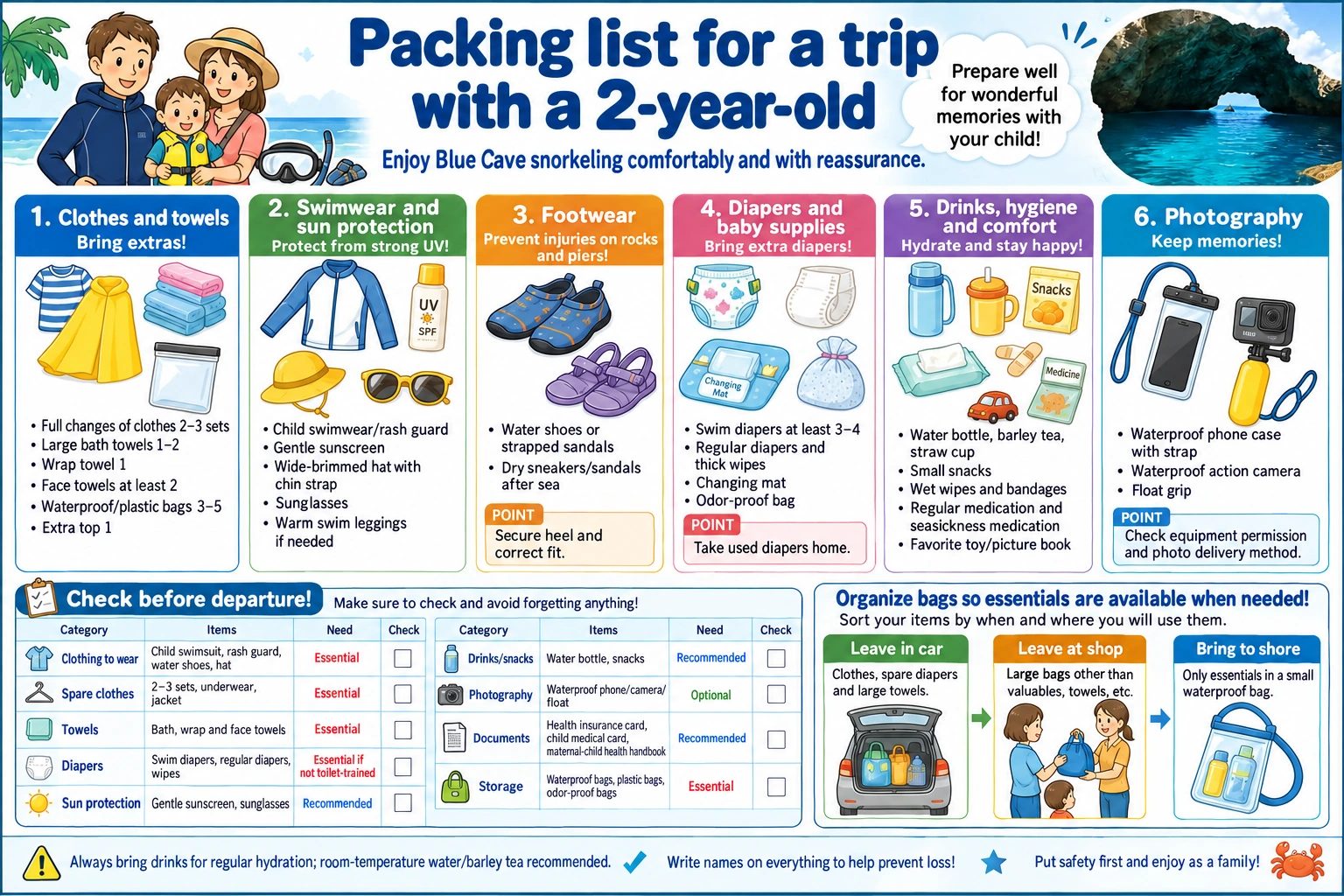
On Blue Cave snorkeling tours, gear such as wetsuits, life jackets, masks, snorkels and fins is almost always provided with the rental fee included. However, when you bring a 2-year-old, you need things specific to babies and toddlers that adults alone would not need. Having spare clothes before and after getting in the water, ways to keep your child warm, sun protection and diaper-changing supplies ready in advance makes a big difference to how hectic the day feels. Here we organize by category the items worth bringing for playing in the sea with a 2-year-old around Cape Maeda in Onna Village.
Bring plenty of spare clothes and towels
The most important items for playing in the sea with a 2-year-old are spare clothes and towels. An adult can change once after getting out of the sea and be done, but small children sweat on the way, spill juice or get wet playing in puddles, and their clothes become unusable at unexpected moments. When joining with a 2-year-old, it is reassuring to bring at least 2 to 3 sets of spare clothes and 3 or more towels, including large ones.
We especially recommend a wrap towel (a wraparound towel) of the type you pull over your head. When changing at the beach or in the parking lot, it lets you take off your child's swimsuit while keeping them covered, and you can also use it to dry off. Many shops around the Blue Cave have warm-water showers and changing rooms, but in the crowded summer months you may have to wait your turn, so an item that lets you handle things quickly outdoors comes in handy.
Also, don't forget waterproof bags or plastic bags for taking wet swimsuits and towels home. If you bring several zip-top bags, you can keep wet and dry clothes separate and there is no worry about soaking the seats of your rental car.
| Item | Recommended quantity | Points |
|---|---|---|
| Full set of spare clothes for your child | 2 to 3 sets | They may need changing right away because of sweat or dirt |
| Large bath towels | 1 to 2 | Wrap your child in them for warmth too |
| Wrap towel | 1 | Handy for changing outdoors |
| Face towels | 2 or more | Keep separate ones for wiping faces, hands and feet |
| Waterproof bags and plastic bags | 3 to 5 | For taking wet clothes home |
| A jacket they can throw on | 1 | For the boat and against air conditioning |
Sun protection with swimwear and rash guards
The ultraviolet rays in Okinawa are very strong compared with mainland Japan, and on the sea around Cape Maeda there is also reflected glare. A 2-year-old's skin is thin and delicate, so please consider sun protection a must. Putting a long-sleeved rash guard over a swimsuit is the surest and gentlest sun protection for a 2-year-old. It also reduces how often you need to reapply sunscreen and protects the skin from things like jellyfish in the water.
Some shops rent children's wetsuits, but stock in 2-year-old sizes is often limited, so be sure to check availability when you book. In case there is none, bringing a warm long-sleeved rash guard or a legging-type swimsuit can prevent your child from getting chilled even when the water is cool.
For sunscreen, choose a gentle formula that is safe for babies and toddlers. In recent years, from the standpoint of protecting Okinawa's marine environment, products without ingredients that affect coral are recommended, and some shops specify which sunscreens may be used. Checking when you book or in the briefing on the day helps you avoid trouble.
In addition, a wide-brimmed hat, a cap with a chin strap and children's sunglasses can soften the sun on the boat and while waiting. With boat entry, there is little shade on the way to the cave, so a hat is especially useful.
Choosing marine shoes and sandals
The coast around the Blue Cave and the rocky area at Cape Maeda have many rugged rocks and pieces of coral, so walking barefoot is dangerous. Not only for beach entry tours but also for boat entry, you walk around the pier and harbor, so footwear should not be taken lightly.
For a 2-year-old, choosing marine shoes that hold the heel firmly in place, or sandals with straps, helps prevent falls and injuries. Flip-flop style sandals with only a thong strap are slippery on wet rocks and can come off in the water, so it is safer to avoid them.
Marine shoes with a hook-and-loop strap over the instep are easy to put on and take off and also fit a growing child's feet well. For size, choose a snug fit assuming your child won't wear thick socks, and the shoes will be less likely to come off in the water. Some shops rent children's marine shoes, so if you want to pack lighter, check in advance.
Also, having dry sneakers or sandals to change into after getting out of the sea makes it smoother to get in the car or head to your next sightseeing spot.
Diapers, wipes and other baby supplies
At age 2, many children are not yet out of diapers, and it is not uncommon for them to be in the middle of potty training. Most Blue Cave tour shops accept children who are not out of diapers, but when going into the sea the basic rule is to put on swim diapers (swim pants) meant for water play. Regular disposable diapers absorb water and swell up, so be sure to prepare ones made specifically for water play.
It is reassuring to bring 3 to 4 swim diapers with some to spare, including the ones for changing before and after the experience. There are drugstores and convenience stores around Onna Village on Okinawa's main island, but going back to buy more after arriving at Cape Maeda wastes time, so be sure to check the count before leaving your accommodation.
Wipes are useful not only for diaper changes but also for wiping sandy hands and feet and cleaning up spills. Bringing one pack of the thick type comes in handy. If you have a diaper-changing mat or a picnic blanket, changing clothes and diapers in the car or at a rest area also goes smoothly.
Here is a summary of other items that are easy to forget when going out with a 2-year-old.
| Category | Items | Use and notes |
|---|---|---|
| Diaper-related | Swim diapers, disposable diapers, wipes, diaper-changing mat, odor-proof bags | Used diapers are generally taken home |
| Food and drink | Water bottle with barley tea, straw cup, snacks in small portions | For rehydrating after playing in the sea and keeping moods up |
| Hygiene and first aid | Wet wipes, adhesive bandages, regular medicines, motion sickness medicine | If you will be on the boat, ask about motion sickness medicine |
| Keeping them happy | A favorite small toy, picture books | Can be used while waiting at check-in or for your turn |
| Other | Maternal and child health handbook, health insurance card, infant medical benefit card | In case you need to see a doctor |
As for drinks, you lose fluids without noticing while playing in the sea, and a 2-year-old may not tell you they're thirsty. Be sure to bring a water bottle with familiar barley tea or water so you can rehydrate often. Drinks that are too cold can upset the stomach, so near room temperature is ideal.
Waterproof phone cases and underwater cameras
On Blue Cave tours, many shops have the guide take underwater photos and provide the data free of charge. That means you don't necessarily need your own camera, but if you want to capture your family's natural expressions or the moments before and after the tour, waterproof equipment widens your options for taking pictures.
If you take photos with a smartphone, using a waterproof case with a neck strap greatly reduces the risk of it falling in the water or being dropped. On the boat and on the rocks your hands are often full, and you may be taking photos while holding your child, so a hands-free design is practical.
If you want to take more serious underwater footage, a waterproof action camera is a good fit. If you attach a buoyant float grip, it won't sink even if you let go and can be retrieved floating on the surface. However, getting distracted by the camera on the boat or in the water can mean taking your eyes off your child. It is reassuring to split roles, with one parent in charge of taking photos while the other focuses on the child's safety.
Note that some shops restrict bringing personal belongings into the water to prevent gear from being dropped or lost. If you plan to bring a camera, check whether it is allowed when you book or at check-in on the day. Asking how you will receive the photo data (an SD card handed over on the spot, online sharing afterward and so on) also makes it smoother to organize your memories after the trip.
Packing checklist
So that you can check before departure, here is a list of what to bring when joining Blue Cave snorkeling with a 2-year-old. Items you can rent at the shop are left out, and the list focuses on what your family should bring.
| Category | Items | Necessity |
|---|---|---|
| What to wear | Child's swimsuit, rash guard, marine shoes, hat | Required |
| Spare clothes | 2 to 3 sets of spare clothes, underwear, a jacket | Required |
| Towels | Bath towel, wrap towel, face towel | Required |
| Diaper-related | Swim diapers, disposable diapers, wipes | Required if not out of diapers yet |
| Sun protection | Gentle sunscreen, sunglasses | Recommended |
| Food and drink | Water bottle, snacks | Recommended |
| Photography | Waterproof phone case, waterproof camera, float grip | Optional |
| Documents | Health insurance card, infant medical benefit card, maternal and child health handbook | Recommended |
| Storage | Waterproof bags, plastic bags, odor-proof bags | Required |
On family trips, where luggage tends to pile up, it helps to sort in advance what stays in the rental car, what you leave at the shop's reception and what you take to the water. If you pack only what you need right before getting in the water into a small waterproof bag, you won't have to search through your luggage every time you change or move, and you can keep your eyes on your child. Being well prepared is the first step to enjoying the sea at the Blue Cave safely with your 2-year-old.
Safety tips for Blue Cave snorkeling with a 2-year-old
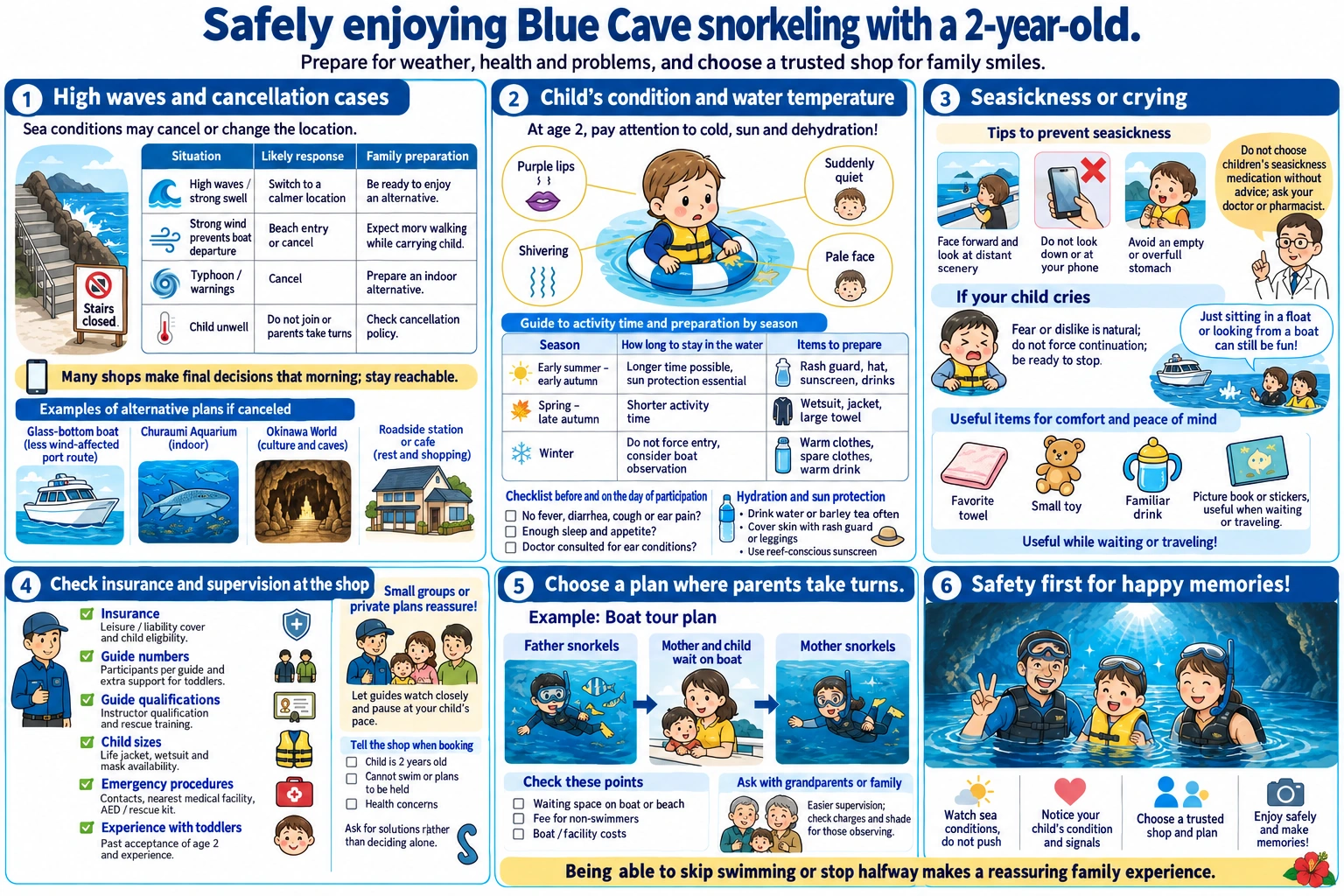
The Blue Cave is one of the most popular spots on Okinawa's main island, but you are dealing with the natural sea. When you bring a 2-year-old, you need to think about safety from a different perspective than when adults enjoy it alone. Here we go over what to keep in mind so the whole family goes home smiling: judging the weather and sea conditions, managing your child's health, preparing for problems that may come up on the day, and even the safety points to check when choosing a shop.
Days with high waves and when tours are canceled
Cape Maeda in Onna Village, where the Blue Cave is, faces the open ocean and is easily affected by wind direction and swells. Especially in winter when strong north winds blow, when a typhoon approaches or when a low-pressure system passes, waves become high, and tours may be canceled or moved to a calmer spot other than the Blue Cave. Keep in mind that whether a 2-year-old can join is judged more strictly than for adults, depending on that day's sea conditions.
Also, Cape Maeda has stairs for beach entry, and on days with high waves, using the stairs may itself be prohibited. In that case, a boat entry tour may still run while a beach entry tour is canceled. Conversely, on days when strong winds keep the boat from going out, only the boat tour may be canceled.
When is the decision to cancel or change made?
At many shops, the final decision on whether to run is made after checking sea conditions on the morning of the tour. Even if a tour is planned to go ahead until the night before, it is not unusual to receive a cancellation notice on the morning of. Make sure to give your mobile phone number accurately so that you can be reached, and be ready to notice incoming calls on the day.
| Situation | Likely response | What families with kids should prepare |
|---|---|---|
| High waves or strong swells | Changed from the Blue Cave to a calmer spot | Be mentally prepared to enjoy it even if the destination changes |
| Strong winds keep the boat from going out | Changed to beach entry, or canceled | Expect a longer distance carrying your child |
| Typhoon approaching or warning issued | Tour canceled | Have an alternative plan ready that you can enjoy indoors |
| Child is unwell | Skip participation, or only the parents take turns | Check the cancellation policy in advance |
Have an alternative plan ready in case of cancellation
When a tour is canceled during a long-awaited Okinawa trip, kids are disappointed too. There are indoor facilities near the Blue Cave, so thinking ahead about alternative plans for rain or poor sea conditions saves you from scrambling on the day. Glass-bottom boats can sometimes run when the wind is light, so it is good to keep them in mind as an option for days when snorkeling is difficult.
Your child's health and sea water temperature
A 2-year-old's body temperature regulation is immature compared with an adult's, and because their bodies are small, they lose body heat quickly in the water. Okinawa's sea is relatively warm all year round, but even in midsummer, after a long time in the water a child's lips may turn purple or they may start to shiver. Even if your child can't say "I'm cold," the most important thing is that parents don't miss signs such as lip color, shivering or suddenly going quiet.
Sea water temperature and clothing by season
Okinawa's sea temperature is generally high in summer and drops in winter. Whether wetsuits are worn or needed differs from shop to shop, but check in advance whether toddler sizes are available. There are times of year when a rash guard alone feels chilly, so bringing a hoodie or a towel-fabric poncho to throw on over it comes in handy.
| Time of year | Guide to time in the water | What to prepare |
|---|---|---|
| Early summer to early autumn | You can stay in the water relatively long, but sun protection is a must | Rash guard, hat, sunscreen, fluids |
| Spring and late autumn | Plan to cut it short | Wetsuit, jacket, large towel |
| Winter | Don't push getting in the water; consider watching from the boat too | Warm clothing, a full set of spare clothes, warm drinks |
Checking your child's health the day before and the morning of
If your child has symptoms such as fever, diarrhea, cough or a middle ear infection, you will need to decide to skip participating. Ear conditions in particular are easily affected by water pressure and seawater, so if your child is under treatment, it is reassuring to consult your regular doctor. Lack of sleep can also trigger poor health, so have your child go to bed early the night before and give them a small portion of easily digestible food for breakfast that morning.
Watch out for dehydration and sunburn too
Out on the sea, you sweat without noticing and dehydrate easily. Bring barley tea or water and give your child fluids often. As for sunburn, Okinawa's ultraviolet rays are stronger than on the mainland, so the basic approach is to reduce exposed skin with a rash guard and leggings. If you use sunscreen, some shops advise choosing products that take their effect on coral into account.
How to handle seasickness or a crying child
With boat entry, the ride from the harbor to the Blue Cave is short, but depending on sea conditions the boat can rock a lot. A 2-year-old has trouble telling you they feel sick, so watch for changes such as a pale face, more yawning or sudden fussiness.
Ways to prevent seasickness
Basic measures are effective: have your child face the direction of travel and look at the distant scenery while on board, don't let them look down at a smartphone on the boat, and board when they are neither hungry nor full. Don't decide on your own about giving motion sickness medicine to a 2-year-old; consult a pediatrician or pharmacist.
Don't push if your child cries
A sea they've never seen, a life jacket they've never worn and a rocking boat make for an experience with a lot of stimulation for a 2-year-old. It is quite possible for a child to be afraid of putting their face in the sea, or to be startled by the darkness of the cave and burst into tears. If you make your child keep going when they don't want to, they may come to dislike the sea itself, so it is important to have the courage to stop right there.
Just floating on a float ring and looking from the surface, or simply watching the colors of the sea from the boat, can still be a very happy memory for a 2-year-old. If you take part with the understanding that "it's fine not to swim" and "it's fine to stop partway," parents feel more relaxed too.
Things that are reassuring to have on hand for fussiness
Keeping items that help your child calm down in the car or in your bag, such as a favorite towel, a small toy or the drink they usually have, can ease fussiness while waiting or traveling. Waiting at check-in or while changing can turn out to be longer than expected, so think about how to pass that time too.
Checking insurance and supervision when choosing a shop
Safety is an area where shops tend to differ. Here is a summary of items worth checking when you ask questions at booking.
| Item to check | What to confirm |
|---|---|
| Insurance coverage | Whether the shop has leisure insurance or liability insurance, and whether toddlers are covered |
| Number of guides | How many participants there are per guide, and whether extra guides are added when toddlers are present |
| Guide qualifications | Instructor certification from a training agency and any first aid and CPR training |
| Children's gear sizes | Whether toddler life jackets, wetsuits and masks are available |
| Emergency setup | Means of contact, the nearest medical facility, and whether there is an AED and first aid kit |
| Experience with toddlers | Whether they have had 2-year-old participants, and examples of how they handled them |
Small groups affect safety
In large group tours, the number of participants one guide watches grows, and it inevitably becomes harder to keep an eye on everyone. If you are joining with a 2-year-old, choosing a tour with few participants per guide, or a private family plan, is the surest safety measure. The price goes up, but it also suits families with kids because you can pause and resume at your child's pace.
Always tell them your child's age when booking
Even a tour with no stated age limit may in practice have no experience with toddlers. If you tell them specifically in the notes field of the booking form or by phone things like "a 2-year-old will be with us," "they can't swim" and "we'd like to take part while holding them," the shop can prepare appropriately. To avoid the trouble of being turned away on the day, agreeing on details in advance is essential.
Choose a plan where parents can take turns
Considering the chance that a 2-year-old may not want to go into the water or may feel unwell on the day, whether there is a setup that lets parents take turns experiencing it is an important thing to check.
Specific ways to enjoy it by taking turns
If the father and mother take turns snorkeling while the other waits with the child on the boat or on land, the adults can fully experience the Blue Cave even if the child doesn't go into the water. Check whether you can wait on the boat for a boat tour, and whether there is a place to wait on the beach for beach entry.
Check the fee for accompanying only
At some shops, adults and toddlers who accompany but don't go into the water are free or get a discount. On the other hand, in some cases a boarding fee is required for everyone riding the boat. If you don't check in advance how the fee for people who don't swim is handled, you could face an unexpected expense at checkout on the day.
Dividing roles is easier with grandparents or relatives
On a three-generation trip, setting aside time for the grandparents to look after the child lets you plan more flexibly. However, the people waiting also need shade and a place to rest, so checking the facilities as well helps everyone stay comfortable.
How to choose a Blue Cave tour that accepts 2-year-olds
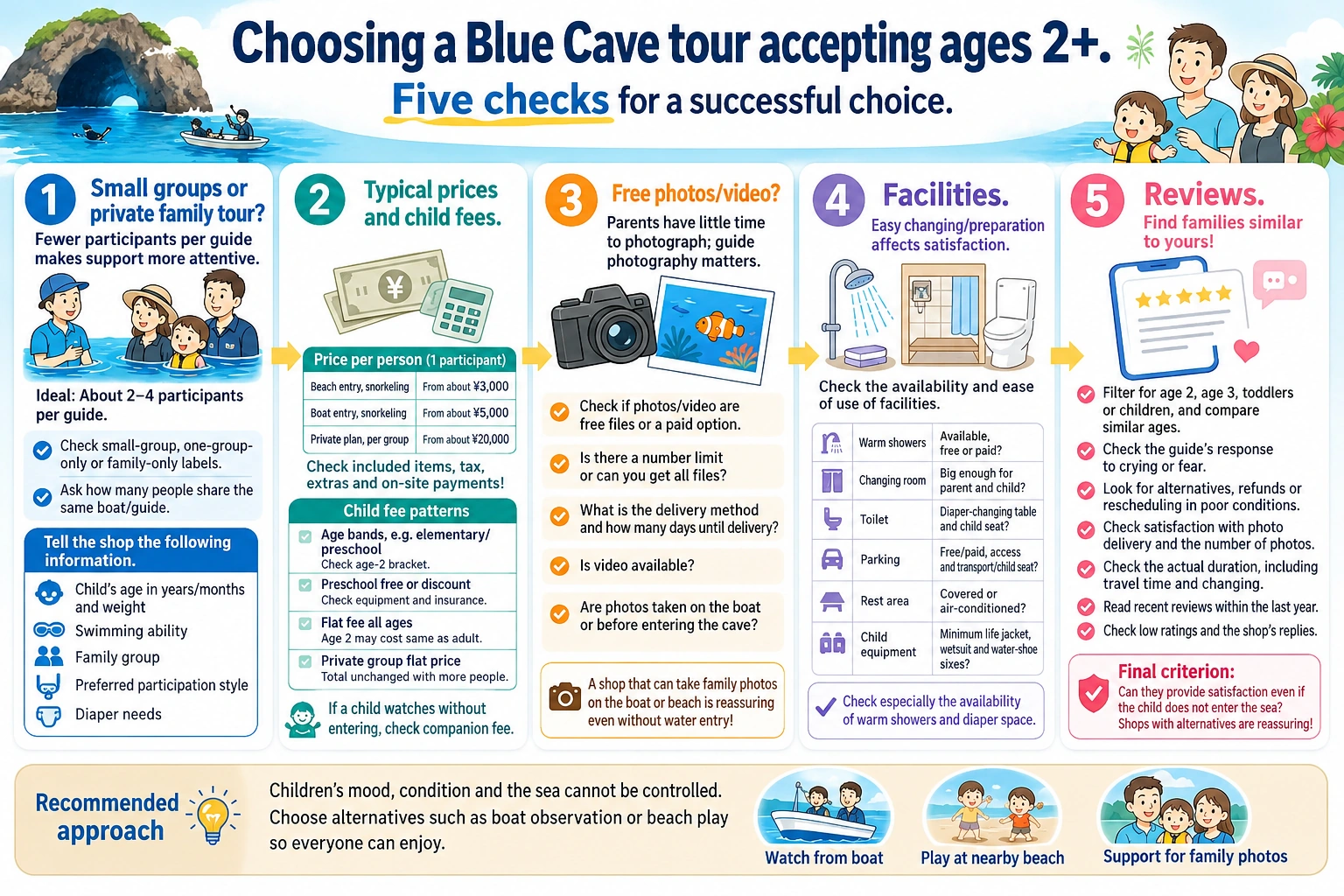
Around Cape Maeda in Onna Village, Okinawa, there are many shops that run Blue Cave snorkeling tours, numbering in the dozens. Even among tours heading for the same "Blue Cave," conditions such as the minimum age, whether a boat is used and how many guides are assigned differ greatly from shop to shop. Especially when bringing a 2-year-old, choosing on low price alone can lead to unexpected limits on the day, such as "your child is too young, so viewing only" or "we can only handle one child per parent." Here we go through, in the order you should check them, the points that families with a 2-year-old should look at to avoid mistakes.
Does the shop offer small groups or private family tours?
The first thing to check is group size: how many parties and people the shop takes on one tour. The Blue Cave is a popular spot, so tours that put large groups in the water are not unusual, but when you bring a 2-year-old, the fewer participants one guide watches, the safer and more comfortable it is. With a 2-year-old, the basic choice is a small-group tour of around "2 to 4 participants per guide," or a private plan for your family alone. Because you don't have to worry about other participants, you can get flexible help when your child cries or when you want to cut things short partway.
The shop's booking page will have wording such as "small group," "private for one party" or "families only," so check whether it is there. If it isn't stated, it is safest to ask specifically when you inquire: "We have a 2-year-old, so how many people will be with the same boat and the same guide?" Also, even for joint tours rather than private ones, some shops have time slots limited to families with children.
Information to tell them when you inquire
When you book or inquire in advance, telling them the following information beforehand makes it easier for the shop to suggest an appropriate plan.
| What to tell them | Examples of specific details |
|---|---|
| Child's age and age in months | Specific numbers such as 2 years 3 months, 12 kg |
| Swimming ability | Can't put their face in the water, afraid of water, and so on |
| Who is coming | 2 adults + one 2-year-old, grandparents coming along, and so on |
| Preferred participation style | Want to go in the water while holding the child, want to watch from the boat |
| Diaper situation | Plan to use swim diapers, and so on |
At this stage, whether the shop's reply is courteous and whether you get specific answers to your questions are also important factors in how confident you will feel on the day.
Typical prices and how children's fees are set
Prices for Blue Cave snorkeling vary with the entry method and plan content. As a rough guide, beach entry snorkeling is often priced from around 3,000 yen per person, boat entry from around 5,000 yen, and a private family plan from the 20,000 yen range per party. Facility fees, parking fees and gear rental may be added separately, so be sure to check whether the listed price is "tax included, no extra charges" or whether you need to pay extra on site.
With a 2-year-old, what to watch is how children's fees are tiered. Settings differ from shop to shop, and there are patterns like the following.
| Child fee pattern | Features and cautions |
|---|---|
| By age category (elementary school fee, toddler fee) | Check whether a 2-year-old falls under the "toddler fee" or outside the categories altogether |
| Free or discounted for preschoolers | If free, check whether gear rental and insurance are included |
| Flat fee regardless of age | A 2-year-old pays the same as an adult. Private plans often show a total price |
| Flat fee per private party | The total doesn't change as the number of people grows, so it tends to be a better deal for a family of 3 to 4 |
Also, when a 2-year-old doesn't go into the water and only watches from the boat, some shops set a small "boarding fee" and others make it free. Checking in advance which applies means no surprises at checkout on the day. Prices tend to rise in the high season (July to August and long holiday weekends), so if you want to keep costs down, going on a weekday in May to June or in October is one approach.
Are photo data and videos included for free?
When you go into the sea with a 2-year-old, your hands are full supporting your child and you have almost no room to take photos yourself. That is why whether a plan includes free photo data taken by the guide with an underwater camera is an especially important selection criterion for tours with kids. The light conditions inside the Blue Cave are difficult, and phone waterproof cases often don't capture it as well as you'd hope, so being able to leave it to a guide used to photography is a big advantage.
Here are the points to check.
- Whether the photo data is free or a paid option (around 1,000 to 3,000 yen)
- Whether there is a limit on the number of photos, or you receive all the data they took
- How you receive it (data transfer on the spot on the day, online sharing later and so on) and how many days it takes
- Whether they can shoot video
- Whether they will also take commemorative photos on the boat or in front of the cave
Even if your child gets fussy partway and can't go into the water, a shop that takes family photos on the boat or on the beach still gives you memories. How flexible the photo service is can also be a sign of whether a shop is used to handling families with children.
Facilities such as warm-water showers and changing rooms
With a 2-year-old, changing, preparing and cleaning up take more energy than the time in the sea itself. A shop's facilities directly affect satisfaction, so be sure to check the facilities in advance.
| Facility | What to check from the viewpoint of a family with a 2-year-old |
|---|---|
| Warm-water showers | Kids dislike cold-water-only showers. Check whether warm water is available and whether it is free or paid |
| Changing rooms | Whether they are big enough for parent and child together, or private. Whether there are benches and places for luggage |
| Restrooms | Whether they are Western-style, and whether there are diaper-changing tables or baby chairs |
| Parking | Free or paid, and whether it is close to the shop. Whether there is a shuttle with a child seat |
| Covered rest area | Whether your child can rest out of direct sunlight. Whether there is air conditioning |
| Children's gear | The smallest sizes of life jackets and wetsuits, and marine shoe rentals |
In particular, whether there are warm-water showers and a space for changing diapers greatly affects how comfortable things are with a 2-year-old. Some shops use the showers at the public facilities at Cape Maeda, while others have their own dedicated facilities, and the latter makes it easier to avoid crowds and move at your child's pace. If the facilities aren't described on the booking site, it is reassuring to check them on an introduction page with photos or on the shop's blog.
What to check in reviews and experience reports
When making the final decision on a shop, reviews from people who actually took part are the most helpful. However, don't look only at the number of stars; it is important to look for reviews written under conditions similar to yours.
Specifically, read them with the following points in mind.
- Narrow down by keywords such as "2 years old," "3 years old," "toddler" and "with kids" to find posts from families with children of the same age
- Descriptions of how the guide responded when a child cried or was afraid
- Descriptions of the alternative response when sea conditions were poor and they couldn't enter the cave (switching to another spot, a refund, rescheduling)
- Whether receiving the photo data went smoothly, and whether the number of photos was satisfying
- The actual time it took, including changing and moving around
- Whether the post is recent. Guide and staff setups change, so put weight on reviews from within the past year
Also, a shop's weaknesses show most in low-rated reviews, so be sure to check what the bad reviews say and how the shop responded to them. A shop that honestly explains or shows how it will improve in response to criticism can be expected to respond reliably if trouble occurs on the day. Conversely, if the same complaints about long waits or insufficient explanations appear repeatedly, it is safer to avoid that shop as a structural problem.
With these checks in mind, we recommend making the final decision on the standard of "Would we still be satisfied even if our 2-year-old couldn't go into the water?" Your child's mood, health and that day's sea conditions can't be predicted fully, so choosing a shop that prepares other ways to enjoy the day, such as watching from the boat or playing at a nearby beach, raises the chances that the whole family goes home smiling.
Other sea activities for 2-year-olds in Okinawa besides the Blue Cave
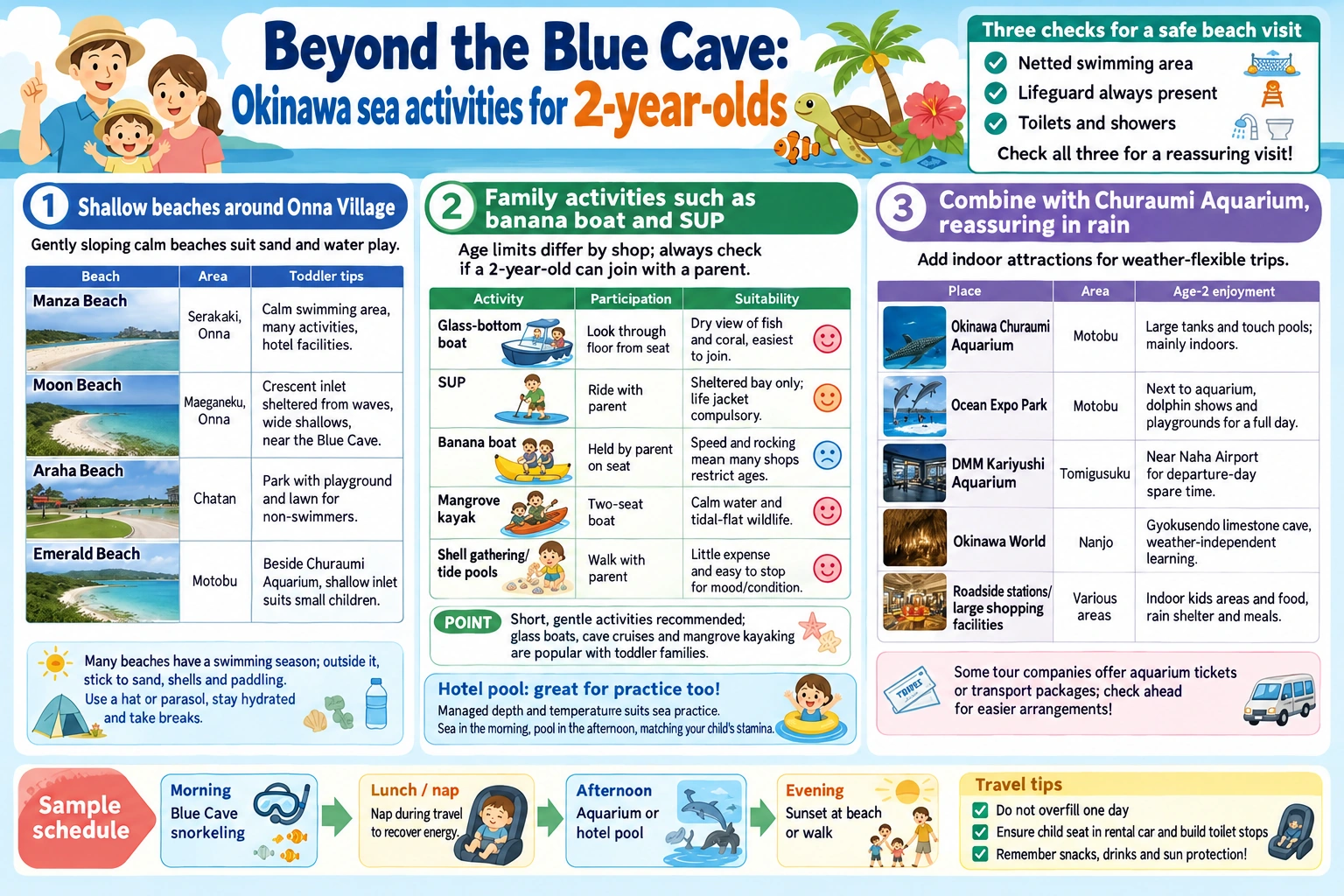
More tours now accept 2-year-olds for Blue Cave snorkeling, but depending on that day's sea conditions and your child's mood, you may decide "today doesn't look possible." Also, if your trip lasts several days, combining other sea activities a 2-year-old can enjoy besides the Blue Cave will make for an Okinawa trip that satisfies the whole family. Here we introduce, mainly around Onna Village, play spots and activities you can enjoy with confidence with a toddler, as well as alternative plans for rainy days.
Beaches around Onna Village with shallow water for playing
The area around Cape Maeda, where the Blue Cave is, has many rocky areas and isn't suited to a 2-year-old walking around and playing freely. On the other hand, Onna Village has beaches with gently sloping shallow water and calm waves, which are well suited to stopping by before or after snorkeling for sand play and water play. When choosing a beach with a toddler, be sure to check three things: that the swimming area is separated by nets, that lifeguards are always present, and that restrooms and showers are available.
Popular beaches around Onna Village for families with kids
| Beach | Area | Points for a 2-year-old |
|---|---|---|
| Manza Beach | Serakaki, Onna Village | The swimming area is calm, with a wide variety of marine activities. Attached to a hotel, with good facilities |
| Moon Beach | Maekane, Onna Village | A crescent-shaped cove where waves rarely build, with a wide shallow area. Close to the Blue Cave |
| Araha Beach | Chatan Town | A park next door has playground equipment and a lawn plaza, so kids can still play when they tire of the sea |
| Emerald Beach | Motobu Town | Next to the Churaumi Aquarium. Gently sloping and cove-like, so it feels safe even for small children |
Note that many beaches in Okinawa have a set swimming season, and outside it there is no lifeguard supervision. If you visit in winter, don't make your child swim; it is safest to limit things to sand play, collecting shells or just getting their feet wet at the water's edge. In the strong-sun seasons, set up a beach tent or umbrella for shade and take breaks with frequent fluids.
Activities parents and kids can enjoy together, such as banana boats and SUP
A 2-year-old can't paddle or swim on their own, but there are marine activities they can join if an adult rides along with them. However, age limits differ greatly from shop to shop, so it is essential to ask each shop individually before booking whether a 2-year-old can join accompanied by a parent.
Comparing activities that are easy for a 2-year-old to join
| Activity | Participation style | How well it suits a 2-year-old |
|---|---|---|
| Glass-bottom boat | Look into the sea from a seat inside the boat | You can see fish and coral without getting wet, so it is the easiest to join |
| SUP (stand-up paddleboarding) | Ride along on a parent's board | Calm inner waters only. Wearing a life jacket is a must |
| Banana boat | Sit while held by a parent | Many shops set age limits because of the speed and shaking |
| Kayak (mangrove) | Ride along in a two-person kayak | No waves, and you can also enjoy watching the creatures on the tidal flats |
| Collecting shells and tide pooling on the beach | Walk along with a parent | No cost, and easy to pause to suit your child's condition or mood |
Banana boats and jet-ski-type personal watercraft have large shaking and impacts, so many shops set minimum ages, and a 2-year-old generally can't join. On the other hand, options with little shaking that are over in a short time, such as glass-bottom boats, cave cruises and mangrove kayaks, are popular choices for families with toddlers. In particular, a glass-bottom boat lets you watch tropical fish such as clownfish and the underwater world around the Blue Cave from inside the boat, making it a realistic alternative for children too young to join snorkeling or who are afraid of water.
Hotel pools and kids' pools are also worth considering. Unlike the sea, the depth is controlled and the water temperature is stable, so even a child who doesn't want to go into the sea can enjoy playing in the water. Doing Blue Cave snorkeling in the morning and relaxing at the hotel pool in the afternoon is a sensible schedule given a 2-year-old's stamina.
A set plan with the Churaumi Aquarium, reassuring even on rainy days
Okinawa is a region easily affected by weather, with summer squalls and typhoons and rough weather caused by north winds in winter. Having an indoor alternative ready in case Blue Cave snorkeling is canceled keeps the overall satisfaction of your trip from dropping. Foremost among these is the Okinawa Churaumi Aquarium.
The Churaumi Aquarium is in Ocean Expo Park in Motobu Town, about an hour by car from Onna Village. In the huge "Kuroshio Sea" tank, you can see whale sharks and giant manta rays swim up close and get close to large sea creatures you can't meet while snorkeling. Stroller rentals, a nursing room and diaper-changing tables are provided inside the facility, so the great advantage is that the burden of getting around and resting is small even with a 2-year-old.
Alternative plans for rainy days or when snorkeling is canceled
| Spot or facility | Area | How to enjoy it with a 2-year-old |
|---|---|---|
| Okinawa Churaumi Aquarium | Motobu Town | Experience sea creatures at the huge tank and touch pool. Mostly indoors, so comfortable even in rain |
| Ocean Expo Park | Motobu Town | Next to the aquarium. There is a dolphin show and a playground area, so you can spend the whole day |
| DMM Kariyushi Aquarium | Tomigusuku City | Close to Naha Airport and easy to stop by in spare time on your departure day |
| Okinawa World | Nanjo City | You can tour the limestone cave Gyokusendo regardless of the weather |
| Roadside stations and large shopping facilities | Various | Indoor kids' areas and restaurants let you shelter from the rain and have a meal |
Some tour companies offer plans that bundle Blue Cave snorkeling with Churaumi Aquarium tickets, or plans with round-trip transportation to the aquarium. Checking at booking whether such set plans exist makes it easier to consider them as a fallback if the tour is canceled on the day.
With a 2-year-old, the biggest tip for an Okinawa trip is not to pack too much into one day. If you alternate sea activities and indoor facilities, such as snorkeling at the Blue Cave in the morning and relaxing at the aquarium or the hotel pool in the afternoon, you can enjoy the whole itinerary without wearing out your child. Plan for things unique to traveling with a toddler as well, such as using nap time for travel and making sure to install the child seat in the back seat of your rental car.
Frequently asked questions about Blue Cave snorkeling
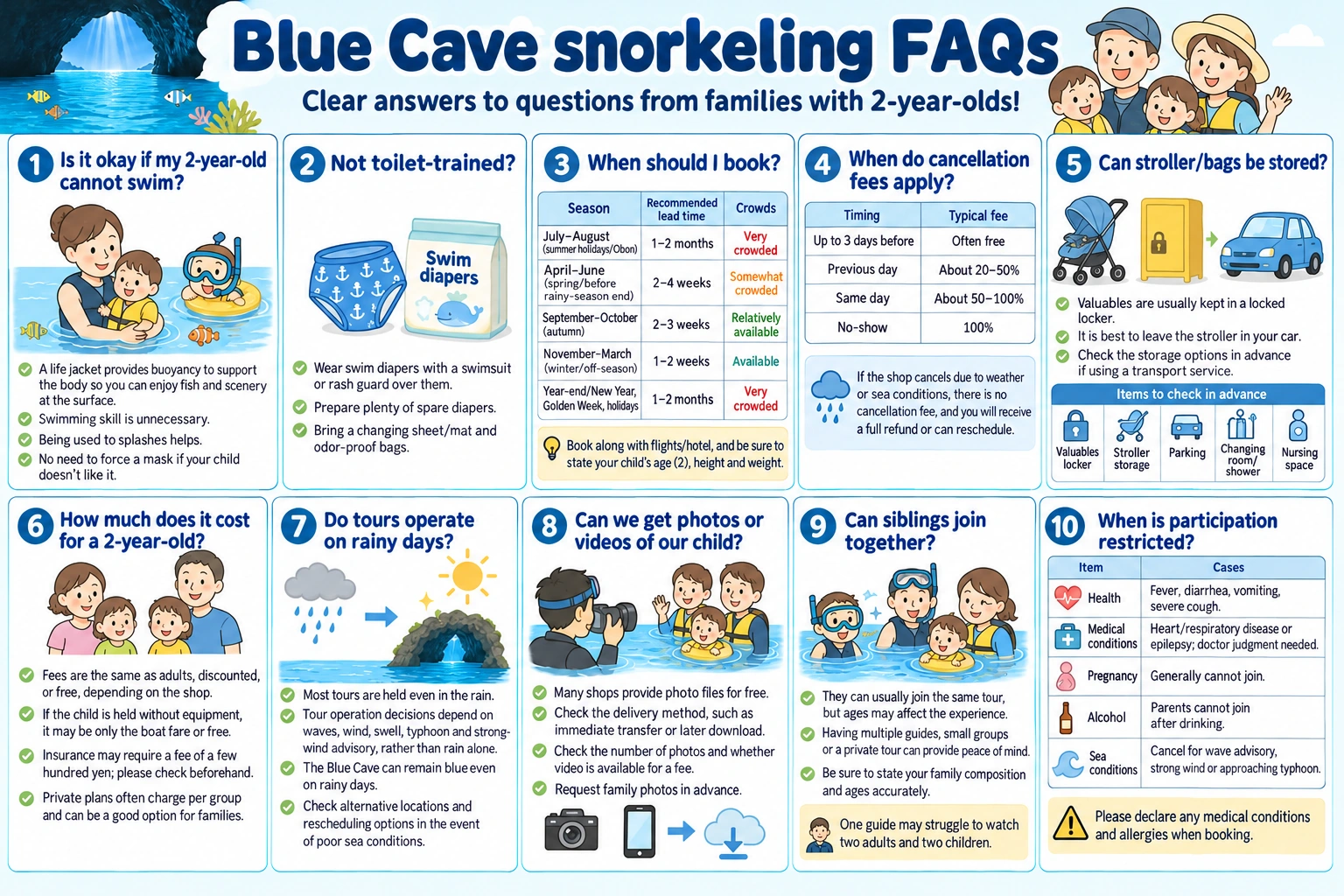
When you consider a Blue Cave snorkeling tour in Okinawa with a 2-year-old, detailed questions like "Is it really safe?" and "Can my child join?" tend to come up one after another. Here we organize and answer, from the viewpoint of families with kids, questions often sent to shops around Cape Maeda in Onna Village. Let's clear up your worries before booking one by one so you can look forward to the day with confidence.
Is it OK if my 2-year-old can't swim?
The short answer is that there are many tours you can join even if you can't swim. Blue Cave snorkeling is not an activity that assumes you swim under your own power; the basic style is to float with the buoyancy of a life jacket and look into the sea from the surface. For a 2-year-old, the main styles are floating on the surface while Mom or Dad holds them, or sitting on a special float ring and putting just their face in the water.
For a 2-year-old, the goal is not "swimming" but "floating in the sea and looking at fish," so swimming ability isn't needed at all. What matters more is whether your child is extremely afraid of water splashing on their face, or resistant to water itself. Getting used to water in the bath or at a pool beforehand makes a big difference in how satisfying the day is.
Also, quite a few children dislike the snorkeling mask. In that case, don't force the mask on; just floating with a life jacket and looking into the sea from the clear surface is plenty of fun. If you are worried, consider shops that have water viewers for looking underwater, or plans with glass-bottom boat viewing.
Can my child join if they're not out of diapers yet?
There are tours that children who are not out of diapers can join, but how it is handled differs from shop to shop. When going into the sea, the usual method is to put on "swim diapers (swim pants)" instead of regular disposable diapers, and then a swimsuit or rash guard over them. Regular disposable diapers absorb water and become heavy and swollen, so they are not suitable for use in the sea or pools.
Swim diapers can also be bought at drugstores and supermarkets in Okinawa, but they may be out of your size, so bringing them from home before you leave is the surest way. Taking a few extra as spares means you won't be flustered when it's time to change.
Also, for diaper changes on the boat or in the changing room, some places don't have a dedicated space. Bringing a picnic blanket or a folding diaper-changing mat lets you manage anywhere. Used diapers are generally taken home, so don't forget odor-proof bags or plastic bags.
How far in advance should I book?
Blue Cave tours are very popular, and small-group and private plans that accept 2-year-olds in particular have limited seats. Here is a rough guide to booking timing by season.
| Season | Recommended booking timing | Crowd level |
|---|---|---|
| July to August (summer vacation, Obon) | 1 to 2 months ahead | Very crowded |
| April to June (spring, before the rainy season ends) | 2 to 4 weeks ahead | Somewhat crowded |
| September to October (autumn) | 2 to 3 weeks ahead | Relatively open |
| November to March (winter, off-season) | 1 to 2 weeks ahead | Open |
| New Year holidays, Golden Week, long weekends | 1 to 2 months ahead | Very crowded |
If you are going with kids during Golden Week or summer vacation, it is reassuring to book the tour at the same time as you secure your flights and hotel. Some shops accept same-day or day-before bookings, but in that case you almost never get to choose a private plan or your preferred time.
Also, when you book, be sure to say that "a 2-year-old will be coming." The life jacket size and wetsuit stock differ by age, so if you don't tell them in advance, the sizes may not fit on the day. Telling them height and weight makes things go smoothly.
When do cancellation fees start?
Cancellation fee policies differ from shop to shop, but in many cases fees start from the day before or the day of. Typical examples are as follows.
| Cancellation timing | Approximate cancellation fee |
|---|---|
| Up to 3 days before | Often free |
| The day before | About 20 to 50% of the fee |
| The day of | About 50 to 100% of the fee |
| No-show without contacting | 100% of the fee |
However, if the shop cancels the tour because of bad weather such as a typhoon or high waves, it is generally not subject to cancellation fees and you get a full refund or a date change. What worries families with kids is "a sudden fever in the child," but this is often treated as a cancellation for personal reasons, so check the policy in advance.
When traveling with small children, choosing a shop that clearly states flexible handling for illness (rescheduling to another day, free cancellation) saves you from worrying until the day. If you book through a booking site, the site's own cancellation policy may apply, so it is important to read the notes on the application screen carefully.
Can I leave a stroller and luggage?
Many shops provide a valuables locker or a place for luggage inside the reception shop or in the car. Valuables such as wallets and smartphones can almost always be left in a locker with a key, but how large items like strollers are handled differs.
With boat entry, you travel to the harbor or beach that serves as the meeting place, so the surest approach is to leave the stroller packed in your own car or rental car. Many people use rental cars at the shops around Cape Maeda and Onna Village, and most of them have dedicated parking, so you can use your car as a place to store luggage.
If you are joining by public transportation or hotel shuttle, check when you book whether they can hold your stroller. If you also use a baby carrier, you can move from the trip to boarding smoothly. Here are points about luggage worth checking in advance.
| Item to check | What to confirm |
|---|---|
| Valuables lockers | Whether there are any, whether they have keys, and whether they are free or paid |
| Strollers | Whether the reception can hold them, and whether there is parking |
| Parking | Number of spaces, free or paid, and distance from the shop |
| Changing rooms and showers | Whether there are warm-water showers, and whether there is enough room for parent and child to use together |
| Nursing space | Whether there is a private room or partition |
How much does it cost for a 2-year-old?
Children's fee settings differ greatly from shop to shop. The going rate for adults on Blue Cave snorkeling is roughly 3,000 to 7,000 yen, but for toddlers it is handled in various ways, such as "same as adults," "discounted" or "free (only accompanying a parent)."
If a 2-year-old doesn't use snorkeling gear on their own and takes part held by a parent, in some cases only the boarding fee is needed, or it is even free. However, some shops require the full fee for everyone because of insurance coverage, so be sure to ask clearly when you book how much the fee for a 2-year-old will be.
Also, for private tours, the fee is often a flat rate "per party" rather than per person, and for a family of 3 to 4 it can end up being a better deal. If you want to enjoy things without worrying about those around you when traveling with kids, we recommend comparing not just the price but also the peace of mind.
Do tours run in the rain?
Tours run in the rain in most cases. Snorkeling is an activity where you get in the sea anyway, and rain itself is not a direct reason for cancellation. What decides cancellation is not rain but sea conditions such as wave height, wind strength and swells, and weather conditions such as typhoons and strong wind advisories.
However, on rainy days the sunlight entering the cave is weaker, so the Blue Cave's characteristic magical blue glow can fade. On a sunny morning the inside of the cave is said to look beautiful because of the relationship between the sun's angle and the amount of light, so if you care about photos, choosing a morning departure is a good idea.
Even when sea conditions are poor and you can't enter the Blue Cave, tours sometimes still run by switching to snorkeling at another, calmer spot. Whether the shop offers such substitution is another point to check before booking.
Can they take photos and videos of my 2-year-old?
Many shops give you photo data taken by the guide with an underwater camera free of charge. With kids, parents are almost always too busy keeping their child safe to take photos themselves, so whether the shop offers this photo service is an important factor in choosing a shop.
Data handover methods vary: handing it over on the spot by SD card or AirDrop, or sending a download URL later. Even if it says "photo data free," there may be a limit on the number of photos or video may be a paid option, so check the conditions in detail. If you want a commemorative photo with the whole family in it, telling the guide before the tour starts makes things go smoothly.
Can siblings join together?
Many families probably want to join with siblings, such as a 2-year-old and an older child of 5 or elementary school age. Basically you can join the same tour, but be aware that the experience will differ because of the age gap.
The older child can put on a mask and enjoy snorkeling on their own, while the 2-year-old's experience centers on being held or using a float ring. To satisfy each sibling, choosing a small-group tour with multiple guides or a private family plan greatly eases the burden on parents. It is realistically difficult for one guide to look after 2 adults and 2 children, so when you book, give the exact family makeup and ages and have the shop arrange an appropriate setup.
Are there cases where we can't join?
For safety reasons, you may be refused participation in the following cases. Knowing them in advance helps you avoid trouble on the day.
| Item | Main cases where participation is restricted |
|---|---|
| Health | When there are symptoms such as fever, diarrhea, vomiting or a strong cough |
| Pre-existing conditions | Heart disease, respiratory disease, epilepsy and the like (a doctor's judgment is needed) |
| Pregnancy | People who are pregnant generally cannot participate |
| Alcohol | Parents who have been drinking cannot participate |
| Sea conditions | Canceled during high wave advisories, strong winds or when a typhoon approaches |
If your child has a pre-existing condition or allergies, be sure to tell the shop in advance on the booking form or by phone. If you report on the day, you may be refused participation or preparations may take extra time. If you share it beforehand, the guide can plan the tour with that in mind.
Summary
At Blue Cave snorkeling in Onna Village, Okinawa, many shops set the minimum age at 3 or older, but in recent years family plans and private tours that accept 2-year-olds have been increasing. The reasons are that small groups make it easier to keep an eye on everyone, more shops now stock children's life jackets and wetsuits, and support for holding and float rings has improved. If you are joining with a 2-year-old, boat entry, which has a short walking distance and is less tiring, is the reassuring choice. If you are worried about swimming, there are also options that let you enjoy the area without going into the sea, such as glass-bottom boats and cave cruises.
To have a comfortable day, bring plenty of spare clothes and towels, swimwear, a rash guard, marine shoes and baby supplies such as diapers and wipes. A waterproof phone case helps you keep memories too. On the other hand, you need to understand that the Blue Cave can be canceled or moved to another spot on days with high waves, and is affected by the weather. Taking your child's health and the sea temperature into account and not pushing them is what matters most.
When choosing a tour, be sure to check whether 2-year-olds are accepted, small-group or private options, how children's fees are set, whether photo data is included, facilities such as warm-water showers and changing rooms, and reviews from families. Choosing a plan where parents can take turns gives peace of mind even to families with a younger child. The higher the season, the earlier it is safe to book, and make sure you understand the cancellation policy beforehand.
Around the Blue Cave there are also beaches with shallow water for playing, activities for parents and kids, and the Okinawa Churaumi Aquarium, which you can enjoy even on rainy days. If you prepare well and choose a plan that doesn't push anyone, an Okinawa trip with your 2-year-old will become an unforgettable family memory.