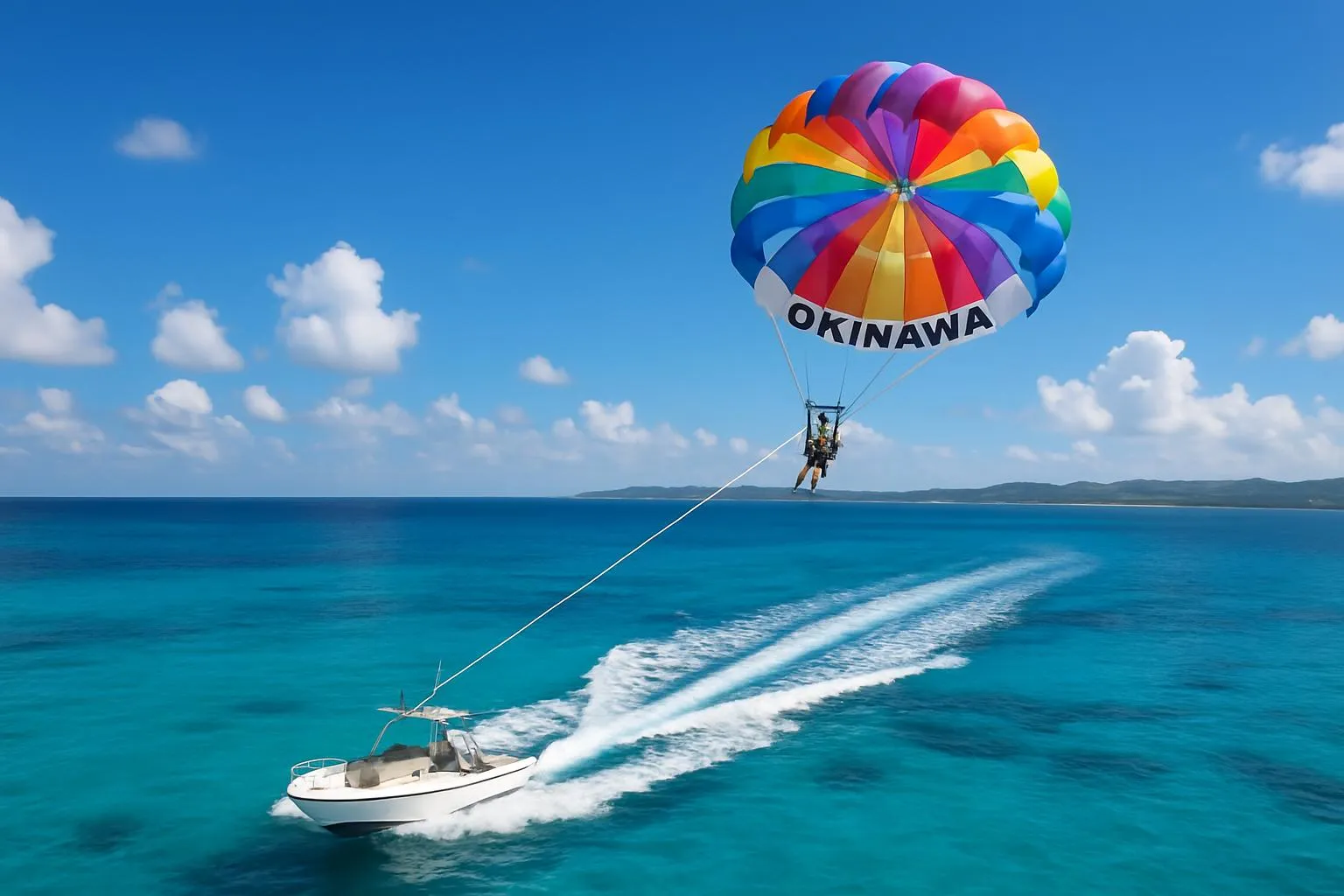
Parasailing lets you have Okinawa's blue sea and sky all to yourself. Are you wondering, “Where should I fly: Naha, Onna Village, or Chatan?” “What are the going rates, and how can I book at the lowest price?” “It's my first time, and I'm worried about safety…” This article is for you: a complete guide to parasailing on Okinawa's main island. We compare the appeal and scenic spots of the three popular areas, Naha, Onna Village and Chatan, in detail to help you find the plan that suits you best. We also cover everything first-timers want to know, from price ranges in each season and how to book at the lowest price with coupons and early-bird discounts, to what to wear and bring on the day, safety measures and the criteria for cancellations. You'll also find tips on using booking sites such as Asoview and Jalan, combo plans with other activities, and how to film with a GoPro. After reading this article, you'll have all the knowledge you need to plan your Okinawa trip smoothly and enjoy the best walk in the sky with peace of mind.
The basics and appeal of parasailing on Okinawa's main island
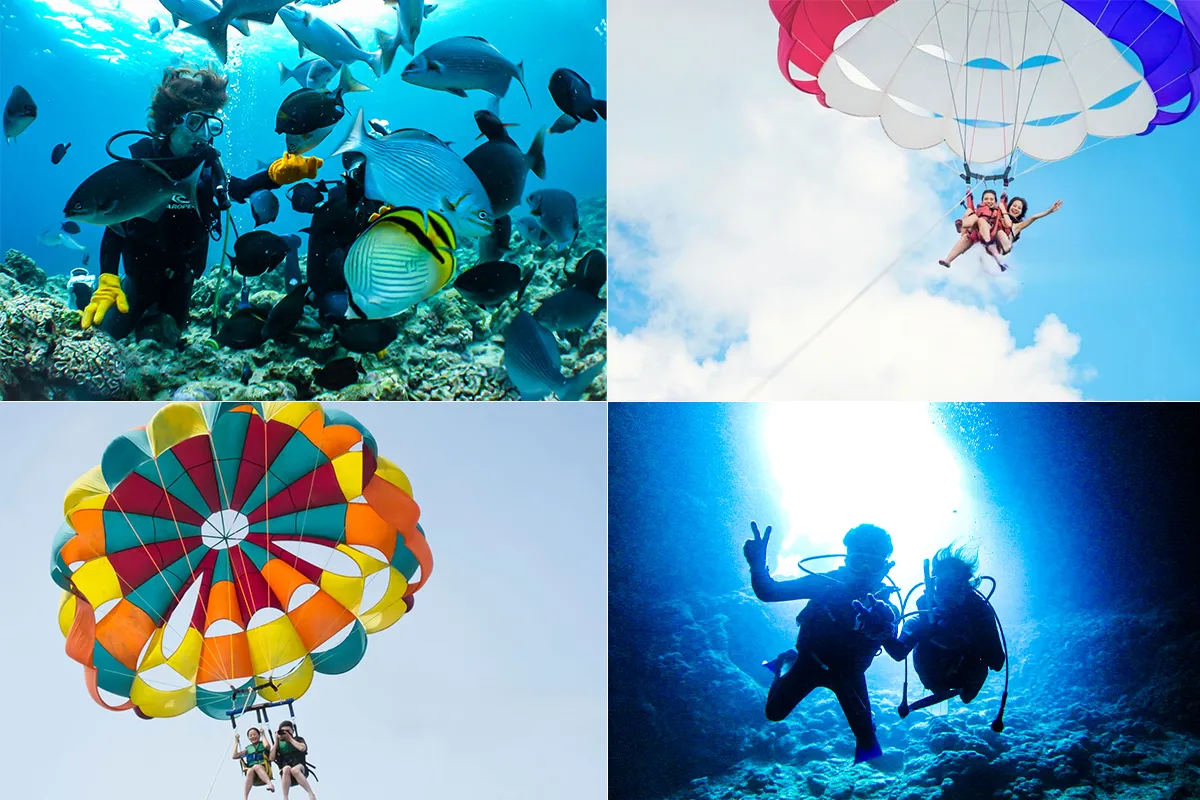
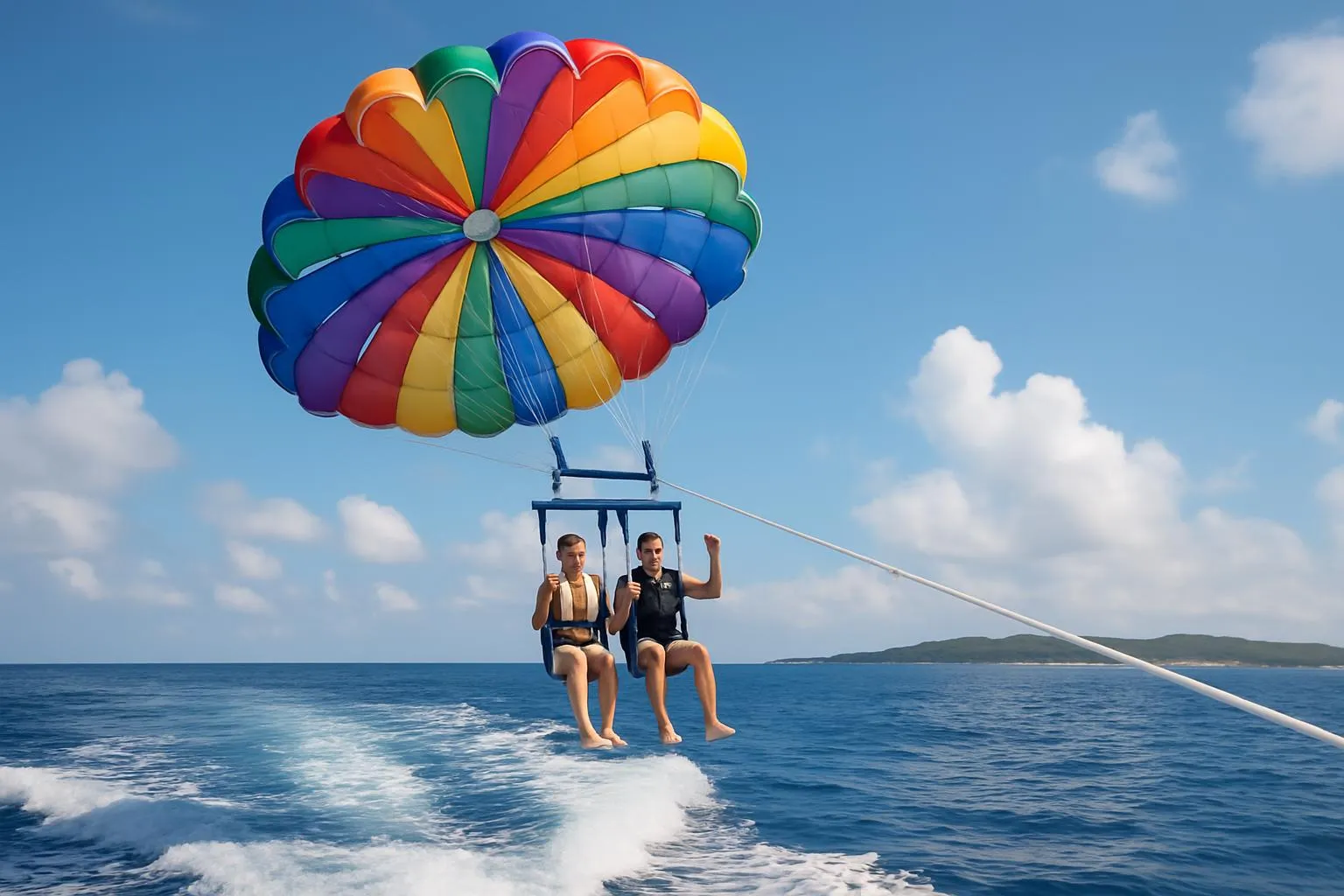
If there is one activity you should try when you visit Okinawa's main island, it is parasailing. Parasailing is a marine sport in which a motorboat tows a parachute and you soar high into the sky like a kite. From a bird's-eye view, you can take in a 360-degree panorama of the emerald green sea and coral reefs that Okinawa is proud to show the world. No difficult skills are required, and it is an easy way to enjoy a walk in the sky, so it is popular with all ages, from children to adults.
How to enjoy parasailing and the views from the sky
The greatest appeal of parasailing is, above all, the magnificent view of Okinawa looking down from the sky. The rope length varies by plan, but 100 m to 200 m is typical, taking you up to a height of 40 m to 80 m. The sea seen from this height sparkles in the sunlight, painting a beautiful gradient from turquoise blue in the shallows to deep indigo offshore. If you are lucky, you may even spot a sea turtle swimming below. Feeling the refreshing wind, you can experience a sense of freedom and wonder that you can never find in everyday life. Some plans also offer the “Sea Dutch,” in which you descend until you skim the surface of the water and get splashed, which is a good choice for thrill-seekers.
Safety measures and equipment that put first-timers at ease
Even if you are thinking, “Heights are a little scary” or “I can't swim, will I be okay?”, you can enjoy parasailing with peace of mind. All participants wear a life jacket and a harness that secures the body. Both takeoff and landing take place on the deck at the back of the boat, so you do not go into the sea yourself and, basically, you don't need to worry about getting wet. An experienced instructor rides along, and flights go ahead only when safety has been confirmed after strictly checking that day's weather, wind and sea conditions. A careful safety briefing is always given before departure, and staff keep watch from the boat below during the flight, so even first-timers can relax and enjoy the trip through the sky.
Age and weight limits and participation requirements
Parasailing requires no special skills, so anyone in good health, from small children to older adults, can take part. However, a few requirements are set for safety reasons. Be sure to check them before you book.
| Item | Details and notes |
|---|---|
| Age | This varies by shop, but participation is generally possible from age 3 to 5 and up. However, children of elementary school age or younger must be accompanied by a parent or guardian. There is often no upper age limit, but please decide whether to take part based on your own physical condition. |
| Weight limit | Weight limits are set so that flights are safe. The limit is generally based on the total weight of the group flying together, not on each person's weight (for example, up to 200 kg in total). The limit may also change depending on how strong the wind is that day. |
| Health | People with serious heart, respiratory, or ear, nose and throat conditions, people who are pregnant or may be pregnant, people with a history of epilepsy, and people who have been drinking alcohol cannot take part. If you have any other health concerns, we recommend consulting the shop in advance. |
These requirements are only general guidelines. Rules differ depending on the shop and plan you use, so it is important to check the latest information on the official website or similar when you book.
Area guide: parasailing from Naha
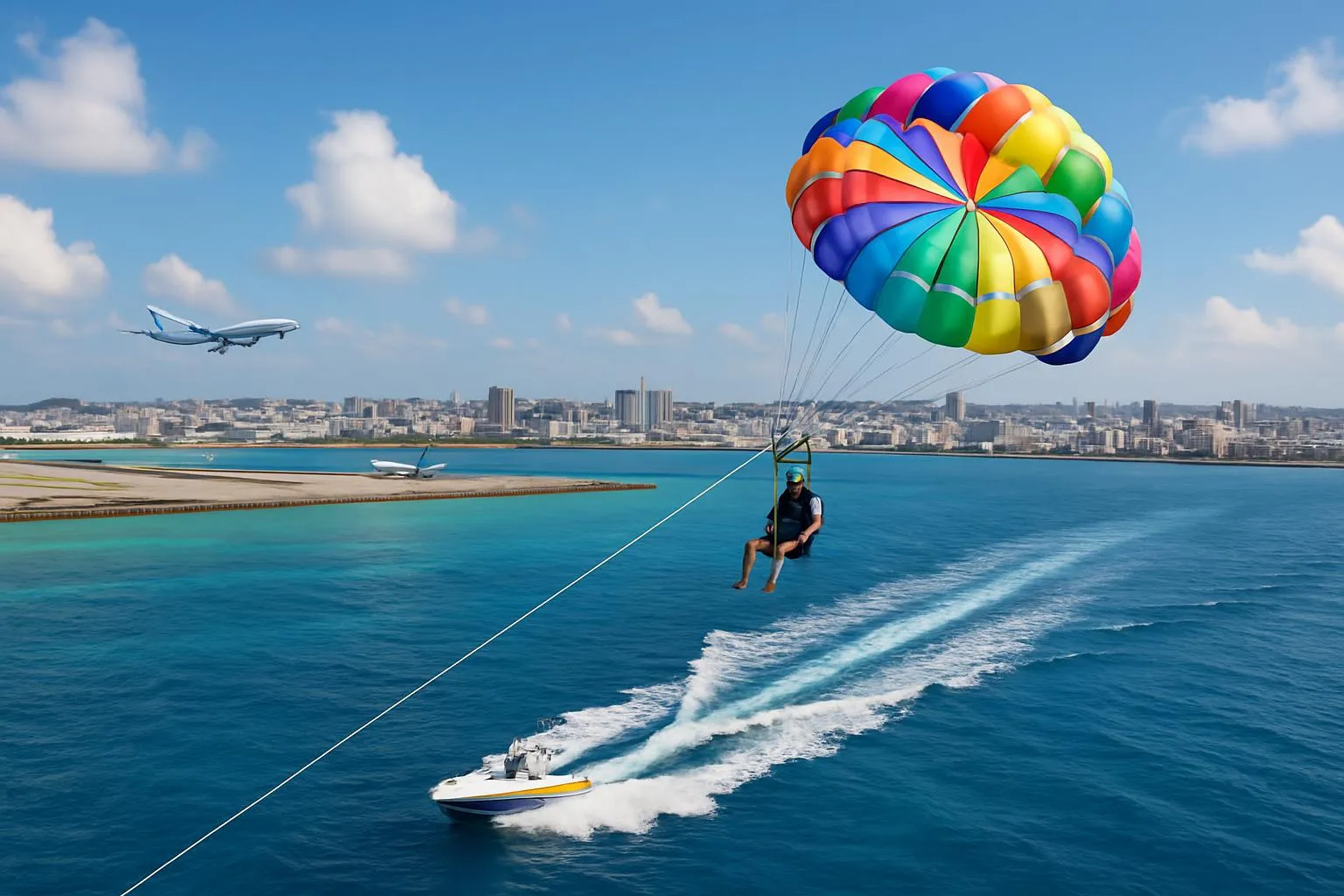
Parasailing departing from the Naha area, the gateway to Okinawa by air, is most appealing for its easy access, about 10 minutes by car from Naha Airport and Kokusai Street. Even on the day you arrive in Okinawa or your last day, you can enjoy a walk in the sky without worrying about flight times. It is also nice that you can combine it with sightseeing in Naha City and plan your trip schedule efficiently. It is a luxurious location where you can enjoy, all at once, the contrast between the city scenery and the sea of “Kerama Blue,” which boasts some of the best water clarity in the world.
Access from Naha Airport and the meeting point
Almost all parasailing from Naha departs from “Naha Miegusuku Port.” It is very easy to reach from Naha Airport, which makes it ideal if you want to make the most of your limited time on your trip.
The main ways to get there are as follows.
| Transportation | Travel time (approx.) | Tips |
|---|---|---|
| Rental car or car | About 10 to 15 minutes | Taking the Naha Umisora Tunnel makes the drive smooth. A paid parking lot is available at the port. It is easiest to set your car navigation to “Naha Beachside Hotel.” |
| Taxi | About 10 to 15 minutes | The fare is around 1,500 yen. It goes smoothly if you tell the driver “Miegusuku Port.” |
| Monorail (Yui Rail) + walking or taxi | About 25 to 30 minutes | The nearest station is “Asahibashi Station.” It takes about 20 to 25 minutes to walk from the station to the port. Taking a taxi from the station is also a good option. |
The meeting point, Naha Miegusuku Port, has a waiting area as well as restrooms, paid showers and coin lockers, so changing and storing your belongings after parasailing are no problem. Some shops offer plans that include a free pickup service from hotels in Naha City, so be sure to check when you book.
Highlights and photo spots from Naha
Parasailing off Naha offers unique views created by the blend of city scenery and grand nature. Enjoy the moving views you can only see from above.
- The “Chibishi Atoll,” the entrance to Kerama Islands National Park: A group of uninhabited islands (Nagannu Island, Kuefu Island and Kamiyama Island) about 10 km west of Naha. You can take in the sea, known as Kerama Blue and famous for some of the best water clarity in the world, from above, and the emerald green gradients created by the coral reefs are breathtakingly beautiful.
- Naha city and Naha Airport: The buildings of Naha City spread out to the east and Naha Airport to the south. With good timing, you may get a rare experience you can't find anywhere else: looking straight down on the powerful sight of airplanes taking off and landing.
- Views that change with rope length: Parasailing rope lengths vary from short ones of around 50 m to 200 m, among the longest in Japan. The higher you go, the wider your view becomes, and you can enjoy a panorama that reaches farther islands. If you are not comfortable with heights, we recommend a shorter rope, and if you want to fully enjoy the scenery, a longer one.
For photos, many tours offer rental of action cameras such as a GoPro. Some tours even transfer the footage to your smartphone after the tour, making it easy to keep memories of your trip.
Duration from Naha and how to choose a departure time
Parasailing from Naha is compact, with a total time of about 1 to 1.5 hours from meeting up to dispersal. That makes it easy to join in between sightseeing stops. Multiple departures are scheduled each day, so you can choose the best time for your travel schedule.
| Time of day | Features | Recommended for |
|---|---|---|
| Morning departures (around 9:00–11:00) | With the sun nearly overhead, this is the time when the sea looks its clearest and bluest. The wind is often relatively calm, so you can expect a stable flight. | - People who want to capture the scenery in photos and video - People who want to make good use of the time after the activity for sightseeing |
| Afternoon departures (around 13:00–15:00) | Popular with people who want to spend the morning relaxing at the hotel or finish other sightseeing in the morning. The sun is strong at this time of day, so be sure to protect yourself from sunburn. | - People who aren't morning people or want a leisurely start - People who want a flexible travel schedule |
| Sunset departures (from 16:00) | A romantic departure where you can enjoy the dreamlike scenery of the sky and sea tinged with the setting sun. Times change with the season, and private plans are sometimes available. | - For making memories as a couple or married pair - People who want to experience scenery that moves you in a different way from the daytime |
Every time of day has its own appeal, but morning departures are especially popular. They fill up quickly, so if you already have your preferred date and time, we recommend booking early.
Area guide: parasailing in Onna Village
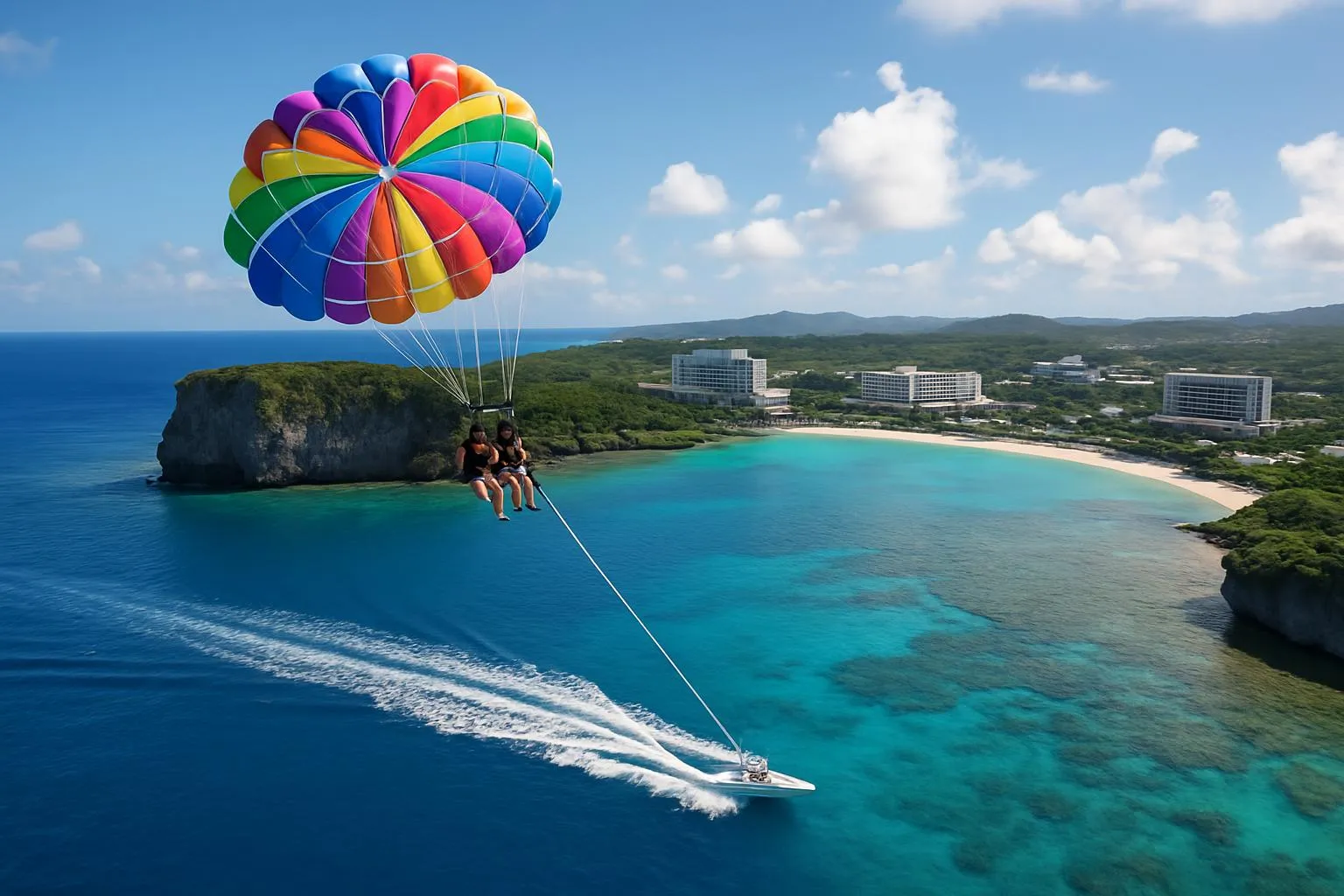
Onna Village, known as one of the top resort areas on Okinawa's main island, is appealing for its beautiful coastline and very clear water. Large luxury resort hotels line the shore, making it an ideal location if you want to enjoy top-class marine activities easily from where you are staying. The contrast between the emerald green sea and the coral reefs seen from the sky is truly spectacular.
Views of Manzamo and the Blue Cave area
The greatest appeal of parasailing in Onna Village is its unique scenery. From above, you can take in, from over the sea, the dramatic sheer cliffs of Manzamo, one of Okinawa's most iconic scenic spots, and the strange rock shaped like an elephant's trunk. Being able to enjoy its majestic natural beauty from a perspective completely different from the ground is a special experience that only parasailing can give you.
You can also enjoy from the sky the beautiful coastline around Cape Maeda, home to the Blue Cave, a world-famous diving and snorkeling spot. You cannot see inside the cave directly while parasailing, but the beauty of a coastline woven from clear, coral-filled water and steep cliffs is exceptional. If the weather conditions are good, you may even be able to see all the way from the west coast sky to the east coast.
Access from Onna Village resort hotels
There are many resort hotels scattered across the Onna Village area, so it is easy to get to the activity from where you are staying. Parasailing tours mainly meet at places such as “Maekane Fishing Port” and “Seragaki Fishing Port,” which are very convenient, within 5 to 30 minutes by car from many hotels.
However, most tours do not offer a pickup service to hotels, so you need to check your transportation in advance. Getting there by rental car or taxi is the basic option. Find out in advance how long it takes from each hotel, and plan so that you are not late for the meeting time.
| Resort hotel | Main meeting point | Travel time by car (approx.) |
|---|---|---|
| ANA InterContinental Manza Beach Resort | Seragaki Fishing Port / Maekane Fishing Port | About 5 to 10 minutes |
| Hyatt Regency Seragaki Island, Okinawa | Seragaki Fishing Port | About 5 minutes |
| Halekulani Okinawa | Maekane Fishing Port | About 10 minutes |
| Hotel Monterey Okinawa Spa & Resort | Maekane Fishing Port | About 10 minutes |
| Rizzan Sea-Park Hotel Tancha Bay | Maekane Fishing Port | About 15 minutes |
| Sheraton Okinawa Sunmarina Resort | Maekane Fishing Port | About 15 minutes |
Popular times for families and avoiding crowds
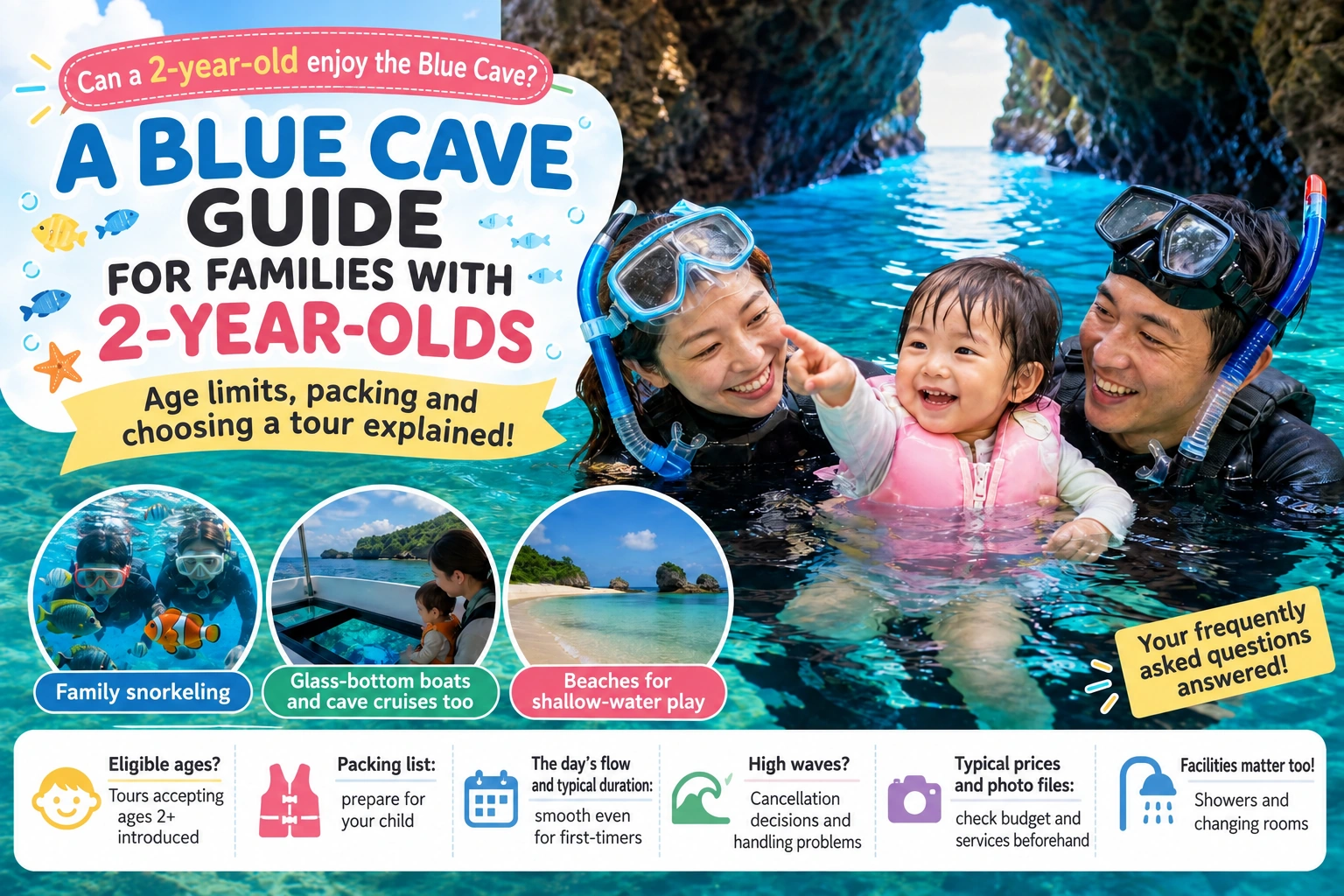
Parasailing is popular with families with small children, and by choosing the time of day and time of year, you can enjoy it even more comfortably. Many shops offer plans for children aged 4 or 5 and up.
Morning departures are recommended
For families, we recommend morning departures, when sea conditions are relatively calm in many cases. The wind tends to pick up in the afternoon, and the boat can rock more easily. Morning departures, with their calmer waves, carry less risk of seasickness, so even small children can take part with confidence. Finishing the activity in the morning also has the advantage of making it easier to plan your afternoon sightseeing.
Tips for avoiding peak-season crowds
During busy periods such as summer vacation and Golden Week, bookings get very crowded. Popular time slots in particular often sell out weeks in advance. For a comfortable experience, keep the following points in mind.
- Make sure to book early: Once your travel dates are set, book as soon as you can. For popular shops and time slots in particular, booking more than a month ahead is the safe choice.
- Aim for weekdays: If possible, booking on a weekday, when there are relatively fewer tourists, makes it easier to avoid crowds at the port and on the boat.
- Consider the first departure of the morning: The earliest departure of the day is recommended because it is relatively easy to get a spot and lets you use the rest of your day well.
Area Guide: Parasailing in Chatan
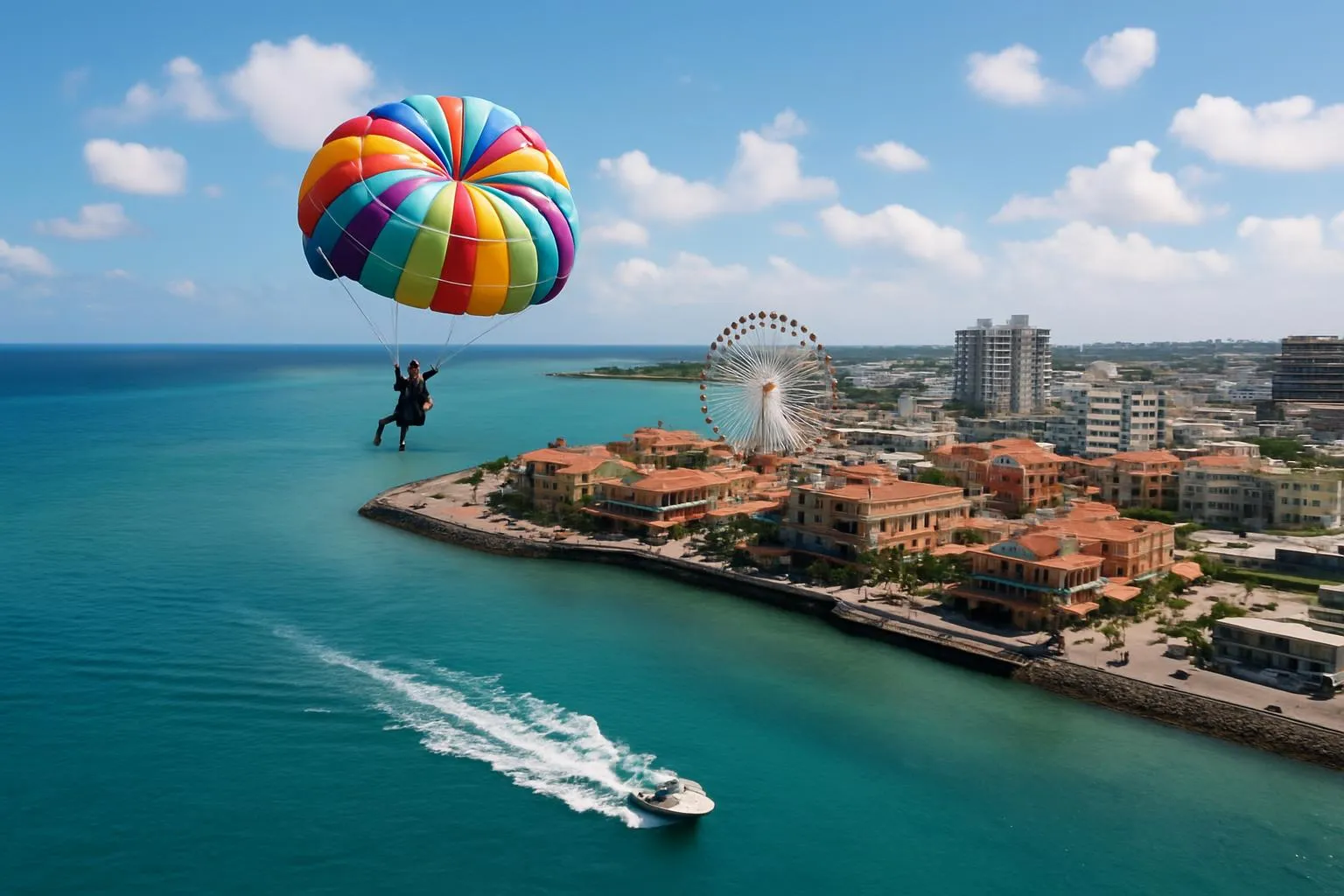
Chatan Town, located in the central part of Okinawa's main island, is a popular area as an urban resort full of exotic atmosphere. It is right next to “Mihama American Village” in particular, and a big draw is that you can enjoy shopping and dining along with parasailing. You get a special flight looking down on a stylish townscape that feels different from Naha or Onna Village.
Views around American Village
The greatest appeal of parasailing in Chatan is, above all, the colorful townscape of American Village that you can see all at once from above. The view of the Ferris wheel and distinctive buildings spreading out feels just like a theme park. During the day, the contrast with the emerald green sea of the west coast is beautiful, and you can enjoy an open, expansive view. On a clear day, you may even see the Kerama Islands in the distance. Many plans let you choose a rope length of 100 m, 150 m or 200 m, and the view changes with the height. In particular, the 360-degree panoramic view looking down from a height of 200 m is spectacular, and it is sure to become an unforgettable memory.
How the meeting at Chatan Fisharina works
Almost all parasailing in the Chatan area departs from “Chatan Fisharina (Uminchu Wharf).” It is easy to reach, about a 5-minute walk from American Village, and free parking is available nearby. Knowing the general flow from meeting up to boarding on the day will help you take part smoothly.
| Step | What happens | Tips |
|---|---|---|
| 1. Meet up and check in | Arrive at the designated meeting spot inside Chatan Fisharina at least 15 minutes before your reserved time. | Fill out the application form and pay. Be sure to use the restroom beforehand. |
| 2. Preparation and safety briefing | You put on a life jacket and harness. Staff explain the points to be aware of during the flight and safety matters (briefing). | If there is anything you don't understand or are worried about, don't hesitate to ask at this time. |
| 3. Boarding and departure | Once you are ready, you board the boat and head to the flight point offshore. | If you are worried about seasickness, we strongly recommend taking motion sickness medicine before boarding. |
| 4. Parasailing experience | After arriving at the point, each person in turn has the harness connected to the boat and the parachute, and slowly takes off into the sky. | The flight time is about 10 minutes per group. |
| 5. Return to port and dispersal | When everyone's flight is finished, you return to the port. You receive your photo data and so on, and the tour ends. | There are many cafes and restaurants nearby, so we also recommend enjoying a meal while savoring the afterglow of the experience. |
The appeal of sunset departures and things to note
What is especially popular in the Chatan area is the “sunset departure,” where you can watch the beautiful sunset on the west coast from the sky. It is a romantic and moving experience completely different from a daytime flight.
The dreamlike scene created by the sky and sea tinged orange, together with the night view of American Village, is perfect for making special memories on a couple's trip, a girls' trip or an anniversary. Photos with silhouettes standing out against the breathtakingly beautiful scenery also look great on social media. It will become a lifelong treasure.
However, there are a few things to note about sunset departures. Because sunset time changes with the season, the departure time also changes. Also, the air temperature tends to drop more over the sea than on land, so it can feel chilly, especially after sunset. It's reassuring to bring a jacket you can throw on. Sunset departures are extremely popular and tend to fill up quickly, so once your travel plans are set, it is important to book early.
| Item | Details |
|---|---|
| Appeal | - You can have the stunning view of the sky and sea tinged with the setting sun all to yourself - You can also enjoy the night view of American Village - A romantic atmosphere, ideal for couples and anniversaries - A dreamlike scene that looks great in photos |
| Things to note | - Sunset time and departure time change with the season - Very popular and fills up easily (booking early is a must) - The temperature drops after sunset, so it helps to have something to wear over your clothes - Depending on the weather, the sunset may not be visible |
How to find the lowest price and price ranges
Parasailing prices on Okinawa's main island vary greatly depending on the area, season and plan details. However, if you know the key points, anyone can enjoy the best walk in the sky at a good price. In this chapter, we explain in detail the specific ways to find the best-value plan wisely and the price ranges worth knowing in advance.
Price ranges on Okinawa's main island and seasonal price changes
Parasailing prices change mainly with two factors: “where you fly” and “when you fly.” First, let's get a grip on the basic price range and how prices differ by season.
The general price range is around 7,000 to 10,000 yen per person. In most cases, this price includes the boarding fee, the parasailing experience fee, rental of all the necessary equipment and insurance. However, depending on the shop, a separate port facility fee may be required. Prices also change with the rope length (flight height), and tend to be higher the longer the rope is.
The biggest factor in price changes is the season. Prices rise when there are more travelers and become more affordable when there are fewer.
| Season | Period | Price trend | Features |
|---|---|---|---|
| High season | July to September | Highest | Demand is concentrated around summer vacation and holiday weekends, and prices peak. Typhoons are also frequent in this period, so be careful. |
| Shoulder season | April to June, October to November | Slightly high to average | The weather is stable, making this one of the best seasons for comfortable enjoyment. Prices are also calmer than in the high season. |
| Off-season | December to March | Lowest | Because there are fewer tourists, prices are the lowest of the year. It is relatively warm even in winter, but strong north winds can lead to canceled departures. If you are lucky, you may be able to see whales. |
Tips for booking at the lowest price and using early-bird discounts
With a little ingenuity, you can enjoy parasailing at an even better price. In particular, planning and booking early is the surest shortcut to the lowest price. Here are some specific tips that will help when you book.
Compare multiple booking sites
Even for the same plan, the price may differ depending on the booking site. Major booking sites such as “Asoview!” and “Jalan Activities” frequently run site-exclusive discount plans and time sales. It is important to check multiple sites side by side and find the plan with the best terms.
Make the most of “early-bird” discounts
Many shops offer “early-bird” plans for people who book in advance. For example, with conditions such as “booking 30 days ahead” or “booking 60 days ahead,” there are many cases where the price is discounted by about 500 to 1,000 yen from the regular price. When planning a trip in the high season in particular, using an early-bird discount is practically a must.
Aim for weekday and morning departures
On weekends, holidays and in the afternoon, popularity concentrates and prices may be set higher. If your schedule allows, aiming for a weekday morning departure, when bookings are relatively open, may help you keep costs down.
Student discounts, coupons and campaigns
If you are a student, or you are looking for even better deals, don't miss discount plans and limited-time campaign information.
Student discount plans
During spring break, summer vacation and the graduation trip season, some shops offer “student discount” plans that apply when you show your student ID. If you use one on a group trip with friends, you can save a lot of money. Check whether a student discount plan is available when you book.
Check booking site coupons
Booking sites often hand out discount coupons when you sign up as a member or during specific campaign periods. By using “first-time-user coupons” or “limited-time coupons,” you can book for even less than the listed price. Get into the habit of always checking whether there is a coupon you can use before you confirm your booking.
Find shops' own campaigns
On official websites and social media (Instagram, X and so on), shops sometimes announce their own limited-time campaigns. You may find unexpectedly good deals, such as “grand opening” or “followers-only discounts.” If there is a shop you are interested in, we recommend following it in advance.
How to book and recommended booking sites
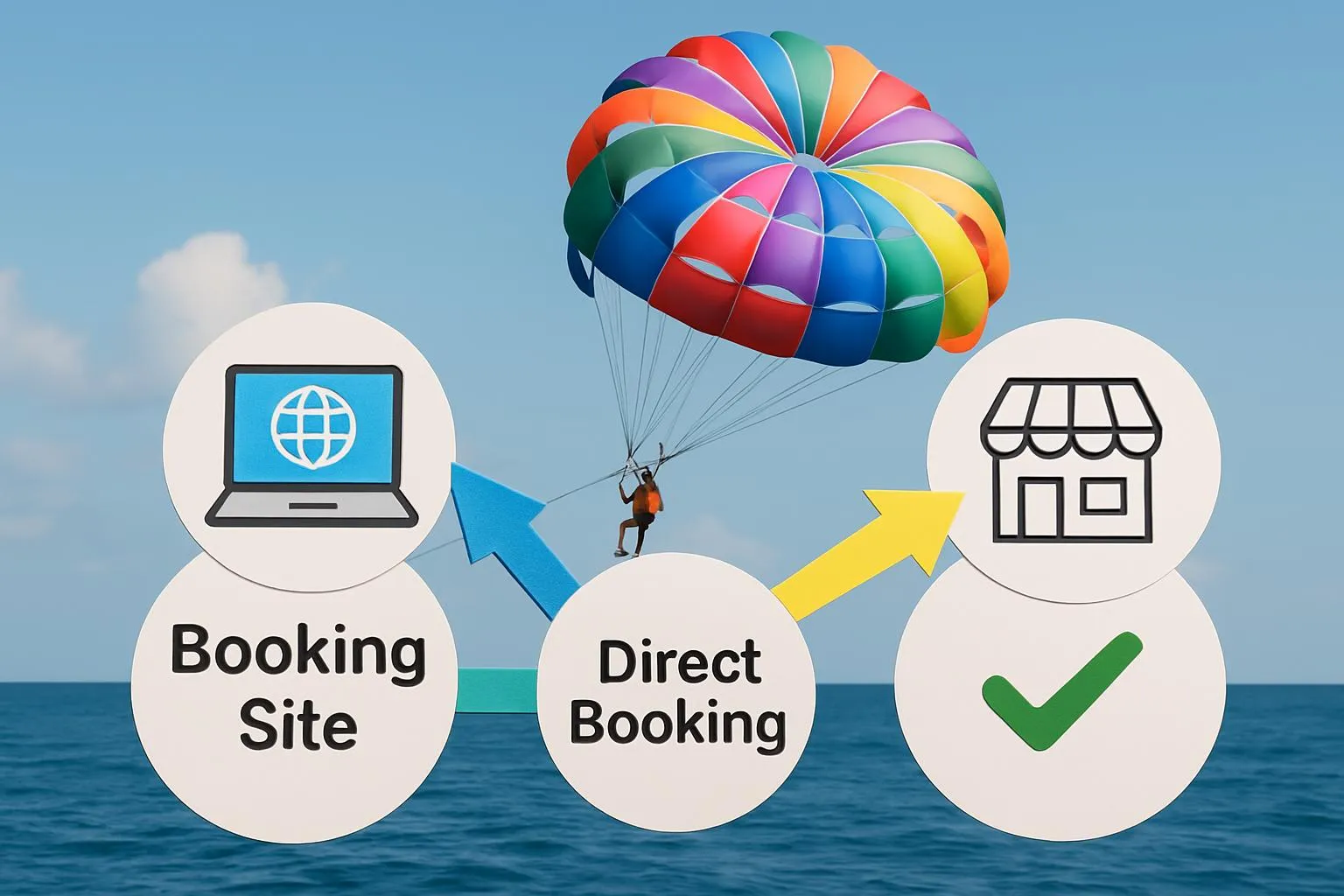
There are many ways to book parasailing on Okinawa's main island. The mainstream options are to use a booking site specializing in activities (an OTA) or to book directly on the official website of the shop that runs the tour. Each method has different advantages and disadvantages, so the best choice changes depending on your travel style and what you value most. Understand the features of each site, such as points and coupons and how easy it is to compare plans, and find the booking method that is the best value and most satisfying for you.
How to use Asoview and Jalan Activities
For booking activities online, the especially popular choices are “Asoview” and “Jalan Activities.” Both carry a wide range of parasailing plans on Okinawa's main island, but each has its own strengths, so we recommend using them wisely.
Asoview is one of Japan's largest booking sites specializing in leisure and fun, and it is known for having an overwhelmingly large number of plans. It is ideal when you want to compare prices, departure times, reviews and more across many tour operators. Many plans carry a lowest-price guarantee, and sales and special features are held often, so it is easy to find good deals. A big advantage is that there are plenty of real users' reviews and photo posts, so it is easy to get a feel for the actual atmosphere.
On the other hand, Jalan Activities is run by Recruit, the same company behind the travel information site Jalan.net, and its biggest appeal is that you can earn and use Ponta points and Recruit Points. You can use points you earned by booking hotels and airline tickets to enjoy parasailing at a discount. The discount coupons handed out regularly are also attractive, and high-discount coupons sometimes appear before weekends and holiday weekends in particular. For people who already use Jalan-related services, it is a very convenient site.
| Comparison item | Asoview | Jalan Activities |
|---|---|---|
| Number of plans | Very many | Many |
| Points program | Its own points (some plans) | Ponta points, Recruit Points |
| Coupons and sales | Frequent sales and special features | Plenty of discount coupons |
| Reviews | Plenty of reviews with photos | Mostly text-based reviews |
| Recommended for | People who want to compare many options, people looking for the lowest price | People who want to earn or use Ponta points, Jalan users |
In the end, the smartest approach is to check both sites at the time you want to book, take into account the coupons and points you can use, and choose whichever is the better deal. Even for the same plan from the same tour operator, prices and perks may differ depending on the booking site, so don't skip the comparison.
How to use points on Rakuten Travel Experiences
For people who frequently use the Rakuten ecosystem, “Rakuten Travel Experiences” is a booking site you can't overlook. The biggest advantage is that you can apply Rakuten Points earned through Rakuten Ichiba and Rakuten Card use to payment for parasailing. It is also ideal as a place to spend limited-time points, and it can greatly reduce your actual out-of-pocket cost.
In addition, bookings through Rakuten Travel Experiences may count toward the SPU (Super Point UP Program), which also helps raise your point multiplier on Rakuten Ichiba. During the Rakuten Super Sale and Shopping Marathon, there are sometimes campaigns in which discount coupons are handed out or the point return rate goes up in tandem. If you book flights to Okinawa and accommodation on Rakuten Travel, you can also manage your activities in one place under the same account, which saves you the trouble of booking and lets you earn and use points efficiently.
In particular, for people who hold a large amount of Rakuten Points or who put all their travel payments on a Rakuten Card, there is a good chance you can book at a better price than on any other site.
Pros and cons of direct booking and comparison sites
Besides using activity booking sites (comparison sites), there is also “direct booking,” in which you book directly on the official website of the tour operator that runs the parasailing. Both methods have their advantages and disadvantages, so it is important to understand the differences. Let's compare the pros and cons of each.
| Booking method | Pros | Cons |
|---|---|---|
| Comparison sites (Asoview, Jalan, etc.) | You can compare plans from multiple shops in a single list. Site-specific points and coupons can save you money. There are many reviews, which give you objective information for your decision. Online payment is smooth. | You can't book limited plans that are not listed on the site. Handling special requests can take time. Very rarely, a fee amount has been added on top of the price. |
| Direct booking (shop's official website) | There may be plans and discounts exclusive to the official website. It is easier to get flexible handling of phone inquiries and special requests. You can check the shop's commitments and the latest information directly. There are no intermediary fees. | It is hard to compare prices and details with other companies. There are few point rewards or large-scale coupons. Depending on the site, the booking system can be hard to use. Payment methods may be limited. |
In conclusion, if you value good prices, convenience and comparing multiple options, we recommend comparison sites. If you are trying parasailing in Okinawa for the first time in particular, a comparison site, where you can find a plan that suits you while referring to reviews, will probably feel more reassuring.
On the other hand, if you have already decided which tour operator to use, or want to discuss a special request such as an anniversary surprise, booking directly through the official website is the better fit. By communicating directly with the staff, you can expect smoother and more flexible handling. Understand the features of both and choose the best booking method for your own needs.
The flow on the day and what to bring
To enjoy parasailing on Okinawa's main island to the fullest, it is important to prepare in advance and know the flow on the day. To avoid situations such as panicking over something you forgot, or being late for the meeting time and not being able to take part, be sure to check this chapter carefully. The things to bring are summarized in a checklist, so please use it when you pack.
From meeting up to boarding check-in and the safety briefing
On the day of your parasailing tour, things start with meeting at the designated place. After you check in and receive the safety explanation, you finally board the boat and head to the offshore point. Getting through this series of steps smoothly is the first step to an enjoyable experience.
Arrive with time to spare
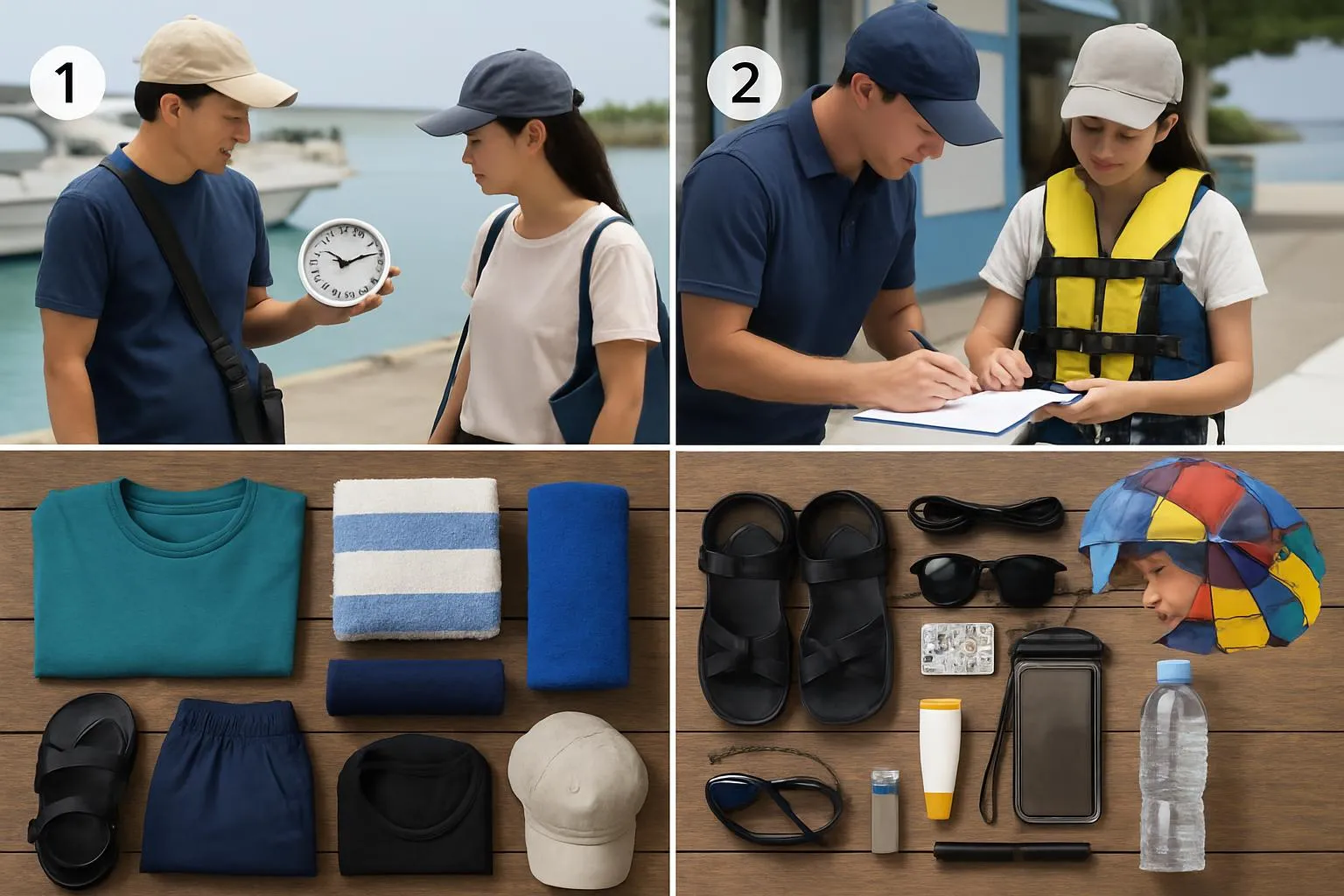
Ideally, arrive at the meeting place 15 to 20 minutes before the departure time. In areas with heavy traffic, such as ports in Naha City in particular, try to leave yourself plenty of time to get there. If you are late, you will not only inconvenience the other participants but, in the worst case, may not be able to take part. It is reassuring to recheck the meeting place map and time in the confirmation email sent when you book.
Check-in and filling out the consent form
When you arrive at the meeting place, first give the staff the name of the person who booked and check in. At this point, it is common for all participants to sign a liability waiver. It includes items that check your health condition and so on, so please fill it out honestly. If your plan involves paying on site, you will often do so at this time.
Safety briefing
Before or after boarding, the staff will give a very important explanation related to safety (briefing). It covers how to put on the life jacket and harness correctly, your posture during the flight, hand signals in case of an emergency, and so on. Not only first-timers but also experienced people should listen carefully, and don't hesitate to ask questions if anything is unclear.
What to wear, being ready to get wet, and protecting valuables
To enjoy parasailing comfortably, suitable clothing and preparation are essential. It is basically an activity in which you rarely get very wet, but you may get hit by spray while the boat is moving, so it is best to be prepared to get wet.
Basically, wear clothes that can get wet
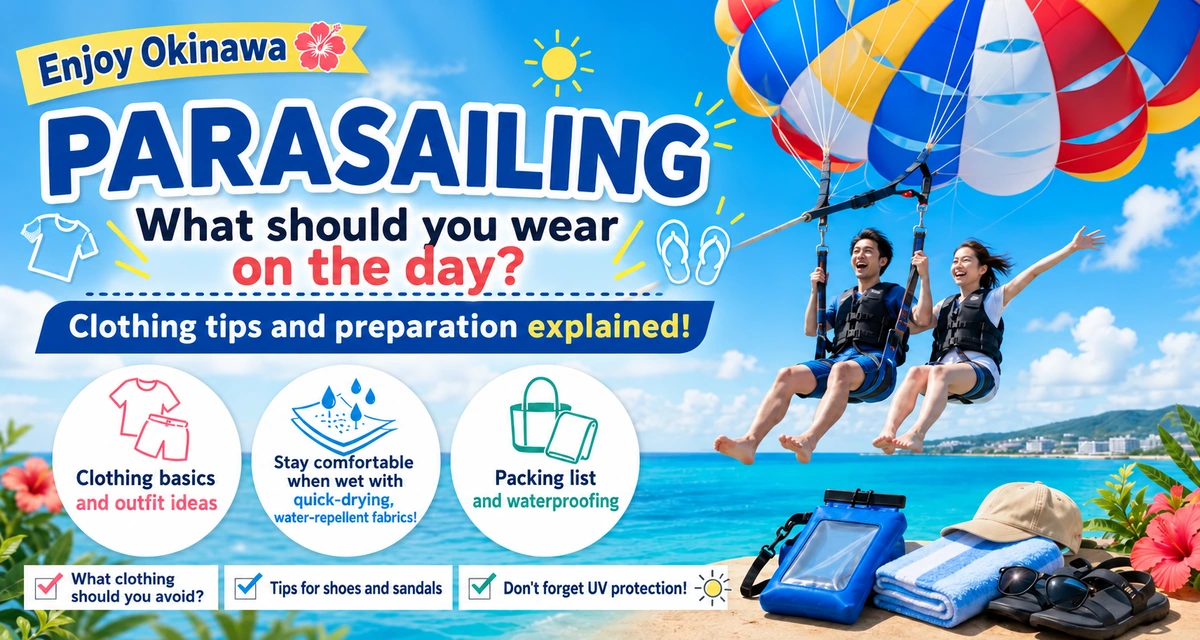
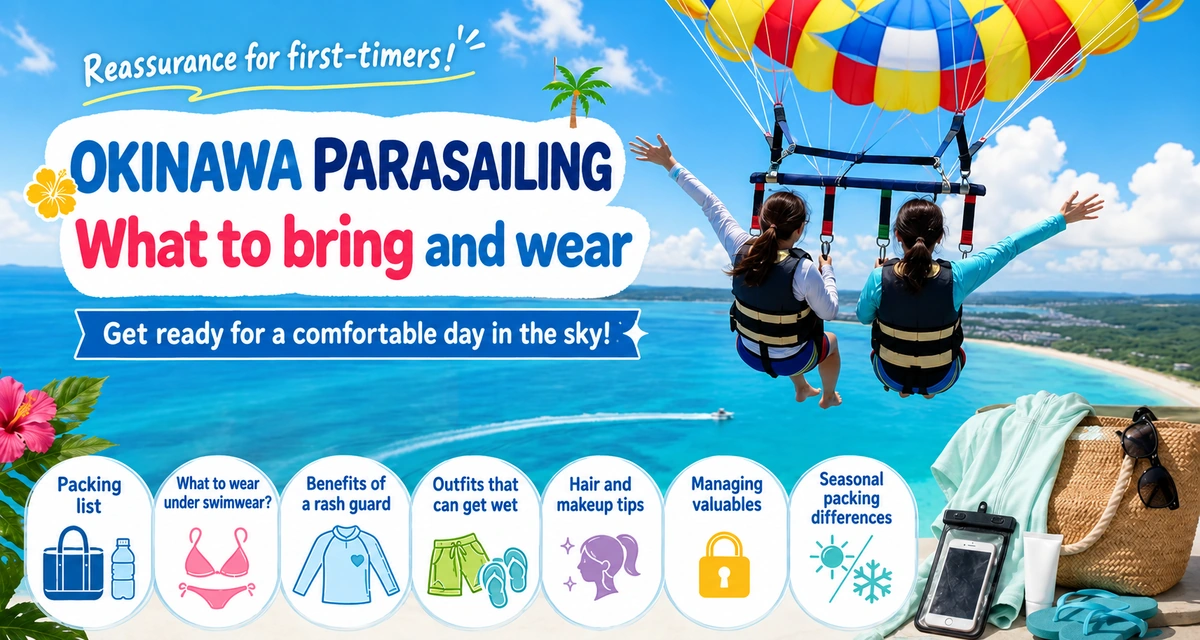
The basic choice is clothes that can get wet and are easy to move in, such as a T-shirt and shorts over your swimsuit. Cotton clothes are slow to dry and make your body cold when wet, so it is safer to avoid them. Because the sun is strong in Okinawa, wearing a rash guard is also recommended as sun protection. For footwear, shoes with heels and slippery footwear are dangerous, so choose sandals or water shoes that secure your heels. Skirts are inconvenient when putting on the harness, so pants are recommended.
Prepare a change of clothes and a towel
Considering that you may get wet during the experience, be sure to bring a full change of clothes and a towel to dry yourself. By changing after the tour, you can avoid getting cold and enjoy the rest of your sightseeing comfortably. Some shops have showers and changing rooms, but it is even more reassuring to check in advance.
How to manage valuables
The rule is to avoid bringing valuables such as your passport, large amounts of cash and expensive accessories as much as possible. Many meeting places offer free lockers or valuables storage, but the number may be limited. Keep the baggage you bring to a minimum and take care of it yourself.
Bringing your phone or GoPro, and photo services
Many people probably want to capture the stunning view from above in photos and video. Most tours allow you to bring a smartphone, but there is a risk of dropping it or getting it wet, so precautions are a must.
Bringing them is at your own risk, so take full precautions
When you take shooting equipment such as a smartphone or GoPro into the sky, measures to prevent dropping and water damage are essential, and everything is at your own risk. Be sure to put it in a waterproof case and attach a neck strap or a band that fastens to your wrist. If you drop it, recovering it is almost impossible. Some tour companies also rent out shooting equipment (such as GoPro).
If you want to go hands-free, we recommend a photo service
For people who want to fully enjoy the scenery without being distracted by shooting, or who are worried about the risk of dropping something, we recommend the photo and video service (a paid option) in which the staff take the pictures for you. The advantages are that you can get photos from angles you can't take yourselves, and that a professional can capture your best smiles against the stunning backdrop.
Packing checklist
To enjoy parasailing on Okinawa's main island to the fullest, check what to bring with the checklist below.
| Category | Item | Tips |
|---|---|---|
| Must-bring items | Swimsuit and clothes that can get wet | A rash guard, T-shirt, shorts and so on. Wearing your swimsuit under your clothes makes things go smoothly. |
| Must-bring items | Towel | Essential for drying your body after getting wet from spray. A slightly larger one is also handy when changing. |
| Must-bring items | Change of clothes | Changing out of wet clothes after the tour also helps prevent colds. Don't forget underwear. |
| Must-bring items | Sandals | Heelless types that secure your heels are safe. Flip-flops are also fine. |
| Must-bring items | Sunscreen | Essential because there is nothing to block the sun on the boat or in the sky. A waterproof type is recommended. |
| Handy extras | Motion sickness medicine | If you are worried about seasickness, it is reassuring to take it 30 minutes to 1 hour before boarding. |
| Handy extras | Hat and sunglasses | Effective against the sun and UV rays. To keep them from blowing away in the wind, take precautions such as attaching a strap. |
| Handy extras | Waterproof case and strap | Essentials if you bring a smartphone or camera. They greatly reduce the risk of dropping or water damage. |
| Handy extras | Something to throw on | After you get wet, the wind on the boat can chill your body. It comes in handy especially in spring and fall, and on days when the weather isn't great. |
| Handy extras | Drinks | Staying hydrated is essential to prevent heatstroke. Bring a plastic bottle or a water bottle. |
Judging weather and sea conditions, and the cancellation policy
Parasailing through Okinawa's beautiful skies is an activity that is greatly affected by weather and sea conditions. To enjoy it safely, it is very important to understand the criteria for going ahead and what happens if it is canceled in advance. Here, we explain in detail the guidelines for deciding whether parasailing goes ahead and the rules on cancellations, just in case.
Wind speed and wave height guidelines and cancellation criteria
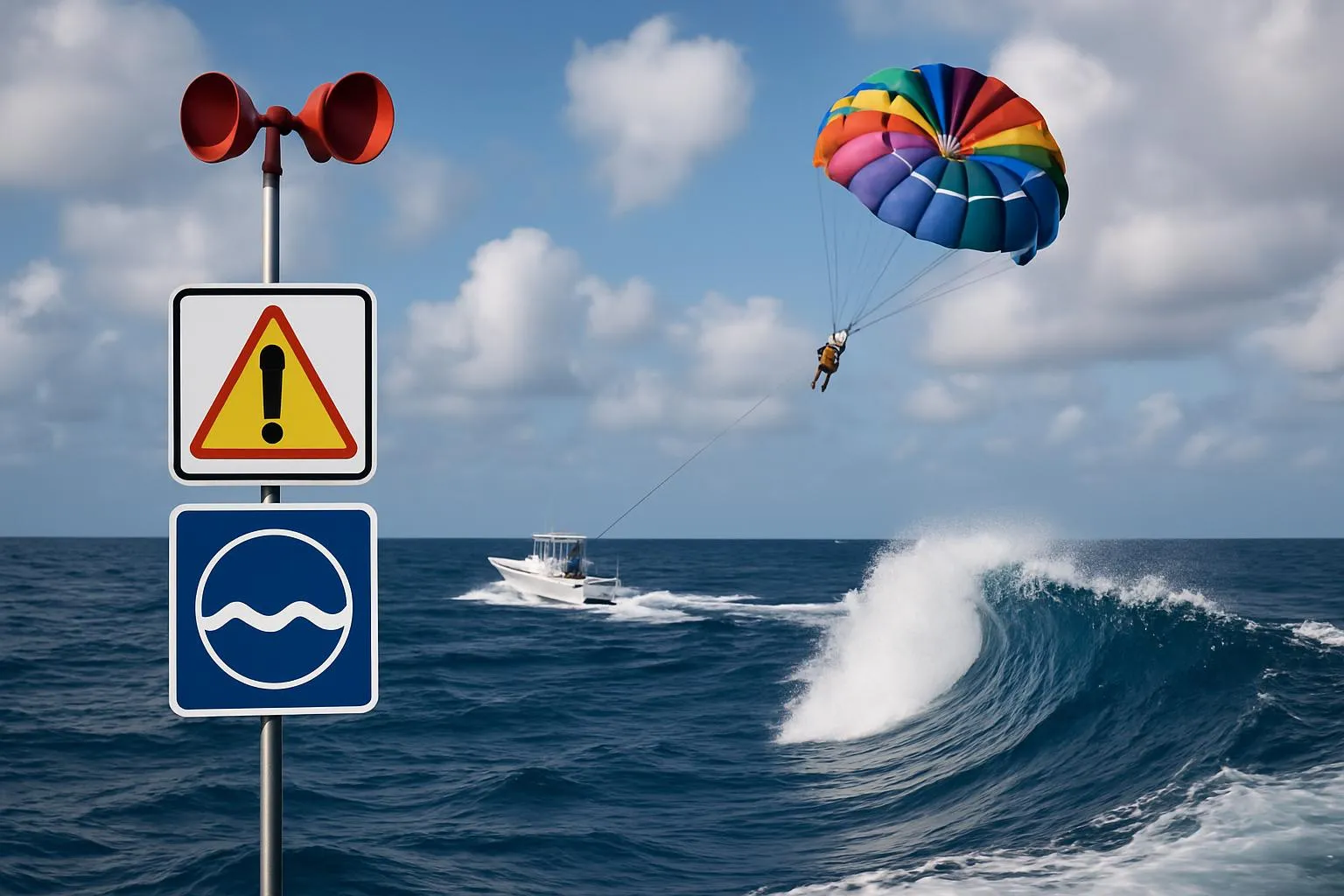
The most important factors in deciding whether parasailing goes ahead are the strength of the wind (wind speed) and the height of the waves (wave height). Even if it is not raining, if the wind is too strong or the waves are too high, safety cannot be ensured and the tour is canceled. Each operator sets its own safety standards, but the general guidelines are as follows.
| Factor | Guideline for going ahead | Guideline when cancellation is likely |
|---|---|---|
| Wind speed | Under 10 m/s | 10 m/s or more |
| Wave height | Under 1.5 m | 2 m or more |
| Weather | Sunny, cloudy, light rain | Thunder, dense fog, typhoons, heavy rain with strong wind |
These figures are only general guidelines. The final decision on whether to go ahead is made by the captain and the operator's staff, who know the sea conditions that day well. Even at the same wind speed and wave height, the level of danger changes with the wind direction and the type of swell, so it is important to follow the professionals' judgment. Please understand that the decision is made with safety as the top priority.
Whether it goes ahead in the rain, and how rescheduling works
Many people worry, “Will it be canceled if it rains?” but parasailing may go ahead even in rainy weather. You will get wet in the sky, but wind and sea conditions, rather than rain, determine whether it goes ahead. In the case of light rain, the tour is almost always held as long as there are no problems with the wind or waves.
However, the tour is canceled in cases such as the following.
- When thunder occurs or is likely
- When there is heavy rain or dense fog that blocks visibility
- When it rains with strong wind
If the tour is judged to be canceled because of bad weather, the operator will contact you at the phone number or email address you registered when you booked. After that, you will mainly choose from the following two options.
- Rescheduling: If there is availability at another date and time during your stay, you can have your booking moved.
- Cancellation (full refund): If rescheduling is difficult, the booking is canceled and the full amount you paid is refunded.
The decision to cancel can come right before the tour starts. On the morning of the day, check frequently for messages from the operator.
Cancellation policy and refund points
When you cancel a booking, how it is handled differs greatly depending on whether it is a “customer-initiated” cancellation or a “cancellation due to bad weather.” To avoid trouble, it is important to be sure to check the cancellation policy when you book.
Customer-initiated cancellations
When you cancel for your own reasons, such as feeling unwell or a change in your schedule, a set cancellation fee is generally charged. The cancellation fee rate varies with when you get in touch.
| When you notify the cancellation | Cancellation fee rate |
|---|---|
| Up to 2 days before the booked date | Free |
| The day before the booked date | 50% of the price |
| On the day of the booked date, or no-show cancellation | 100% of the price |
Note: The above is only an example. Cancellation policies differ depending on the operator and booking site, so be sure to check the details of the plan you booked.
When the tour is canceled due to bad weather
If the operator decides to cancel the tour because of bad weather such as wind or waves, no cancellation fee is charged at all. Even if you paid in advance, the full amount is refunded.
The refund method differs depending on how you booked.
- If you pay on site: There is no payment, so no procedure is needed.
- If you paid by credit card: The refund is usually processed through the credit card company. How long it takes for the refund to show up depends on the card company's billing cutoff date.
- If you used booking site points: The points you used are returned.
If you have any questions about refunds, contact the operator or the customer support of the site where you booked (Jalan Activities, Asoview and so on).
Safety measures, insurance and frequently asked questions

Parasailing, which lets you fully enjoy Okinawa's beautiful sky and sea, is a very safe activity run under proper safety management. In this chapter, so that everyone can have the best experience with peace of mind, we explain in detail how the safety equipment works, the participation requirements, the insurance that covers emergencies, and the points many people wonder about. Reliable operators put thorough safety measures in place and carry insurance for emergencies.
How the life jacket and harness work
The most important pieces of equipment supporting parasailing safety are the life jacket and the harness. They are not just something you put on; by understanding their functions and how they work, you can approach the activity with even more peace of mind.
The importance of the life jacket
The life jackets worn for parasailing are ones bearing the “cherry blossom mark” (sakura mark), conforming to the safety standards set by the Ministry of Land, Infrastructure, Transport and Tourism. This is not a mere flotation device; it is a life vest designed so that, even if you land in the sea, your face naturally turns up out of the water and you can keep breathing. Staff put one that fits your build on you correctly, so even people who can't swim have nothing to worry about.
The structure of the harness that supports your body
The harness is the most important piece of safety gear connecting the parachute to your body and supporting you in the air. The swing type, in which you rest your weight as if sitting in a chair, is the mainstream, and because your weight is spread out, it feels stable and lets you enjoy the walk in the sky in a relaxed state. Very sturdy materials are used, and multiple belts and buckles secure your body firmly. Before departure, experienced staff carefully check the fit and the connection points many times, so there is almost no worry of it coming off in the sky.
Whether children and seniors can take part, and points to note
Parasailing requires no special skills, so it is an activity that a wide range of generations, men and women, young and old, can enjoy. However, because safety comes first, a few participation standards regarding age and health are set.
There is no clear age limit set by law, but most operators set their own standards for safety reasons. The general standards are below, but be sure to check each company's rules before you book.
| Who | General participation standard | Main points to note |
|---|---|---|
| Children | As a guideline, age 4 or 5 and up, and weight of 20 kg or more. | A parent or guardian must accompany them. They need enough strength and balance to sit on the swing by themselves. If the wind is strong that day, for example, they may not be able to board at the captain's discretion, in consideration of safety. |
| Seniors | Many operators set no upper age limit. | Good health is a prerequisite. If you have heart disease, high blood pressure or any other chronic condition, consult your family doctor in advance and be sure to tell the operator as well. If you are unsure about your own stamina, don't push yourself and talk to the staff. |
| Pregnant women | For safety reasons, they cannot take part in most tours. | Even in the stable period of pregnancy, please refrain from taking part in consideration of the unexpected. |
Motion sickness medicine, seasickness prevention and managing your condition
It is rare to get sick from parasailing itself, but you may get seasick on the boat that takes you to the point or while waiting for other participants. To enjoy it in top condition, take full precautions and look after your health in advance.
Tips for preventing seasickness
If you are worried about seasickness, we recommend the following measures.
- Take motion sickness medicine: This is the most effective measure. Take it 30 minutes to 1 hour before boarding.
- Preparing the day before: Get plenty of sleep and avoid heavy drinking.
- Meals on the day: Avoid both an empty stomach and a full stomach, and try to eat lightly.
- While on the boat: Look at the distant scenery as much as possible and stay relaxed. Comfortable clothes that don't constrict your body are also effective.
Frequently asked questions (Q&A)
Q. Is it okay if I can't swim? A. Yes, no problem. You always wear a life jacket, and takeoff and landing take place on the boat, so you basically do not go into the sea. Q. Can I enjoy it even if I'm not good with heights? A. Most people say it felt stable and was not as scary as they expected. If you tell the staff in advance, they can also adjust the rope length to make the height lower. Q. Is it okay to keep my glasses or contact lenses on? A. You can take part with them on, but if you are worried about dropping or losing them, we recommend preparing a glasses strap or using disposable contact lenses. Q. Is insurance included in the tour? A. Yes, most regular tour prices include accident insurance and liability insurance in case of an unexpected accident. It is even more reassuring to check the details of the coverage when you book.
Details on access, parking and meeting points
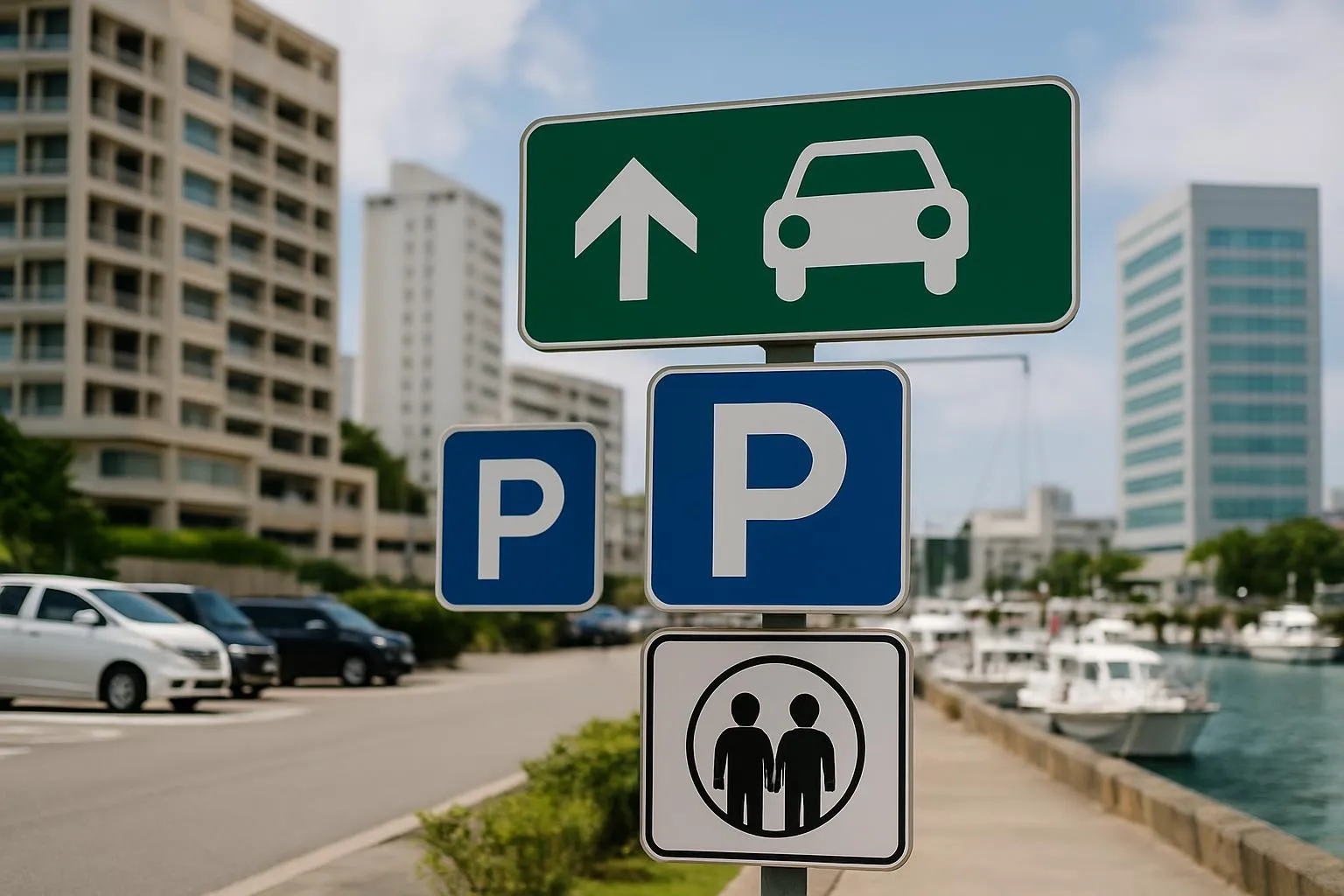
To enjoy parasailing on Okinawa's main island to the fullest, it is important to know in advance how to get to the meeting point and the parking information. In the high season in particular, parking lots tend to get crowded, so you need to allow plenty of time. Here, we explain clearly how to get to the meeting points in each of the main areas, “Naha,” “Onna Village” and “Chatan,” along with detailed parking information.
Meeting points around Naha Miegusuku Port
Most parasailing tours in the Naha area depart from “Miegusuku Port,” located in western Naha City. Access from Naha Airport and Kokusai Street is good, and it is appealing because it is easy to stop by even on the day you arrive in Okinawa or your last day.
Access by car and travel time
If you are going by rental car, from Naha Airport you can avoid traffic jams and get there smoothly by using the “Naha Umisora Tunnel.” The travel time is about 10 to 15 minutes. From around Kokusai Street, you can arrive in about 15 minutes via Route 58. When setting your car navigation, it is easiest to use “Miegusuku Port” or the adjacent “Naha Beachside Hotel” as the destination.
Access by public transportation
Local buses are also available, but few go directly to the port and you have to walk from the nearest bus stop, so if you have a lot of luggage, taking a taxi is convenient. As a guideline, the taxi fare is about 1,500 to 2,000 yen from Naha Airport and about 1,000 to 1,500 yen from Kokusai Street.
Parking information for Miegusuku Port
Miegusuku Port has a spacious paid parking lot where you can park before boarding. However, it may fill up in busy periods such as summer vacation and Golden Week, so we strongly recommend arriving 30 minutes before the departure time.
| Item | Details |
|---|---|
| Name | Miegusuku Port parking lot |
| Fee | 200 yen for the first hour, then 100 yen added for each hour after that, with a maximum of 500 yen per 24 hours |
| Payment method | Cash |
| Hours | 24 hours |
| Notes | There are parking spaces inside the port reserved for contract holders (yellow lines), so be sure to park in a general-use space with white lines. |
Ports and parking along Prefectural Route 58 in Onna Village
In Onna Village, a beautiful resort area on the west coast, there is no single large port; it is common for tours to depart from the ports or beaches designated by each operating shop. “Maekane Fishing Port” and “Seragaki Fishing Port” are often used. Be sure to check the meeting place information the shop sends you after your booking is complete.
Access from the main interchanges
The Okinawa Expressway is convenient for getting to Onna Village. Coming from the Naha direction, exit at “Ishikawa IC,” and from the Nago direction, at “Yaka IC,” and head for Route 58. Many meeting places are located along Route 58, or a little way off it. From Ishikawa IC, you can reach the main ports in about 5 to 15 minutes.
Parking and notes for each port
Many parasailing shops provide free parking for participants. However, parking space is often limited, so it is reassuring to check at the time of booking whether parking is available, where it is, and what to do if it is full. In particular, the area around Maekane Fishing Port is the meeting place for several shops, so it is important to stick to the parking space you are assigned.
| Example port | Parking features |
|---|---|
| Maekane Fishing Port | Use the free parking space designated by the shop, or the general parking lot inside the fishing port. The location differs by shop, so you need to follow the instructions. |
| Seragaki Fishing Port | There is often free parking prepared by the shop nearby. Checking the location in advance is a must. |
Chatan Uminchu Wharf and nearby parking
In the Chatan area, which is next to American Village and offers exotic scenery, “Chatan Town Fisharina (Uminchu Wharf)” is the main meeting point. The convenient location, where you can enjoy shopping and dining before and after your activity, is popular.
Access by car and landmarks
From the Naha direction, head north on Route 58 and you will arrive in about 40 minutes. The large Ferris wheel you can see on your left is the landmark for American Village. Turn left at the “Ihei” intersection and head toward the sea to reach the Fisharina.
Parking inside Uminchu Wharf
Uminchu Wharf has several public parking lots. They used to be free but are now paid. However, the first 2 hours are free, so in many cases you will not be charged if you stay within the time parasailing takes.
Nearby public parking lots
Weekends and sunset hours in particular are expected to be crowded, so allow plenty of time. If the Fisharina parking lots happen to be full, you can also use the free public parking lots around American Village.
| Item | Details |
|---|---|
| Name | Chatan Fisharina public parking lots (Nos. 1 to 3) |
| Fee | First 120 minutes free, then 100 yen per 60 minutes, with a maximum of 400 yen per 24 hours |
| Payment method | Cash, credit cards, electronic money |
| Hours | 24 hours |
| Notes | It gets very crowded during events and the like, so also consider using public transportation. |
Okinawa main island activities to enjoy together with parasailing
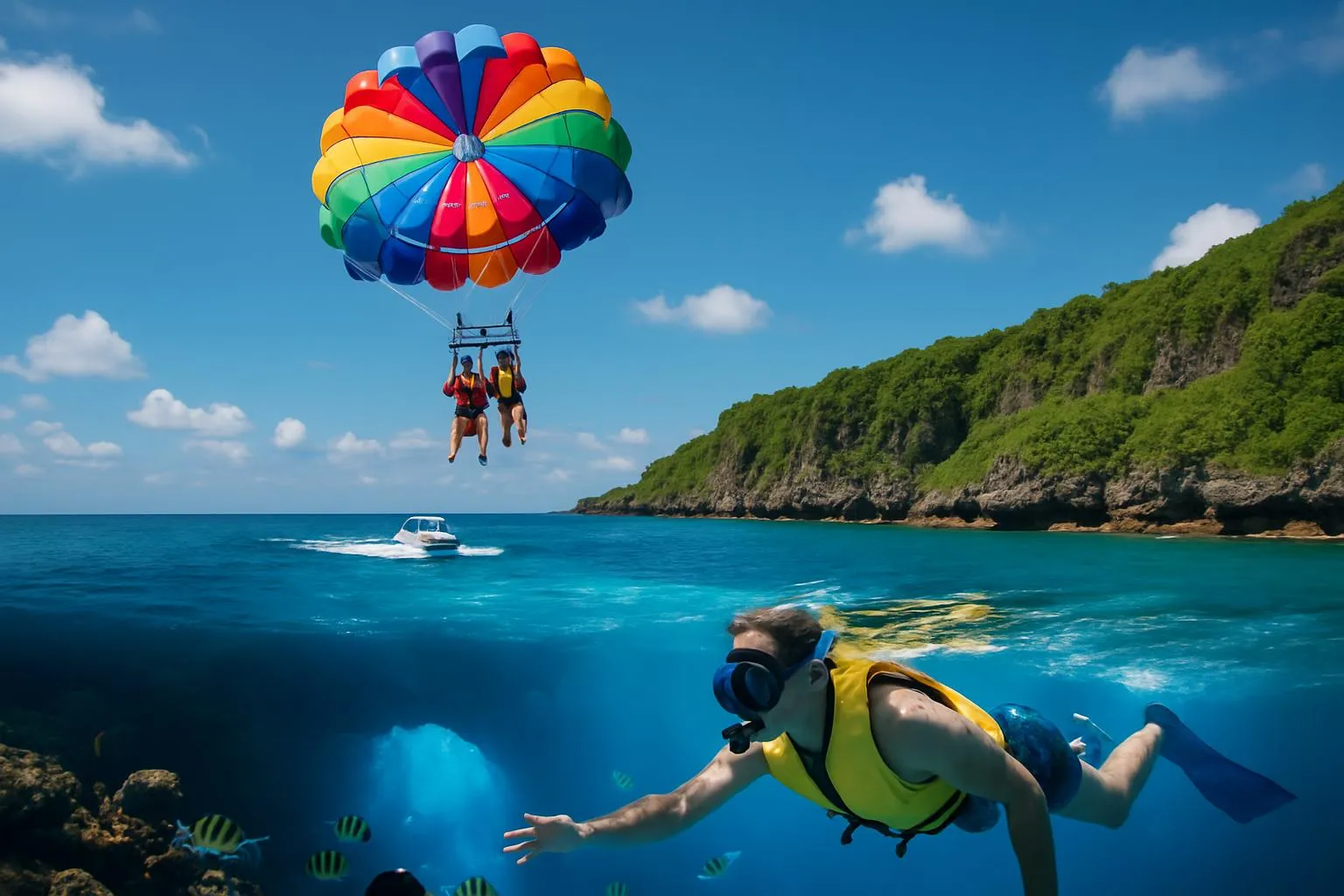
Parasailing is a wonderful activity that lets you fully enjoy Okinawa's stunning scenery from the sky, but it is relatively compact, taking about 1 to 1.5 hours. That is why combining it with other activities and sightseeing can make your day in Okinawa even more fulfilling. Here, we introduce recommended plans to enjoy together with parasailing, by area.
Combining snorkeling and the Blue Cave
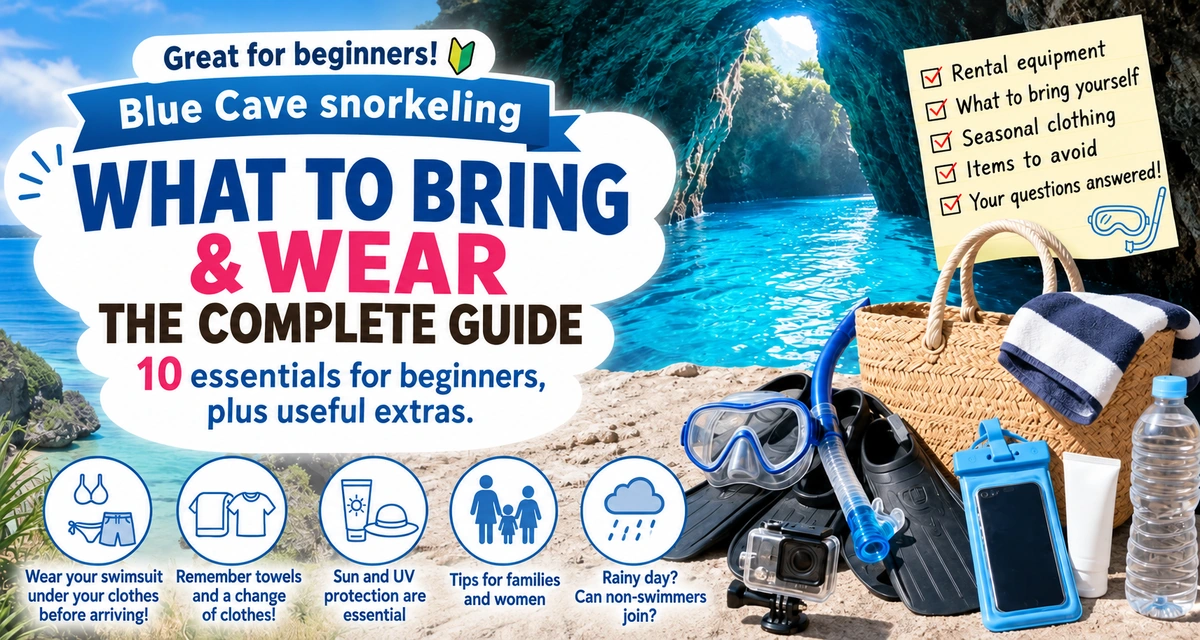
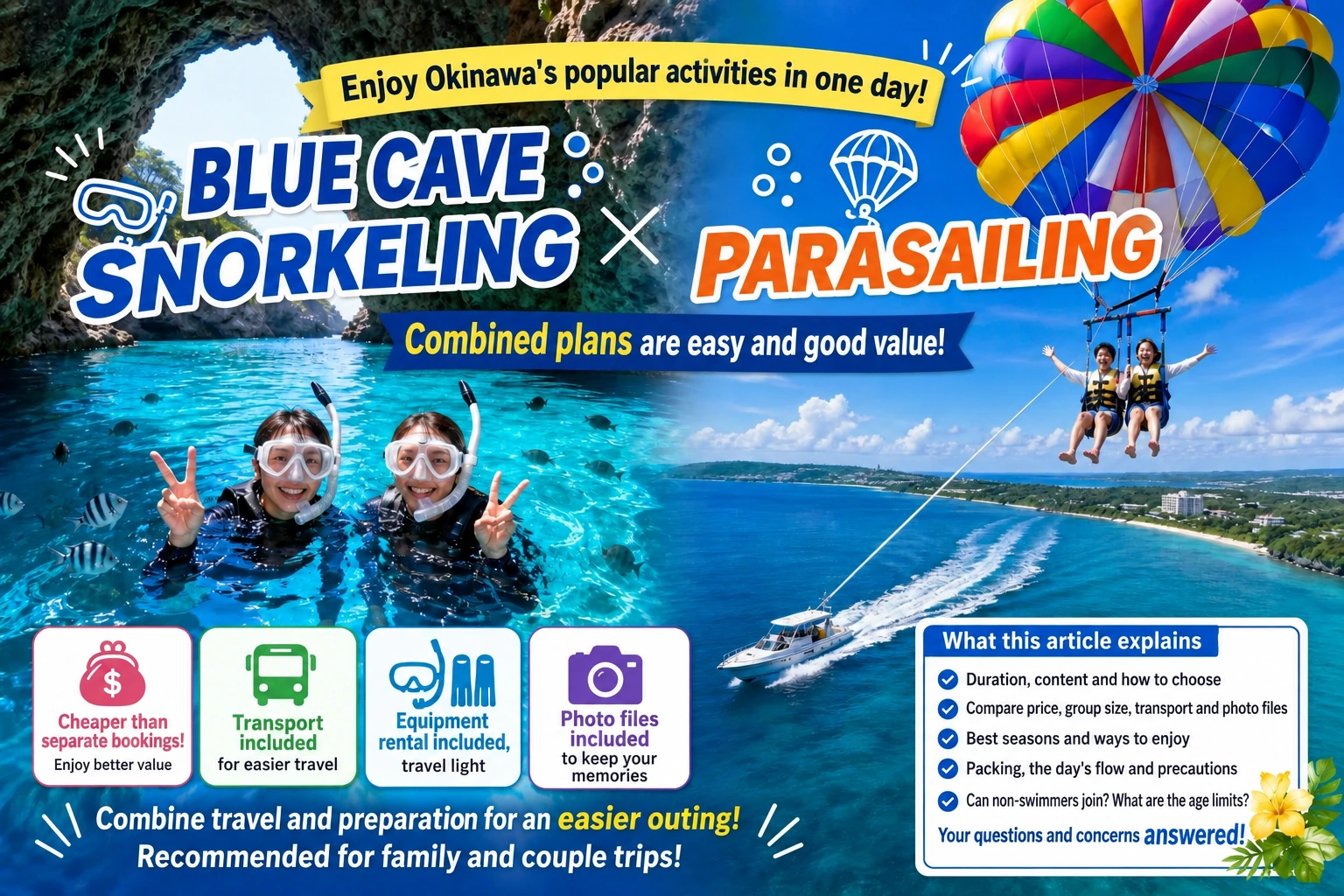
To fully enjoy Okinawa's sea, the classic combination is parasailing, for the stunning views from the sky, and snorkeling, for the mysterious world beneath the sea. In particular, if you try parasailing in the Onna Village area, a combo plan with snorkeling in the “Blue Cave,” where you are surrounded by a mysterious blue light, is very popular.
Many tour companies offer combo plans, which not only come at better prices than booking separately but also make getting between meeting points smoother. After feeling the vastness of Okinawa's sea through parasailing, getting up close to colorful tropical fish and coral reefs while snorkeling lets you experience the appeal of Okinawa's sea in three dimensions.
Parasailing in the morning, Blue Cave snorkeling in the afternoon
This model schedule is recommended for people who want to make good use of their time. You get an exhilarating feeling from parasailing in the morning, then after lunch you are soothed by the dreamlike world of the Blue Cave in the afternoon, making for a highly satisfying day. Around Onna Village, there are many shops that run both parasailing and Blue Cave tours, so getting between tours is smooth.
Discount plans with jet skis and banana boats
For people who want to enjoy marine sports more actively, not just an elegant walk in the sky, we recommend combo plans with thrilling activities such as jet skis and banana boats. By using an “all-you-can-play plan” that bundles parasailing with several marine sports, or a discount plan, you can play in Okinawa's sea all day long.
These plans are especially popular with groups of friends and families, and part of their appeal is that you can try various kinds of towed tubes, such as banana boats, marbles and U-tubes.
How to choose a combo plan and price guidelines
The price of a combo plan differs depending on the type and number of activities combined. Choose the best plan for your own stamina and time. Below are general guidelines for combo plan prices and durations.
| Plan | Price guideline (per person) | Duration |
|---|---|---|
| Parasailing + banana boat | 8,000 to 12,000 yen | About 1.5 to 2 hours |
| Parasailing + jet ski experience | 10,000 to 15,000 yen | About 2 hours |
| Parasailing + 3 marine sports | 12,000 to 18,000 yen | About 3 hours |
Note: Prices and durations vary by tour company and season, so be sure to check when you book.
Sample sightseeing courses around Senaga Island, Shuri Castle and more
Okinawa's appeal is not only the sea. After enjoying parasailing, we also recommend touring sightseeing spots where you can experience Okinawa's culture and history. By combining it with sightseeing spots that have distinctive features in each area where parasailing is offered, your travel memories become even deeper.
Parasailing from Naha and sightseeing in the south
Parasailing departing from a port in Naha City is appealing because of its easy access from the airport and the way you can make good use of the time before and after your flight. A classic course is to look out over the Kerama sea while parasailing in the morning, then in the afternoon touch the history of the Ryukyu Kingdom at the World Heritage site “Shuri Castle Park,” or enjoy shopping and souvenir hunting on “Kokusai Street.” In the evening, enjoying a sunset dinner at “Senagajima Umikaji Terrace” near the airport while watching planes take off and land is also a recommended way to spend the day you arrive in Okinawa or your last day.
Parasailing from Onna Village and sightseeing in the central and northern areas
After parasailing in Onna Village, the center of the west coast resort area, we recommend visiting the scenic spots in the central part of Okinawa's main island. The sheer cliff scenic spot “Manzamo” and the theme park “Ryukyu Village,” where you can experience Ryukyuan culture, are nearby. Also, if you go a little farther, you can reach popular sightseeing spots in the north such as the Okinawa Churaumi Aquarium and Kouri Island. It is the ideal course for people who want to enjoy both Okinawa's nature and culture while staying at a resort hotel.
Parasailing from Chatan and an American culture experience
Parasailing in the exotic Chatan area lets you take in the colorful townscape around American Village from the sky all at once. After parasailing, a stylish way to spend the day is popular: enjoying dining and shopping at “Mihama American Village,” then strolling “Sunset Beach” at sunset time. It is the perfect area if you, as a couple or with friends, want to spend a day full of resort feeling.
Tips for photography and photogenic spots
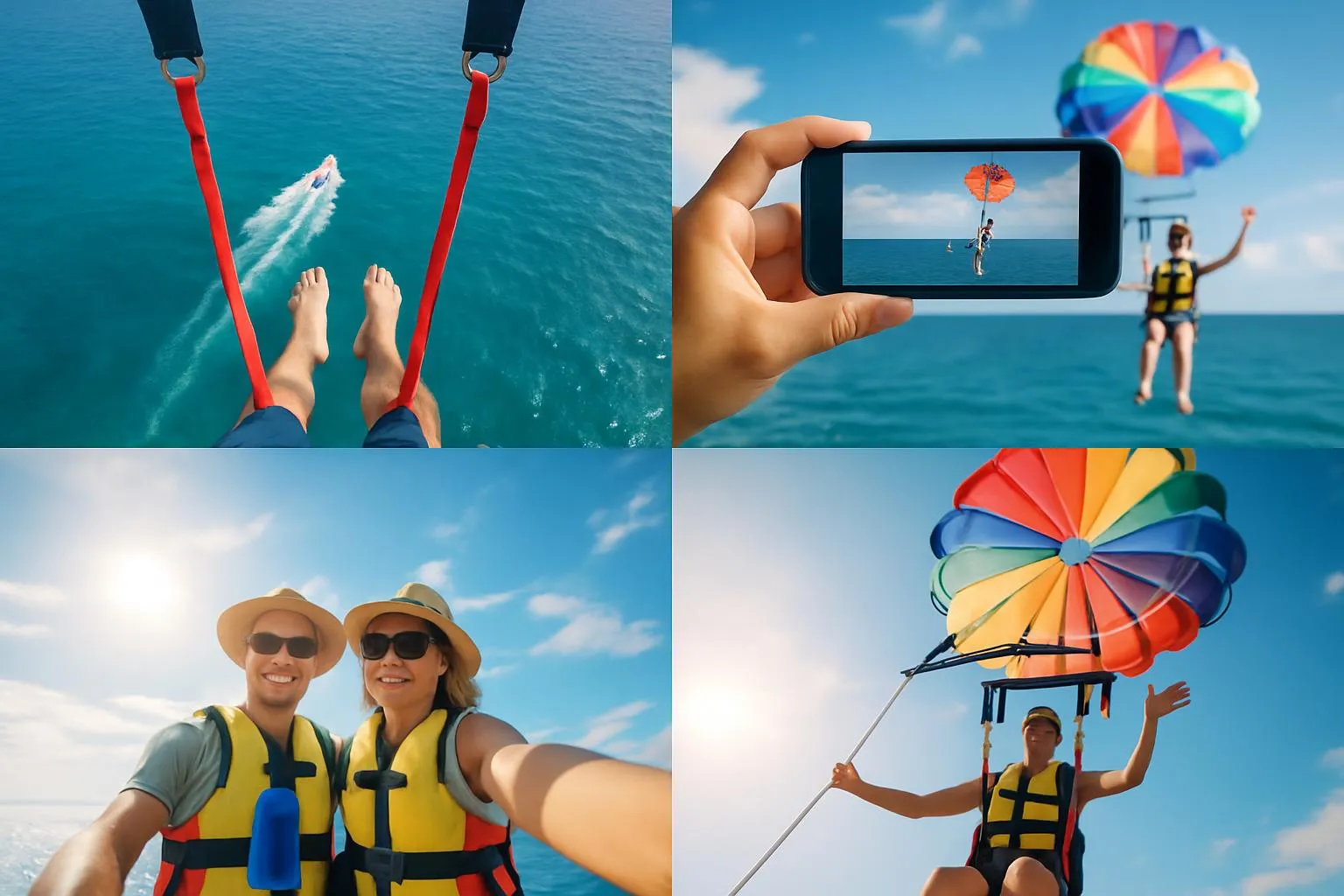
The stunning view from the sky that you experience while parasailing in Okinawa is something special that stays with you for a lifetime. We explain in detail, from a professional's perspective, the photography tips for capturing that emotion more vividly and beautifully in photos and videos, and the points that make your shots look great. With a little ingenuity, your photos can be reborn as works of art.
Aerial-style composition and dealing with backlight
Shooting in the sky is difficult in different ways from shooting on the ground, but if you get the key points down, even beginners can take professional-looking photos. Controlling composition and light is especially important.
Recommended compositions for a dynamic look
Try to be aware of compositions that make use of the height unique to parasailing. Using the wide-angle mode of your smartphone or GoPro will give you even more dynamic photos.
- Shoot the sea and boat directly below: This is the classic composition for taking “aerial-style” photos that look as if they were shot with a drone. The key is to get your own feet, the advancing boat and the beautiful emerald green sea in the frame.
- A composition built around the horizon: If you line up the horizon, the boundary between Okinawa's blue sky and sea, in the middle of the frame or on the lower 1/3 line of the rule of thirds, you get a beautiful, stable landscape photo.
- Photograph the participants together with the view: Capture the happy expressions of the friends and family flying with you together with the stunning view spreading out behind them. Selfies are fine, but if you photograph each other, you can capture a more natural and cheerful atmosphere.
Shooting techniques that turn backlight to your advantage
If the sun is behind your subject, people tend to come out dark because of “backlight,” but you can deal with it using a few techniques.
- Check where the sun is: The basic approach is to check which direction the sun is in before shooting and find an angle where the light falls on the face, either “front light” or “side light.”
- Use exposure compensation: By adjusting the exposure compensation in your smartphone's camera function (often shown with a sun icon) to plus, you can brighten people who have gone dark in backlight.
- Use HDR mode: Shooting with HDR (high dynamic range) mode turned on captures both the bright and dark areas nicely. It is especially useful when you want both the blue of the sky and the expressions on people's faces.
Choosing clothing colors and accessories that look great in photos
The color of your clothing has a big influence on the overall impression of a photo. By choosing colors that stand out against Okinawa's scenery, you will stand out even more as the star of the shot.
In parasailing, spray can hit you while the boat is moving, so clothes that can get wet are the basic choice. Beyond that, enjoy choosing colors with photos in mind.
| Recommended colors that look great in photos | Reason and effect |
|---|---|
| Vivid colors such as white, yellow, pink and red | They contrast clearly with Okinawa's blue sky and sea, making people stand out. The whole photo looks bright and lively. |
| Pastel colors | Recommended when you want soft, gentle-looking photos. The pale shades match Okinawa's soft light. |
| Colors you may want to avoid | Reason |
|---|---|
| Similar shades such as blue, navy and light blue | They can blend into the colors of the sky and sea, making people harder to spot. |
| Dark colors such as black and dark green | The whole photo can feel heavy, and the open, tropical atmosphere may be harder to convey. |
Accessories make the difference! Items that look great in photos
Adding accessories, not just clothing, makes your photos even more original.
- Sunglasses: They are great not only as sun protection but also as a fashion item. With mirrored-lens sunglasses, the sky and sea reflect in the lenses, and you may get unique photos.
- Hat: Choose a hat with a chin strap so it won't blow away in the wind. A straw hat and the like instantly boosts the resort feel. However, you may be told to take it off during takeoff and landing and during the flight for safety.
- Waterproof smartphone case: A waterproof smartphone case with a strap you can hang around your neck helps prevent drops while shooting. Check in advance whether you can operate the phone through the case.
Drone precautions and flight rules
Some people may want to capture dynamic footage from above with a drone, but individual drone filming during parasailing comes with strict regulations and dangers.
About using drones during tours
To put it plainly, flying a drone you brought yourself during a parasailing tour is prohibited by almost all operators for safety management reasons. This is because there is a very high risk of it hitting the boat, participants or the parasailing rope, which could lead to a serious accident. Some operators may offer plans that include drone filming, so check in advance if you want it.
General rules for flying drones on Okinawa's main island
Even if you want to film Okinawa's stunning scenery with a drone separately from parasailing, you must follow rules such as the Civil Aeronautics Act and the Act on the Prohibition of Flights by Small Unmanned Aircraft. In particular, in the following airspaces, as a rule you cannot fly a drone (100 g or more) without the permission and approval of the Minister of Land, Infrastructure, Transport and Tourism.
- Airspace around airports and similar facilities
- Airspace at a height of 150 m or more above the ground or water surface
- Around important national facilities (such as defense-related facilities)
- Above Densely Inhabited Districts (DID)
These rules are updated frequently, so it is essential to check the latest information on the Ministry of Land, Infrastructure, Transport and Tourism's website or related apps before flying.
Ways to enjoy each time of year and the best season
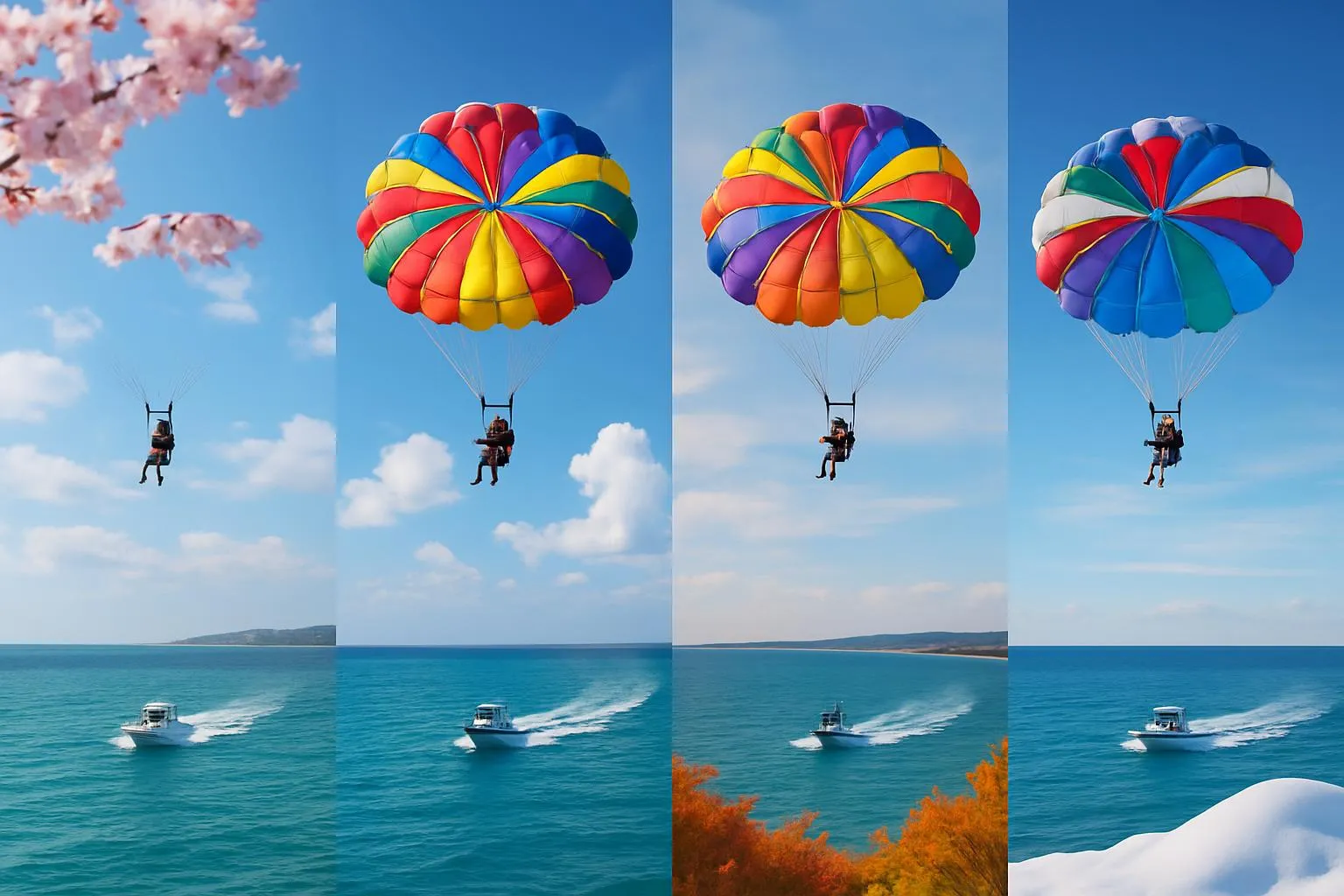
Parasailing on Okinawa's main island is not an activity in which you go directly into the sea, so you can basically enjoy it all year round. However, the scenery you see, how the temperature feels and the sea conditions differ greatly by season. Understand the appeal and cautions of each season and find the best season for you.
Sea conditions and best times in spring, summer, fall and winter
Okinawa's climate in each season greatly affects the parasailing experience. Not only air and water temperature but also wind stability and sea clarity change with the season. Compare the features of each season in the table below and use it as a reference for your travel plans.
| Season | Approximate period | Features and how to enjoy it |
|---|---|---|
| Spring | March to May | The most comfortable season of the year, called “Urizun.” The weather is stable, and because it is before the peak summer season, you can avoid crowds relatively well. The sun is not as strong as in midsummer, and you can enjoy a comfortable walk in the sky. In April, the swimming season opens at most beaches and all of Okinawa starts to come alive. However, the rainy season may begin around mid-May, so checking the weather forecast is important. |
| Summer | June to August | When the rainy season ends, full-fledged summer arrives. This is the time when the contrast between the blue sky and the sea shining emerald green is most beautiful, and you can enjoy truly Okinawan scenery. There are many days with stable wind, which makes for ideal conditions for parasailing. Taking part in a swimsuit feels great, and you can enjoy the sense of freedom unique to summer. However, the sun is very strong, so sunburn and heatstroke prevention are a must. It is also typhoon season, so caution is needed. |
| Fall | September to November | The harsh heat of summer eases and the weather becomes comfortable again. Although the risk of typhoons remains, it is a hidden-gem season with many ideal parasailing days when the wind is calm on sunny days. There are fewer tourists than in summer, so it is recommended for people who want to enjoy it at a relaxed pace. Even in October, the sea temperature is still high, making it suitable for combining with other marine sports. |
| Winter | December to February | Because the air is clear, you get the appeal of crisp views that reach all the way to distant islands. Another feature is that the sea is clearer than in summer. The north wind makes it feel cold, but with cold-weather gear you can enjoy it without problems. As a pleasure unique to this time of year, if you are lucky, you may spot a humpback whale from above. |
As for the best time to fly, the morning, when the wind is generally calm, is recommended. In summer especially, a southerly wind called “Kachibai” may strengthen in the afternoon, so early time slots are the ones to aim for. On the other hand, in places such as the Chatan area on the west coast, evening sunset departures are also popular.
Typhoon season risk management and alternatives
What people worry about most on an Okinawa trip is typhoons. July to October in particular is the season when typhoons approach most often. Parasailing is directly affected by wind and waves, so safety comes first, and it is canceled if the standards are exceeded.
Booking and things to check when a typhoon is approaching
Typhoon path forecasts change daily, so operators also judge carefully until the last minute whether to go ahead. In many cases, the decision to cancel comes the day before or on the morning of the day. When you book, be sure to check the cancellation policy. At most shops, no cancellation fee is charged when canceled due to weather, but if you cancel for your own reasons, the set fee applies, so be careful.
Alternative plans when parasailing is canceled
Even if parasailing is canceled, Okinawa has plenty of attractive sightseeing spots. If you think of alternatives in advance, you can switch your plans smoothly and still enjoy your trip.
- Churaumi Aquarium: A classic popular spot that is not affected by the weather. The impressive whale sharks are a must-see.
- DMM Kariyushi Aquarium: Close to Naha Airport, this new entertainment aquarium is appealing for its latest visual expression and spatial design.
- Cultural experiences: You can touch Okinawa's traditional culture through Ryukyu glass making, coloring shisa, bingata dyeing experiences and more.
- Shopping: Enjoying dining and souvenir hunting at Kokusai Street, Outlet Mall Ashibinaa and large shopping complexes is also a good idea.
Sunburn protection and heatstroke prevention
Okinawa's ultraviolet rays are very strong compared with mainland Japan, and especially on the sea there is reflection off the water surface, so precautions are a must in any season. If you let your guard down, you can get a bad sunburn in a short time, so prepare thoroughly.
Essential sunburn protection gear
There is almost nothing to block the sun on a boat. Prepare the following items to protect your skin from UV rays.
- Sunscreen: We recommend the highest-level waterproof type, such as SPF50+, PA++++. It comes off easily with sweat and water, so reapply often.
- A rash guard or something to throw on: A long-sleeved rash guard is very useful for preventing sunburn and the drop in body temperature caused by sudden weather changes.
- Hat: One with a chin strap is best so it won't blow away in the wind.
- Sunglasses: To protect your eyes from UV rays as well, prepare a pair with UV-blocking function.
Heatstroke prevention to watch for on the boat
To avoid feeling unwell in the middle of a fun activity, you also need to be careful about heatstroke. In summer especially, the temperature and humidity are high, and you are using up your stamina without realizing it.
The most important thing is to hydrate often. Make a point of drinking water, tea, sports drinks and the like regularly, before you feel thirsty. Also, drinking heavily the day before or not getting enough sleep raises the risk of seasickness and heatstroke. Take part in top physical condition.
Real price comparisons and sample budgets
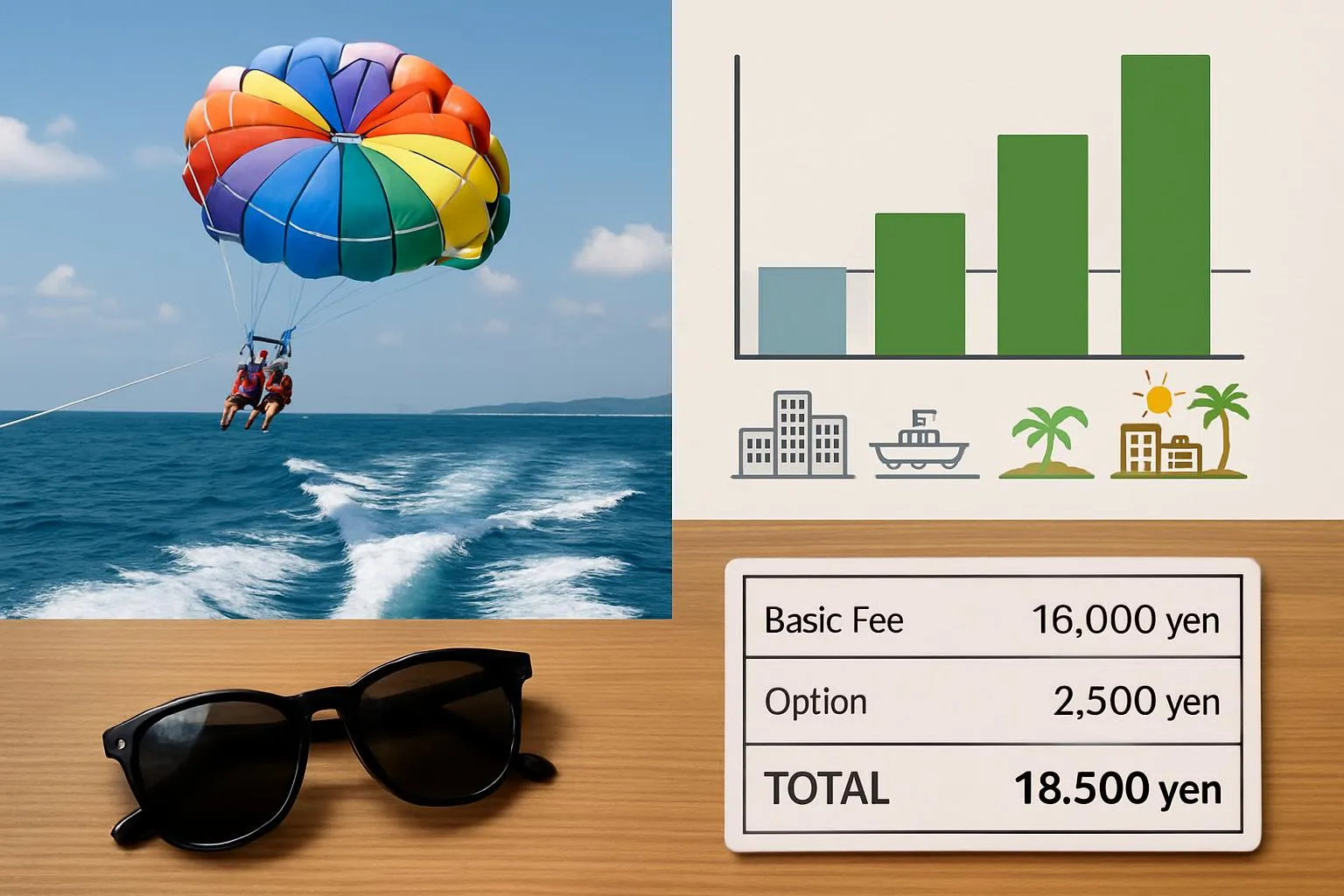
When planning a parasailing experience on Okinawa's main island, the price is what people worry about most. Prices vary greatly depending on the area, plan details and options. Here, we compare specific price ranges by area and suggest sample budgets to match your travel style. To choose a plan you won't regret, get a good grasp of the cost breakdown and the value for money.
Reference price range from Naha and what is included
The Naha area is known for its easy access from Naha Airport and its wide choice of plans you can easily join between sightseeing stops. The price range is about 7,000 to 9,000 yen per person, which is a standard range even compared with other areas on Okinawa's main island. Many plans include the basic equipment rental fee and insurance, but it is important to check the breakdown before you book.
It is an especially recommended area if you want to make good use of your time and enjoy an activity on the first or last day of your trip. Because it is easy to join, it is also very popular, so booking early is wise, especially on weekends and in the tourist season.
| Item | Details | Price guideline |
|---|---|---|
| Base price | Boarding fee, parasailing experience fee, life jacket rental | About 7,000 to 9,000 yen |
| Insurance | Accident insurance, etc. | Often included in the base price |
| Extra options | Rope extension (such as 200 m), photo and video service | About 1,500 to 3,000 yen |
| Other | Port facility fee, parking fee | May be required separately (from about 300 yen) |
Sample budget: a couple enjoying parasailing from Naha
- Base price: 8,000 yen x 2 people = 16,000 yen
- Option (commemorative photo data): 2,500 yen
- Estimated total budget: about 18,500 yen
Price differences and options in Onna Village and Chatan
The Onna Village and Chatan areas on the west coast are appealing for their beautiful sunsets and views of groups of resort hotels. Thanks to their great locations, prices are set slightly higher than in the Naha area, with a range of about 8,000 to 10,000 yen per person. In Onna Village in particular, there are plenty of plans bundled with snorkeling or diving at the popular “Blue Cave,” and in many cases booking them together works out cheaper.
Also, the “rope extension” option, which lets you enjoy stunning views from a higher altitude, is popular in these areas. By extending the usual rope of around 100 m to 200 m, you can have a special experience with nothing blocking your view, truly as if you had become a bird. The going rate for this option is about 1,500 to 2,500 yen per person.
| Option | Details | Extra price guideline |
|---|---|---|
| Rope extension | Extend the usual 100 m to 120 m to 200 m or the like, for a higher altitude. | About 1,500 to 2,500 yen |
| GoPro rental | Rent an action camera and film your own video during the flight. | About 2,000 to 3,500 yen |
| Photo data | Purchase of high-quality photo and video data shot by the staff. | About 2,000 to 3,000 yen |
Value for money of plans with photo data
There are mainly two ways to record the stunning views during parasailing: “shoot them yourself” or “use a photo service.” Some shops allow you to bring a smartphone or GoPro, but considering the risk of dropping it and the chance that you can't get satisfying photos because of shaking during the flight, a plan with professionally shot data is a very cost-effective choice.
The price of a plan with photography is about 2,000 to 3,000 yen on top of the base price. The staff shoot from the boat at the best timing and angles, so you can be sure to get photos that you couldn't take yourselves, showing off the contrast between the parachute and the beautiful sea. A photo with the whole family or group in it in particular makes a wonderful keepsake of your trip. Considering the trouble and cost of preparing an expensive waterproof camera yourself and, above all, the advantage of being able to focus on the activity without being distracted by shooting, it is by no means a high investment.
Summary
Parasailing on Okinawa's main island is a fantastic scenic activity that lets you look out over the emerald green sea and coral reefs from the sky. The greatest appeal is that even beginners and families with small children can easily enjoy a walk in the sky with thorough safety measures in place. In this article, from choosing an area to booking at the lowest price and preparing for the day, we have covered the information you need to enjoy parasailing on Okinawa's main island to the fullest.
As a conclusion on choosing an area, “Naha” is best if you value access from the airport, “Onna Village” if you want to enjoy the very clear sea you can only get in a resort area, and “Chatan” if you want a beautiful sunset as your backdrop. Each area has a different appeal, so choose the best place to match your travel plans and purpose.
To keep costs down, the smart approach is to use booking sites such as “Asoview” and “Jalan Activities,” where early-bird discounts and coupons are available. Prices change with the season, so once your travel plans are set, book early to enjoy it at a good price. On the day, don't forget clothes that can get wet and sunburn protection, and take part in top physical condition.
Use this article as a reference, prepare well, and make your parasailing experience on Okinawa's main island an unforgettable, wonderful memory.