
If you visit Okinawa, meeting tropical fish up close is an experience you will want to try at least once.
Okinawa's beautiful seas are home to plenty of tropical fish, and the otherworldly scenery will capture your heart.
Okinawa has many coral reefs and rocky areas that tropical fish love to live in, so your chances of meeting them are far higher.
In the beautiful underwater world, you can easily experience encounters with tropical fish.
In this article, we introduce beaches and other spots in Okinawa where you can meet tropical fish, as well as activities for meeting them, by difficulty level.
If you are interested in getting close to tropical fish in Okinawa, please use this as a reference.
Why is the sea in Okinawa so clear?
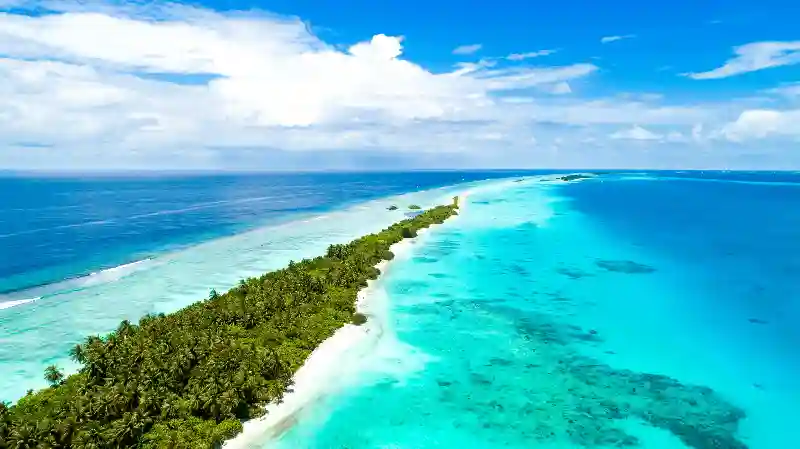
When people think of Okinawa, many picture its clear sea.
There are various reasons why the sea in Okinawa is so clear.
First, the Kuroshio Current, which is highly transparent, flows past where Okinawa is located.
This warm Kuroshio Current is low in nutrients and has little plankton, and because there is little mixed into it, its transparency is high.
The current also flows fast, so the seawater does not easily become cloudy and keeps its high transparency.
This shows that Okinawa's location itself affects the beauty of its sea.
Next, the marine life that lives in Okinawa is another reason the sea there stays so clean.
The parrotfish that lives in Okinawa feeds on algae growing on coral, but with its strong teeth it also crunches up the coral along with the algae.
The coral that it cannot fully digest is then excreted and becomes white sand.
Even a single parrotfish excretes a considerable amount of white sand, which builds up on the seabed and beaches of Okinawa and creates the beautiful white sand.
Sea cucumbers also eat organic matter on the sand together with the sand, and excrete fine sand.
In the course of digestion, they release "calcium carbonate," which is essential for coral skeletons.
It is also said that sea cucumber waste neutralizes the acidification of seawater, making the water a better place for coral to live.
The good match between sea cucumbers and coral creates an interaction that makes Okinawa's sea even more beautiful.
And above all, the many kinds of coral that grow in Okinawa's sea can be called the key players in making it beautiful.
Coral absorbs carbon dioxide in the sea and photosynthesizes, releasing minerals into the water along with oxygen.
This purifying action keeps the seawater beautiful.
The bodies of coral are made mainly of limestone, and after the coral dies, it creates the beautiful color of Okinawa's blue sea.
The limestone breaks down into white sand, which reflects the sunlight that reaches the seabed and creates an emerald green.
Because the seabed in Okinawa is shallow, sunlight is easily reflected, which is another factor that creates its beauty.
There are about 800 species of coral in the world, and about 200 species, or 25% of them, can be seen in Okinawa.
Coral is beautiful just to look at, and it is also an important presence that constantly carries out the purifying action that keeps Okinawa's sea beautiful.
Can you meet tropical fish anywhere in Okinawa?
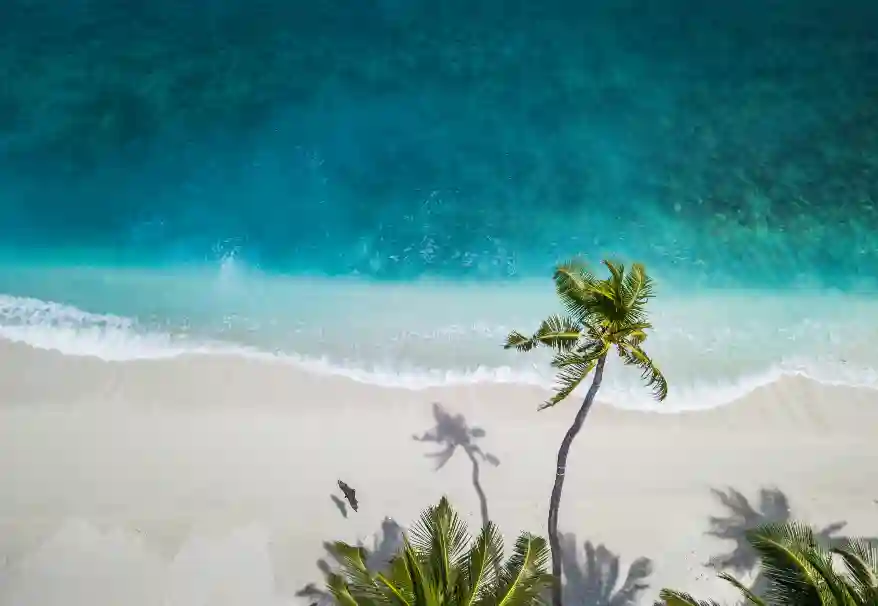
Okinawa is known for its beautiful sea. Surrounded by water, it has many beaches and swimming areas, but can you meet tropical fish at any beach in Okinawa?
The answer is that the places where you can meet them are limited.
Tropical fish live in areas with plenty of coral and rocky areas, and they rarely show themselves in areas without coral or rocks.
That is why you cannot see tropical fish at artificially made beaches such as those at hotels.
Please note that it does not mean tropical fish are found everywhere in Okinawa.
That said, the sea in Okinawa, home to more than 200 species of coral, is inhabited all year round by many colorful tropical fish such as damselfish, butterflyfish and clownfish.
If you want to see tropical fish, head to an area with coral or rocky areas where tropical fish live, or join a tour to go see them.
Where in Okinawa can you meet tropical fish?
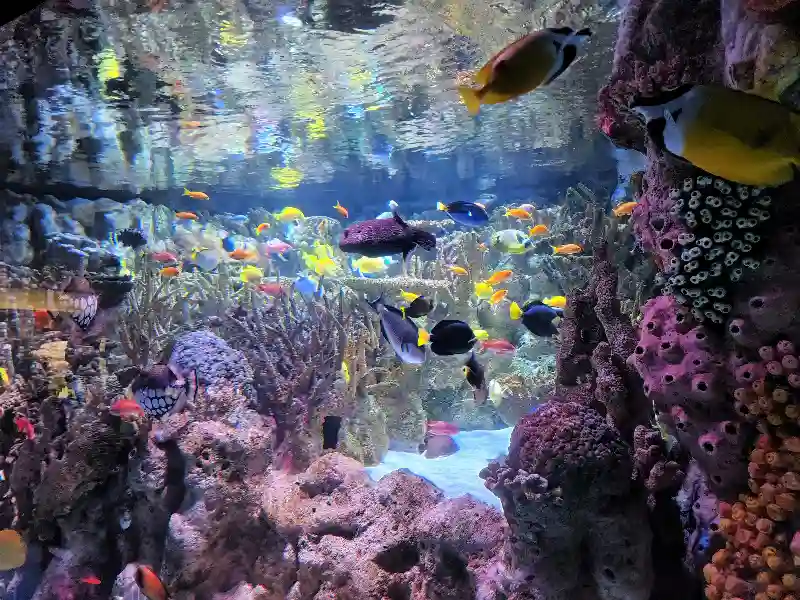
If you aim for beaches with coral and rocky areas where tropical fish can be seen, you will have more chances to meet tropical fish underwater.
We introduce beaches and other spots in Okinawa where you can meet tropical fish, by area.
Spot in Okinawa to meet tropical fish 1: Onna Village
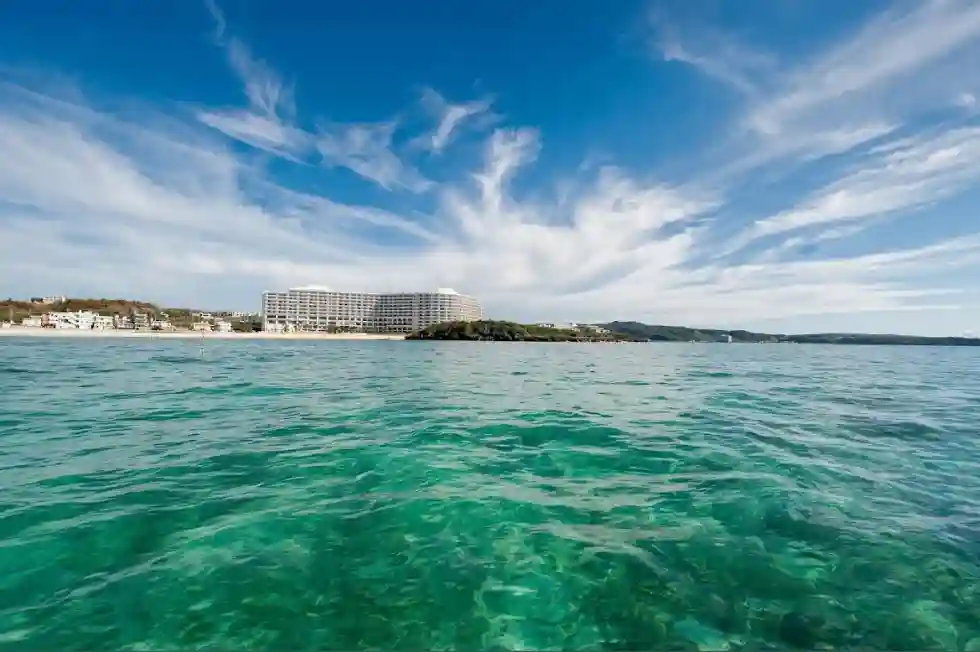
Onna Village is an area in the middle of the main island of Okinawa, facing the sea, and it is the largest coastal resort area on the main island.
It has famous, beautiful scenic spots such as Manzamo and Cape Maeda, and a wide range of marine activities.
In Onna Village, we recommend joining a snorkeling tour. Among the many tours, being able to visit the Blue Cave, with its beautiful, dreamlike light, is something unique to Onna Village.
The Blue Cave is a spot at the foot of the cliffs of Cape Maeda in Onna Village, and it is called that because the sea surface glows a mysterious blue as sunlight entering the cave is reflected.
In the Onna Village area, you can enjoy the beautiful sea just by strolling along the coast without getting in the water, but seeing the dreamlike underwater scenery and the tropical fish swimming there up close is a precious experience you can only have in Onna Village.
In addition to the Blue Cave, there are also many tours that take you to spots with plenty of tropical fish, so you can fully enjoy the beautiful sea of Onna Village.
The abundance of tours is another welcome point.
Onna Village is also an area with many hotels, making it an ideal place for a trip.
Being just a short trip from where you stay lowers the barrier to joining activities, and even beginners can easily get close to Okinawa's tropical fish.
The sea of Onna Village is sometimes described as a vivid cobalt blue.
Seeing tropical fish in the cobalt blue sea of Onna Village will be a mysterious and unforgettable memory.
Spot in Okinawa to meet tropical fish 2: Cape Bise
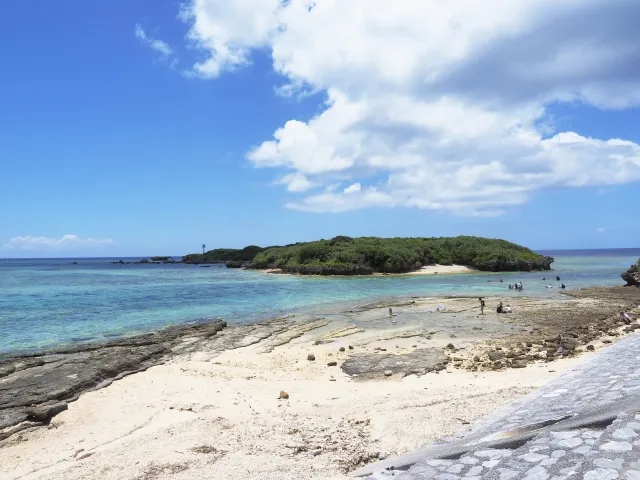
Cape Bise is a beach in a resort area around Motobu Town.
The surrounding area has many sightseeing spots, such as the Okinawa Churaumi Aquarium and the Bise Fukugi tree-lined road, where you can experience Okinawa's original landscape, and it is one of the easy areas to reach when visiting Okinawa for sightseeing or travel.
It is a beach with little sand, and most of it is rocky.
When you step onto the beach at Cape Bise, you notice tropical fish swimming right at your feet.
Being able to meet tropical fish right away, without going out into deep water, is unique to Cape Bise.
You can enjoy it plenty even without snorkeling, so it is easy to get close to tropical fish.
Especially at low tide, the water recedes and becomes shallow, so even children can swim easily, and it is recommended for families too.
The beach at Cape Bise is almost all rocky, so to prevent injuries, avoid going barefoot or in beach sandals and be sure to bring marine shoes or the like.
We also recommend covering your skin with a rash guard. Snorkeling gear can be rented on site, so you can visit empty-handed with peace of mind.
There are also warm-water shower facilities, so you can stay comfortable even after you finish playing in the sea.
Cape Bise is a shallow beach with little danger, but there are no lifeguards, so when you go with your family, we recommend keeping an eye on your children at all times and playing safely.
Spot in Okinawa to meet tropical fish 3: Oodomari Beach
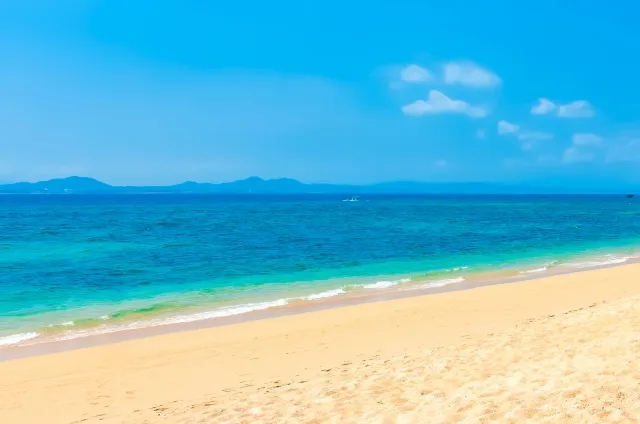
Oodomari Beach is on Ikei Island in east-central Okinawa, and it has been quietly gaining popularity as a beach where you can swim with tropical fish.
The blue of the sea, its vividness and its transparency are outstanding, and because marine sports such as jet skis are prohibited, many tropical fish swim here steadily.
The sand is beautiful and you can of course enjoy the lovely beach, and individual snorkeling is permitted, so its appeal is that if you simply prepare a snorkel and fins, you can enjoy snorkeling with the ease of reaching the area with tropical fish right away.
At Oodomari Beach, whether you are an advanced snorkeler or a beginner, you can easily get close to tropical fish once you are in the water.
Being able to enjoy it freely on your own is another point that lets you take it at a leisurely pace.
If you go out a little way, coral rock spreads out, and you can see tropical fish swimming within arm's reach.
Many tropical fish unique to Okinawa swim here, such as the scissortail sergeant, which is used to people, and the colorful Picasso triggerfish.
The waves are calm and lifeguards watch over the sea, so you can enjoy it safely.
At Oodomari Beach, with its pure white, silky sand and easy tropical fish watching, there is a beach house where you can take a break and still enjoy the sea.
You can also have a barbecue on the sand, so you can enjoy the sea all day long.
When you get tired from snorkeling, we recommend resting on the sand.
Spot in Okinawa to meet tropical fish 4: John Man Beach
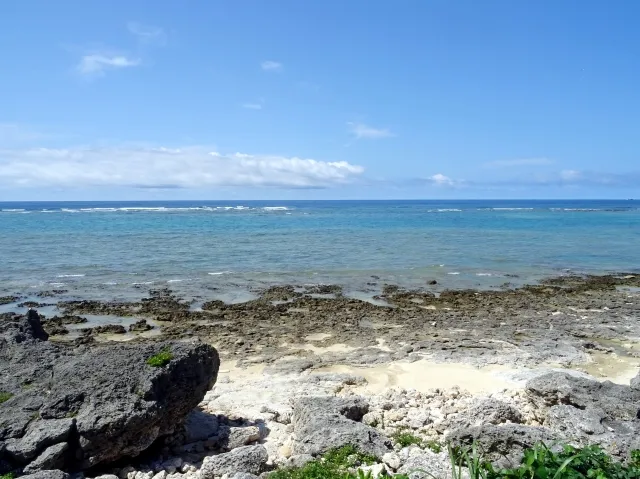
John Man Beach is located in southern Okinawa and is also called Odo Coast.
The sea is very calm and there are almost no waves, so it is a beach where you can play safely.
There is almost no sandy beach and many rocky areas, so you need to be prepared to prevent injuries with a rash guard, marine shoes and the like.
John Man Beach's appeal is that you can enjoy the coral reef safely. In addition to having almost no waves, it has many shallow areas and you can play leisurely, so even if you go with small children, you can relax.
If you go to the center, where the water is a little deeper, you can see many tropical fish, but there is plenty of coral in the shallow areas too, so you can also watch beautiful tropical fish right in front of you.
You can see up close the butterflyfish often found near coral reefs, damselfish such as the blue devil damselfish and the longfin damselfish, as well as tropical fish such as the Moorish idol and the bluestreak cleaner wrasse, a member of the surgeonfish family.
John Man Beach, where you can safely watch a variety of tropical fish, is one of the beaches ideal for snorkeling and playing in the shallows.
Tropical fish you can see in Okinawa
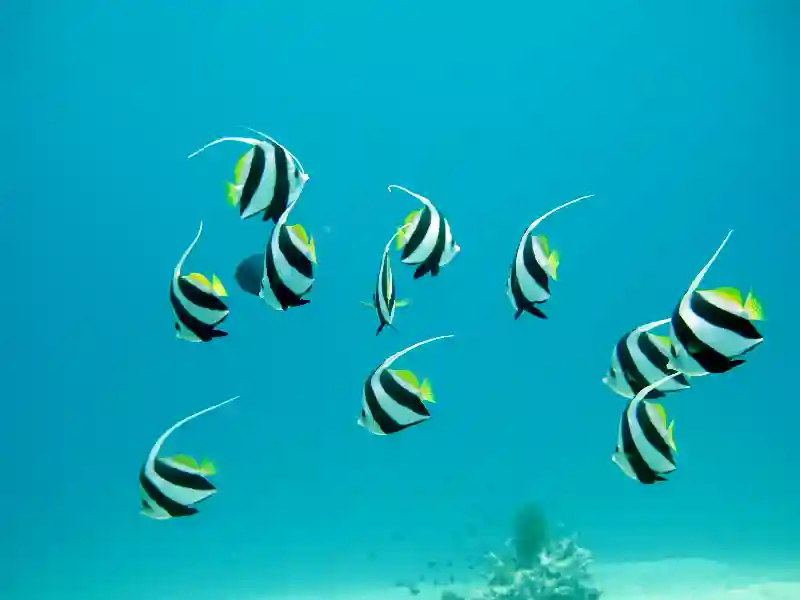
Blessed with abundant coral reefs, Okinawa's tropical fish swim freely.
What kinds of tropical fish live in Okinawa?
Here are some of the tropical fish you often see.
- Sunset wrasse
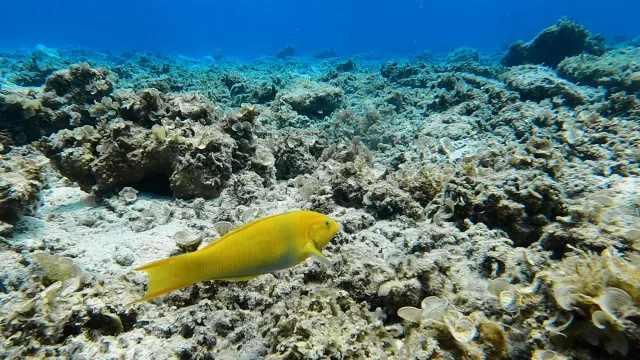
The sunset wrasse has a slender, vividly yellow body.
It is friendly, and when you are snorkeling it sometimes comes close to you.
It often lives in shallow coral reefs and is one of the tropical fish commonly seen in Okinawa.
Females are yellowish overall, but the male has an orange pattern on its head, blue pectoral fins, and a body color that fades from golden yellow to yellow behind the head, so you can also enjoy the difference in color between males and females.
- Scissortail sergeant
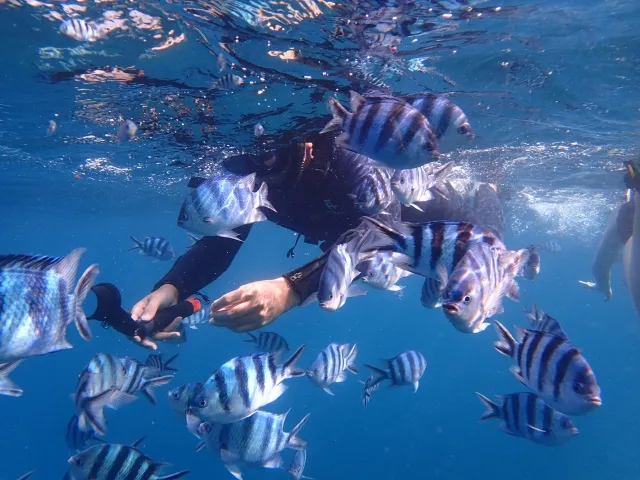
With a white body marked by 6 black vertical lines, the scissortail sergeant is one of the tropical fish most commonly seen in Okinawa.
Its black-and-white body stands out well against Okinawa's blue sea, and it is adorable when it approaches in a school.
In feeding experiences, you often see them gather, quite used to people.
- Blue devil damselfish
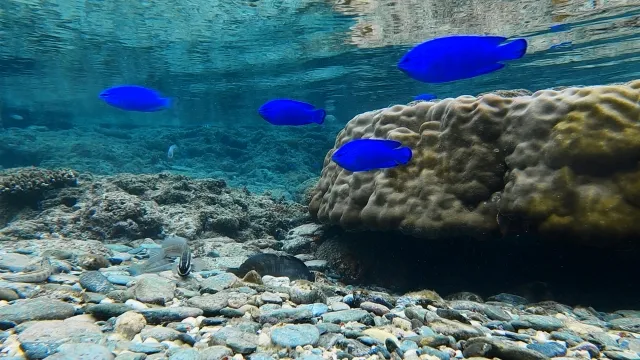
The blue devil damselfish is a small tropical fish that swims in schools in shallow areas. Its deep blue is vivid and eye-catching.
With its jewel-like beauty, it is a fish that gives you the satisfaction of having seen tropical fish.
Since they live in shallow water, depending on the beach you can even spot them without diving.
- Porcupinefish
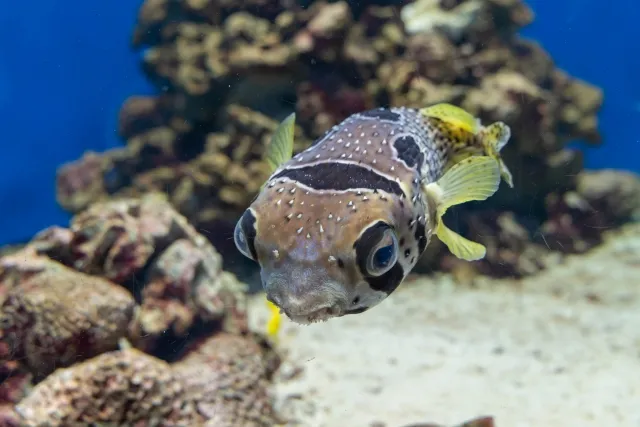
The porcupinefish, which swims along cutely and fluffily underwater, is also one of the tropical fish you can see in Okinawa's sea.
Sharp spines cover its whole body, and when it meets danger it puffs up its body and raises its spines so that it will not be swallowed by an enemy; this sight is said to be the origin of its Japanese name.
If you spot one, gently watch over it without disturbing it.
In Okinawa, the porcupinefish is also treated as a high-class fish and is sometimes used as an ingredient in soups and the like.
It is also sold at markets and is one of the well-known fish in Okinawa.
- Yellow boxfish
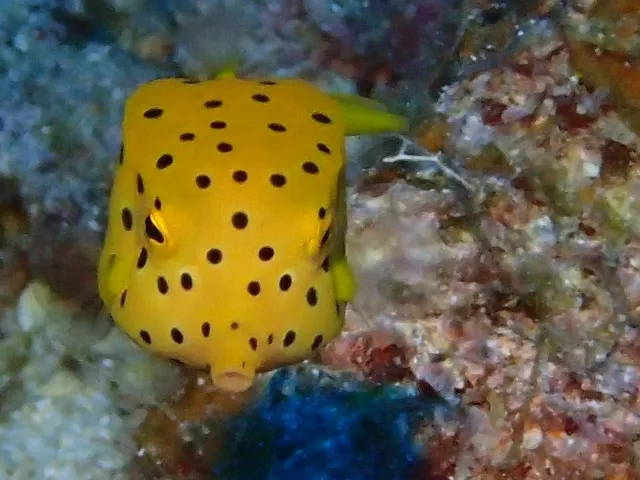
The yellow boxfish is a type of boxfish with a yellow body that looks scattered with small black polka dots.
Its expression, with a small pursed mouth, is endearing, and it is a tropical fish popular with divers.
The yellow body is only seen in juveniles, and as it grows it gradually turns whitish.
If you see a yellow boxfish underwater, you can tell it is a juvenile.
At only about 1 to 5cm in body length, it is quite small, so it is a tropical fish that is delightful to find if you are lucky.
Besides these, Okinawa lets you meet many kinds of tropical fish, from commonly seen ones to rare ones that you are lucky to see.
They are living creatures, so which tropical fish you meet depends on timing, but if you are lucky, you may meet a rare tropical fish in just one outing.
Being able to easily meet wild, colorful tropical fish is unique to Okinawa.
It can also be fun to look up the tropical fish you found yourself later, wondering whether it was a rare one.
5 activities for meeting tropical fish in Okinawa
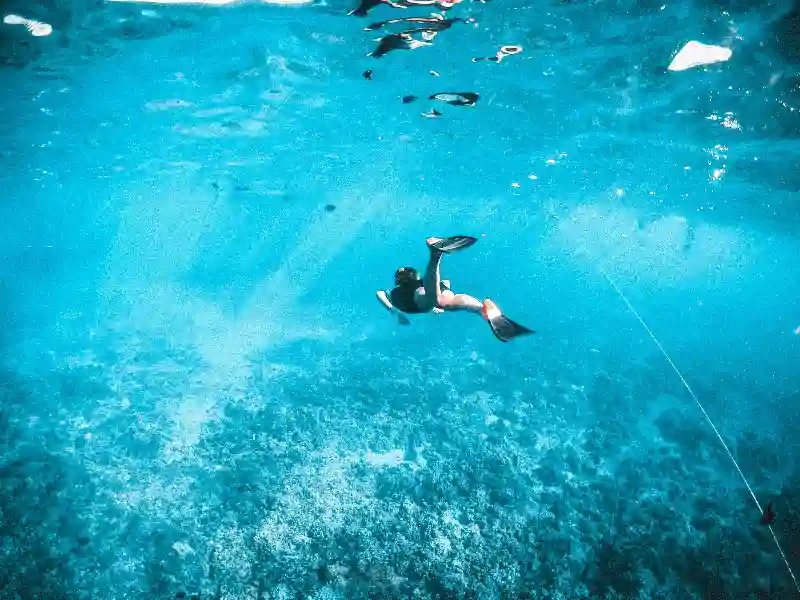
For those who want to see tropical fish in Okinawa, we recommend activities at spots where tropical fish live.
A tour guide takes you to spots with plenty of tropical fish, so your chances of meeting them go up dramatically.
Okinawa offers a variety of tours for getting close to tropical fish, and many of them are easy to try, so even if you are not confident in the water or are new to activities, you can join with peace of mind.
We introduce them by difficulty and level, so choose the one that suits your pace.
Sea walking [Difficulty level: Low]
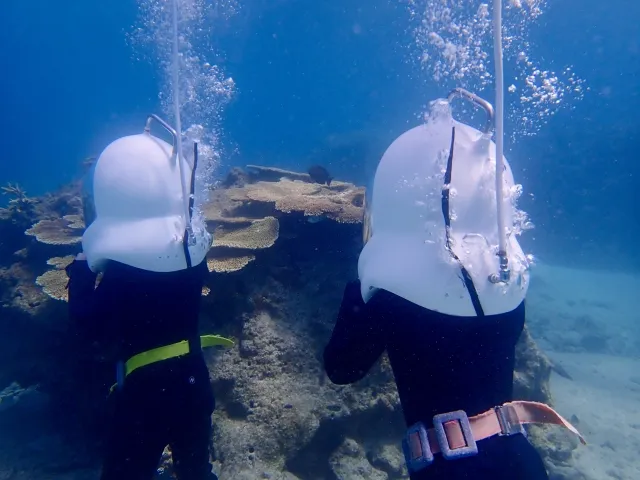
Sea walking is an activity in which you wear a helmet weighing about 30kg and stroll along the seabed, observing tropical fish and other fish and marine life.
No training or license is required. It is a popular activity because of how easy it is: you just wear a special helmet that supplies oxygen when you go underwater, put on weights and enter the sea.
Air flows into the helmet, so you can breathe easily just as you do on land while enjoying a stroll underwater.
No special training is needed, so everyone from children to older adults can easily stroll in the sea where tropical fish live.
Seawater does not get inside the fully waterproof helmet, so it is fine even if you are wearing makeup, glasses or contact lenses.
This hints at why it is popular with women who worry about their makeup smudging.
Even people who are afraid of water can enjoy the underwater stroll with peace of mind, because their faces do not get wet.
Sea walking is just walking on the seabed, so even people who cannot swim can feed the tropical fish underwater and enjoy getting close to them.
It is an activity we especially recommend to people who say "I can't swim" or "I'm not confident in the water."
Some tours also let you take photos underwater.
You do not wear goggles or a tank, so participants' faces show clearly, which is perfect if you want a photo of yourself with Okinawa's tropical fish.
If you can take a photo surrounded by tropical fish in Okinawa's beautiful underwater world, it will make a wonderful memory.
Glass-bottom boat [Difficulty level: Low]
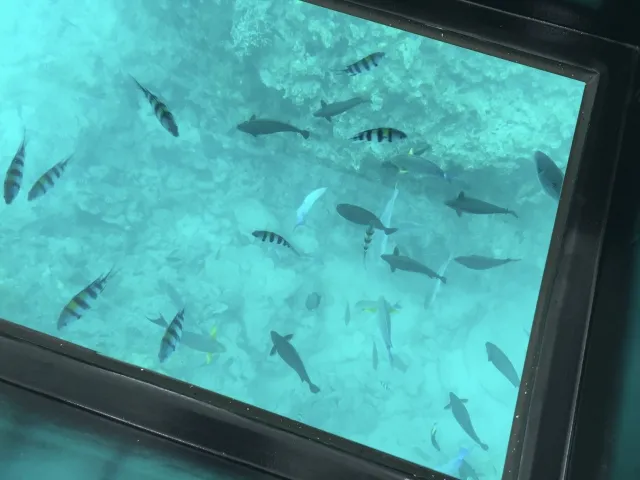
A glass-bottom boat is an activity in which you ride a boat with a glass bottom and view the underwater world from inside the boat.
You do not go directly into the sea, so there is no need to change clothes or prepare, and you can experience Okinawa's beautiful sea just by riding the boat.
People who are worried about their health and find it hard to enter the sea, or who do not want to get wet, can also take part, so it is perfect for anyone who wants to get even a little taste of the sea where tropical fish swim.
Even if you feel unwell during your trip and cannot join activities that involve diving into the sea, such as snorkeling, you can safely take part in a glass-bottom boat.
Some glass-bottom boat tours require a reservation and others accept same-day sign-ups, so another appeal is that you can try it right away when you suddenly want to get close to Okinawa's tropical fish.
It is an activity you can enjoy with the ease of simply riding a boat, even when you are tired from traveling and find it hard to dive into the sea.
In general, it is said that the sea becomes clearer when the air temperature is low, so a glass-bottom boat, which lets you appreciate the sea's clarity without entering the water, is an ideal activity in winter too.
It is also recommended for those who want to enjoy Okinawa's sea in winter.
Feeding experience [Difficulty level: Medium]
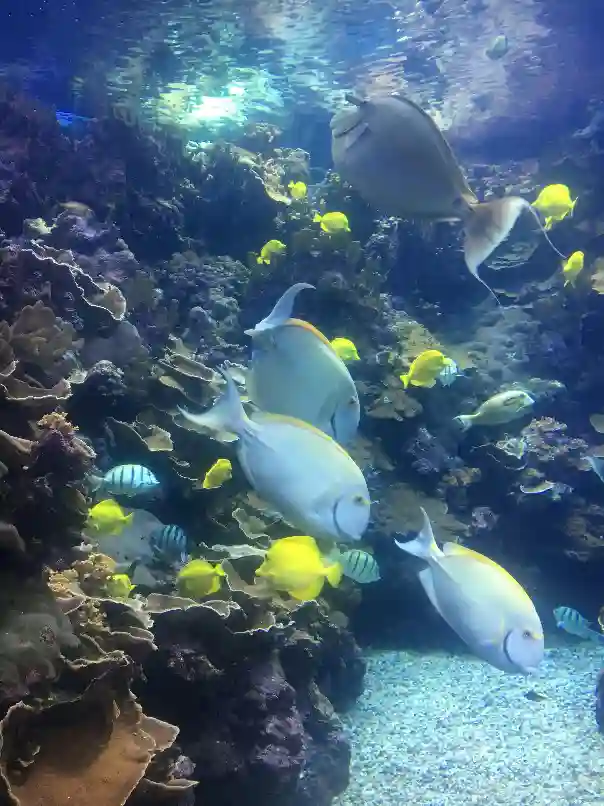
Many people probably want to try feeding Okinawa's tropical fish.
Tours that offer only a feeding experience are hard to find, but some diving and snorkeling experiences include feeding, so try looking for those.
In feeding experiences, it seems that sausages, bread and "kuruma-bu" (wheat gluten), unique to Okinawa, are often used as food for tropical fish.
In recent years, out of consideration for protecting the underwater environment, cut pieces of fish such as saury and sardines are sometimes given instead.
A feeding experience fulfills the wish to be surrounded by small, colorful tropical fish and cute fish of unique shapes, but more fish may gather than you imagine, and participants may become frightened and panic, so especially when letting small children take part, take care to keep an eye on them at all times.
Depending on the kind of tropical fish, those used to being fed will come over right away.
Even without food in your hand, they will approach, and their friendly manner is sure to soothe you.
Snorkeling [Difficulty level: Medium]
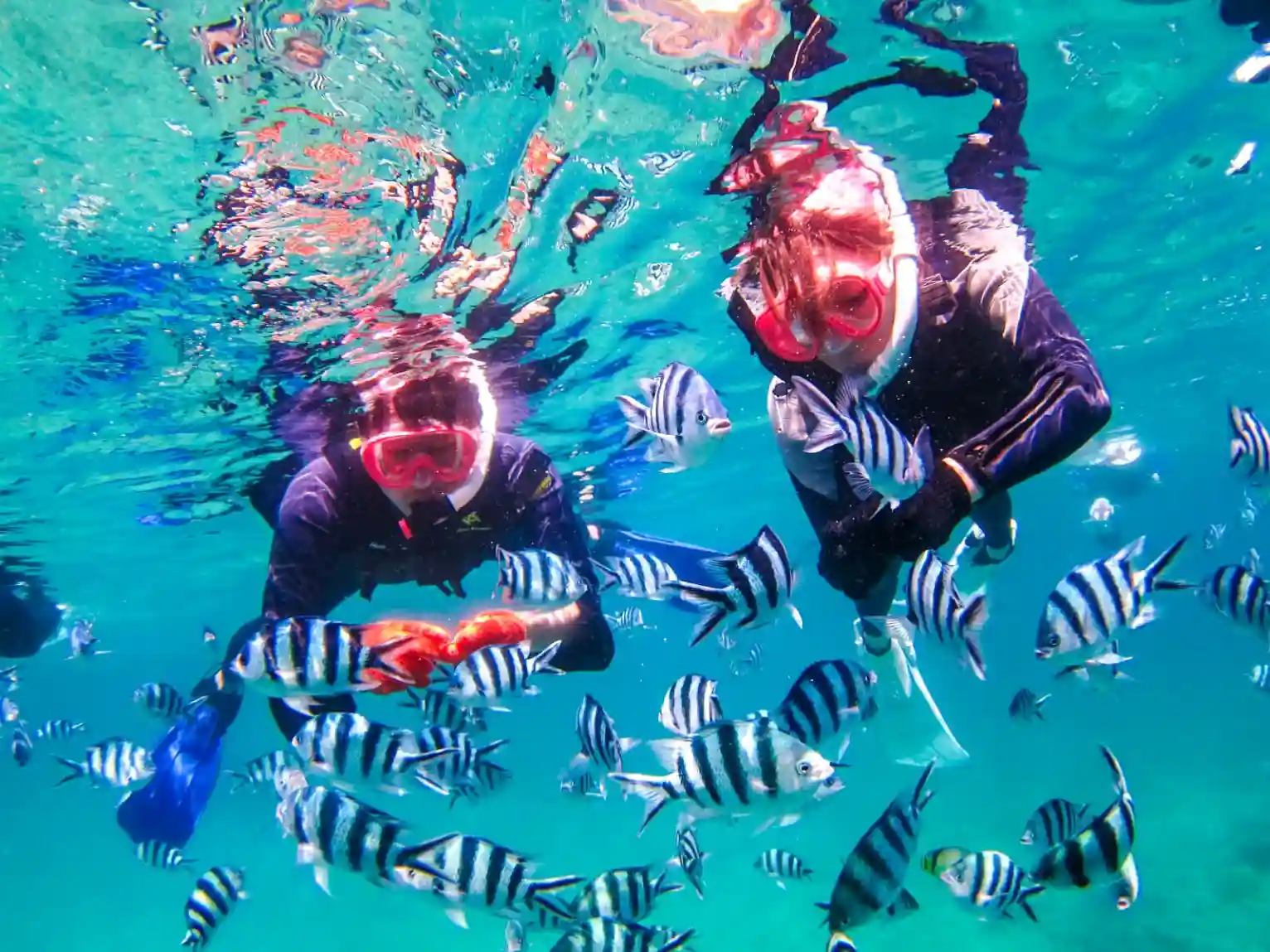
Snorkeling is an activity in which you wear gear such as a rash guard, a life jacket, a wetsuit, fins and a snorkel and enjoy swimming at the surface and diving down.
Because you wear gear, it may feel like a bit of a hurdle, but the guide staff will teach you thoroughly, so among activities where you get in the water and swim, it is one that even beginners can join with confidence.
As long as you can wear the gear correctly, both adults and children can try snorkeling.
Some tours are held in groups, but there are also small-group and private plans, so you can enjoy it at your own pace and feel relaxed.
There are also tours that small children can join, so it is perfect for those who want to enjoy it as a family.
It fulfills the wish to swim with tropical fish in Okinawa's sea!
Try looking for a plan that suits you.
Some tours are designed so that even people who are not confident swimmers can join with confidence, with considerations such as the guide staff towing you with a float.
If someone tows you by your float, you are just floating, so your fear fades.
When you apply, feel free to ask what kind of support is offered.
You can have an unforgettable experience swimming with Okinawa's tropical fish.
Diving [Difficulty level: High]
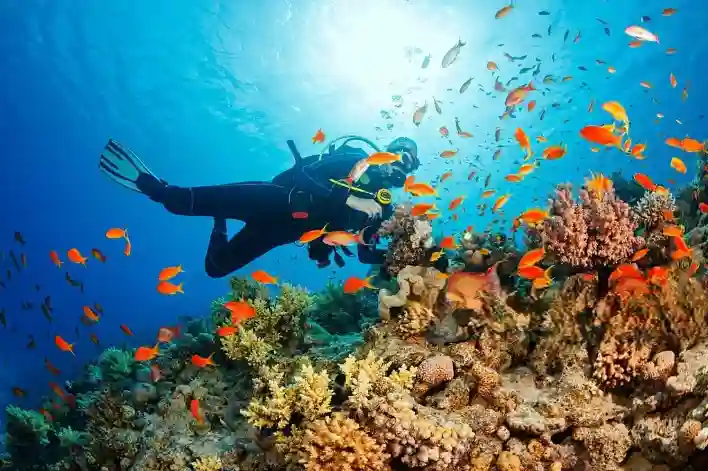
Diving, also called scuba diving, is a marine sport in which you enjoy being underwater while breathing air from a cylinder.
Its appeal is that you can experience the floating sensation unique to being underwater, get away from daily life, observe marine life such as colorful tropical fish and coral reefs, and enjoy the beautiful underwater world, including its terrain.
Diving tends to be seen as a high hurdle, but like snorkeling, it is a sport you can do even if you cannot swim.
As long as you can operate the equipment used in diving, you can dive, so if you think "I want to try it," it is worth taking the challenge.
There are different kinds of diving, and the easiest is "introductory diving," which you can do without a diving license.
Even without knowledge of or experience in diving, you can go into the sea right away once you receive minimal instruction from a diving instructor before the experience.
It is easy to join and recommended for those who want to try it once before getting a license, or who think that since they have come to Okinawa they would like to experience diving.
It seems that many people get hooked on diving after the experience and go on to get a license.
People with a license can go to dive points that are off-limits to introductory diving, so they can greatly broaden their enjoyment of Okinawa's sea compared with introductory diving.
The joy of diving advanced spots is a privilege of license holders only.
At difficult dive points, you can fully enjoy underwater scenery that can only be seen there.
You can see tropical fish away from the beach too! Recommended sightseeing spots in Okinawa
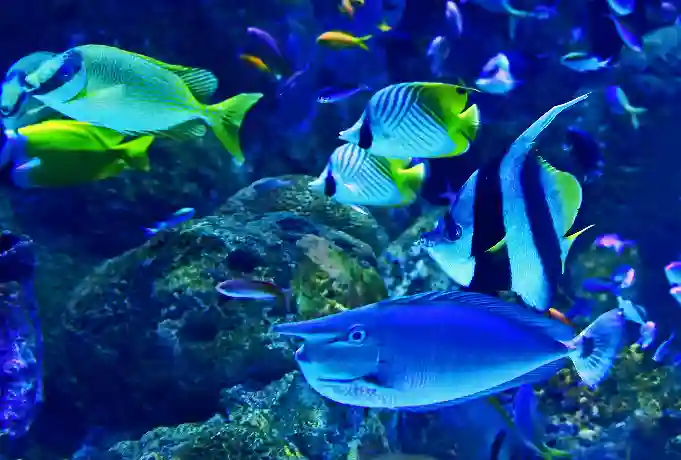
If you want to learn more about tropical fish, we also recommend observing them closely at an aquarium or similar facility.
Here are aquariums unique to Okinawa where you can see tropical fish away from the beach.
Churaumi Aquarium
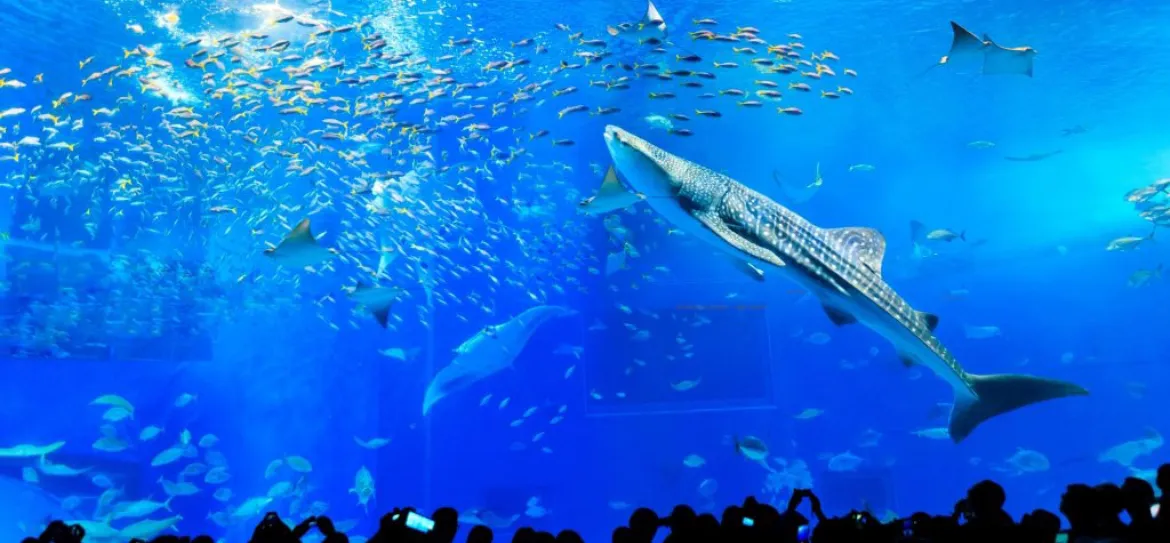
The Okinawa Churaumi Aquarium is inside Ocean Expo Park in Motobu Town, and it can be called the most famous aquarium in Okinawa.
In its spacious building there are areas where you can view tropical fish and coral reefs, making it a perfect aquarium for anyone who wants to learn more about Okinawa's tropical fish.
The "Tropical Fish Sea" zone faithfully recreates Okinawa's coral reefs, and the exhibit takes you from shallow rocky areas flooded with intense light, to beautiful sandy bottoms, and on to dimly lit caves, as if you were looking at the coral reef seas that spread around Okinawa.
The tropical fish that live in Okinawa's sea are kept in conditions close to nature.
In the tanks where a rich variety of tropical fish swim, the highlight is the schools of colorful snappers, such as the red-bodied humpback red snapper and the bluestripe snapper with its blue lines on a yellow body.
About 180 species of tropical fish swim in the "Tropical Fish Sea" tank, and you will be soothed by the world of colorful tropical fish.
You can also enjoy Okinawa's tropical fish in the "Coral Sea" zone, where a variety of corals are raised on a large scale.
The "Coral Sea" tank has no roof and is designed to take in Okinawa's intense sunlight directly.
This tank uses an open system that constantly supplies fresh seawater from the sea right in front of the Okinawa Churaumi Aquarium, and taking in fresh seawater makes the large-scale raising of coral possible.
About 80 species and 440 colonies of reef-building coral make for a breathtaking view.
The "Coral Sea" tank was made with reference to the coral reef scenery that the Churaumi Aquarium's keepers saw when diving in the sea of Motobu Town, the aquarium's home.
It recreates scenery you can actually see in Okinawa, so you can enjoy the coral reef landscape more realistically.
Many of the corals displayed in this comfortable environment have apparently kept growing in the tank for more than 20 years since the aquarium opened. The sight of tropical fish swimming freely among those coral reefs is breathtakingly beautiful.
The Churaumi Aquarium offers a variety of programs for visitors, such as worksheets for learning about the aquarium's creatures and the "Behind-the-Scenes Watching" program, which gives a thorough, detailed guide to the aquarium's back areas.
When you want to learn more about Okinawa's sea and tropical fish, such as "What kinds of coral reefs can be seen in Okinawa?" or "What was the name of that tropical fish I saw in the sea?", we recommend learning at the Churaumi Aquarium.
DMM Kariyushi Aquarium
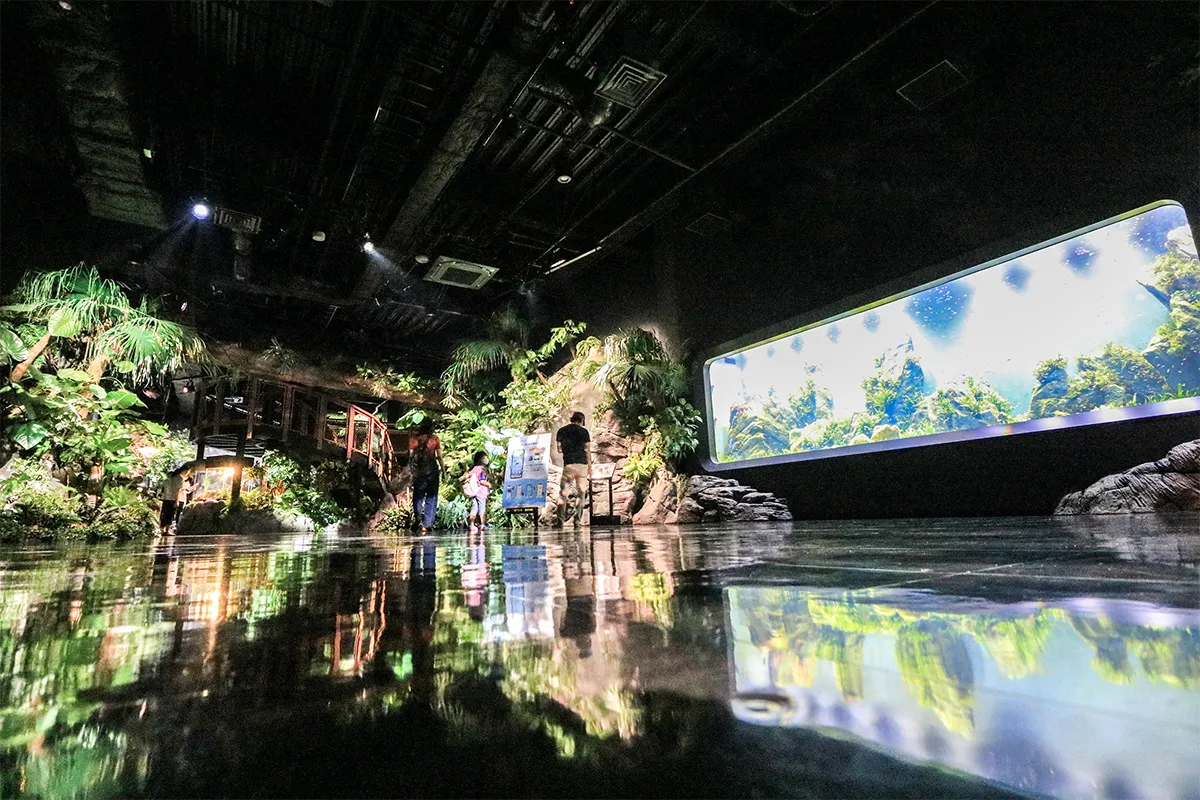
DMM Kariyushi Aquarium is an aquarium in Tomigusuku City, Okinawa Prefecture, located about 20 minutes by car from Naha Airport.
A "new kind of entertainment aquarium" that makes full use of the latest visual expression and spatial design, it expresses the beauty of living creatures and the natural charm created by Okinawa's subtropical climate through video and a variety of spatial effects.
In the "Clear Sea Where Diverse Life Thrives" zone, you can observe many kinds of tropical fish, such as the vivid blue blue devil damselfish, the longnose hawkfish whose red and white pattern camouflages it against branching coral, and the beautiful yellow tang.
The tropical fish are displayed in an artistic space where many small tanks are placed at even intervals, and the tanks are designed so they can be viewed from all four sides, letting you observe creatures hiding in the shadows of rocks and the like.
Also, the tanks themselves are set at a low position, so you can observe the creatures from an angle close to the water surface as well.
DMM Kariyushi Aquarium also raises coral, the home of tropical fish, and puts effort into aquaculture, education and awareness.
The coral being raised is displayed in a zone with the lights lowered inside the building, where you can feel a dreamlike world.
You can take your time admiring coral in many colors and shapes.
This new aquarium, which makes full use of cutting-edge video, offers a different way to enjoy it from other aquariums.
It is relatively small and can be toured in a short time, so we recommend going before or after an activity.
Summary
We have introduced beaches and other spots where you can meet tropical fish, as well as activities.
In Okinawa, you can easily enjoy getting close to tropical fish at beaches where they live, and by joining a tour to meet tropical fish, you can fully enjoy Okinawa's beautiful sea, coral reefs and tropical fish.
Facilities such as aquariums can be visited all year round, and some activities can be joined regardless of season, so another charm of Okinawa is that you can enjoy it in many ways throughout the year.
Use this article as a reference and enjoy meeting Okinawa's tropical fish.