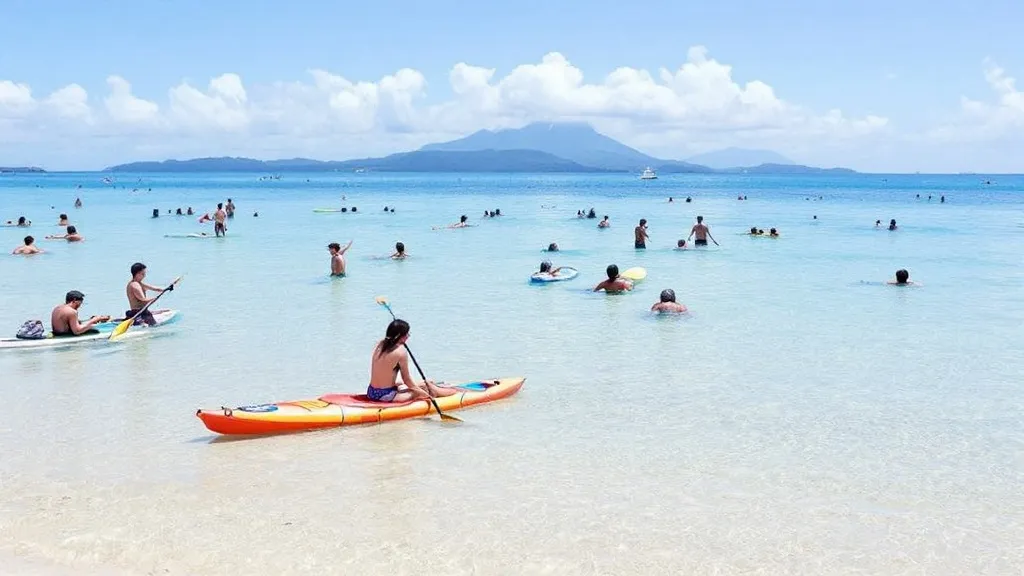
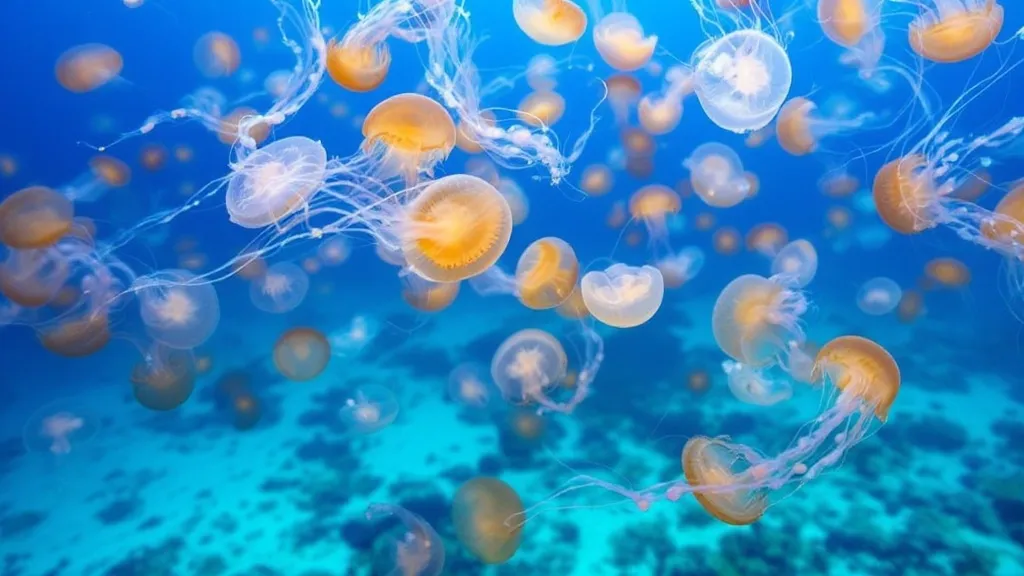
Okinawa's beautiful waters are home to a wide variety of jellyfish. For divers and snorkelers, they are both part of the charm of the sea and a risk that calls for caution.
In this article, we explain in detail the types and characteristics of jellyfish found in Okinawan waters, as well as when and where they appear by season and location, and we also give specific steps for first aid if you get stung, how to use over-the-counter medicine, and when to see a medical facility.
We also cover the jellyfish-protection gear and rental services available locally, and summarize in an easy-to-follow way how to prepare in advance and what to watch for on site so you can enjoy ocean activities safely.
After reading this article, you will know more about dealing with jellyfish trouble in Okinawa's sea and come away with practical measures for approaching underwater activities with peace of mind.
Okinawa's sea and jellyfish: the basics
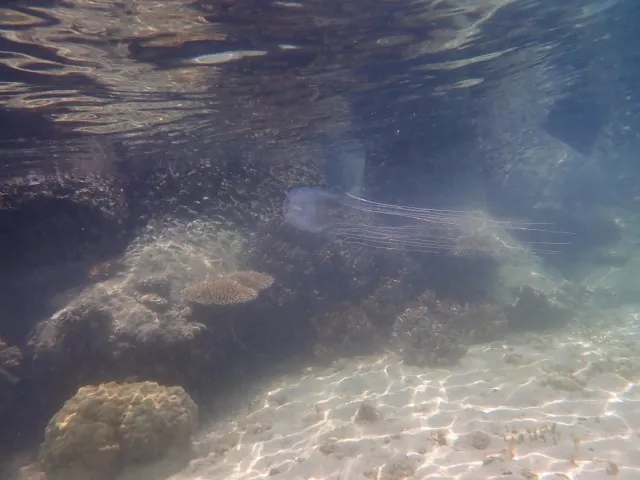
Okinawa is a region where a warm marine environment and abundant sea life coexist.
The clear water and wide-spreading coral reefs make marine activities such as diving and snorkeling extremely appealing, but jellyfish often appear depending on the season and ocean currents, so it is important to understand their ecology and behavior patterns.
In Okinawa's sea, the number of jellyfish varies with changes in water temperature and the influence of tidal currents, and situations that call for caution can be seen especially in summer and in certain areas.
Here we organize the basic knowledge about Okinawa's sea and jellyfish, and offer information to help you enjoy the ocean safely.
For more detail on jellyfish ecology and dangers, please also refer to reliable sources such as Wikipedia: Jellyfish.
For information on Okinawa's marine environment and weather, the official website of the Japan Meteorological Agency is also useful.
| Item | Details |
|---|---|
| Water temperature | Okinawa's sea is characterized by relatively high water temperatures throughout the year, and a warm climate is maintained even in winter. |
| Visibility | Because coral reefs spread throughout the area, the bright, clear water is well suited to diving and snorkeling. |
| Currents | Tidal currents change with the season and the weather, and this also changes how plankton and jellyfish appear. |
| Ecosystem | A wide variety of marine life coexists here, and jellyfish also play an important role in their own ecosystem. |
In addition, changes in the marine environment have a major impact on where jellyfish live and how they appear.
In particular, rising temperatures and changes in ocean currents are thought to affect jellyfish breeding seasons, and this has been observed in Okinawan waters as well.
For this reason, when planning marine leisure in Okinawa, checking local ocean and weather information beforehand is the basis of staying safe.
This chapter comprehensively explains Okinawa's unique marine environment and basic information about jellyfish, providing the foundational knowledge that lets you enjoy the sea with peace of mind.
We recommend regularly checking the latest ocean information and jellyfish data from reliable sources.
Types of jellyfish found in Okinawan waters
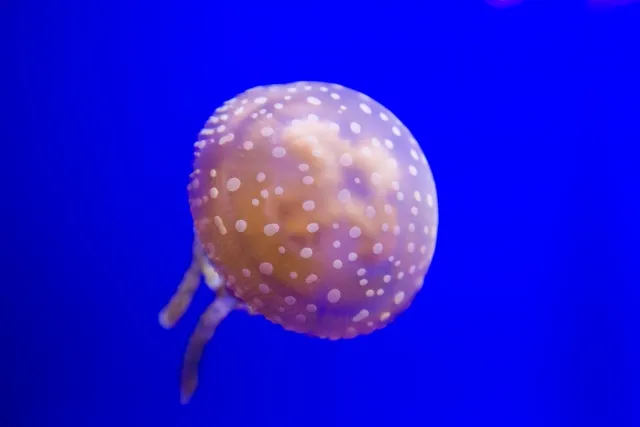
Okinawa's sea has high visibility and a rich natural environment, so many different kinds of jellyfish live here.
Here we explain in detail the main types of jellyfish living in Okinawan waters, including their characteristics, dangers and when they appear.
This way, people who enjoy diving and snorkeling can learn about them in advance and experience the charm of the sea with peace of mind.
Characteristics of typical jellyfish
Jellyfish commonly seen around Okinawa are divided into several groups by body size, density of stinging cells, shape and so on.
Each type has its own ecology and level of danger, and they also differ in how they swim and whether they tend to appear in groups.
For example, depending on body size and the amount of stinging cells, some cause only a mild sting, while others are dangerous and can cause serious symptoms.
Habu box jellyfish are dangerous
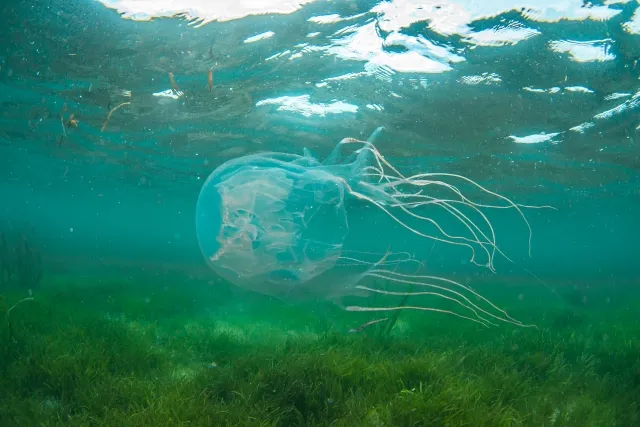
Habu box jellyfish are known for their strong venom, and contact can cause intense pain and skin inflammation.
The tentacles of the Habu box jellyfish carry many stinging cells, and once stung, immediate first aid is necessary.
At popular dive spots in Okinawa, information on Habu box jellyfish sightings is announced from time to time, so it is important to check information from official agencies.
Portuguese man o' war are dangerous
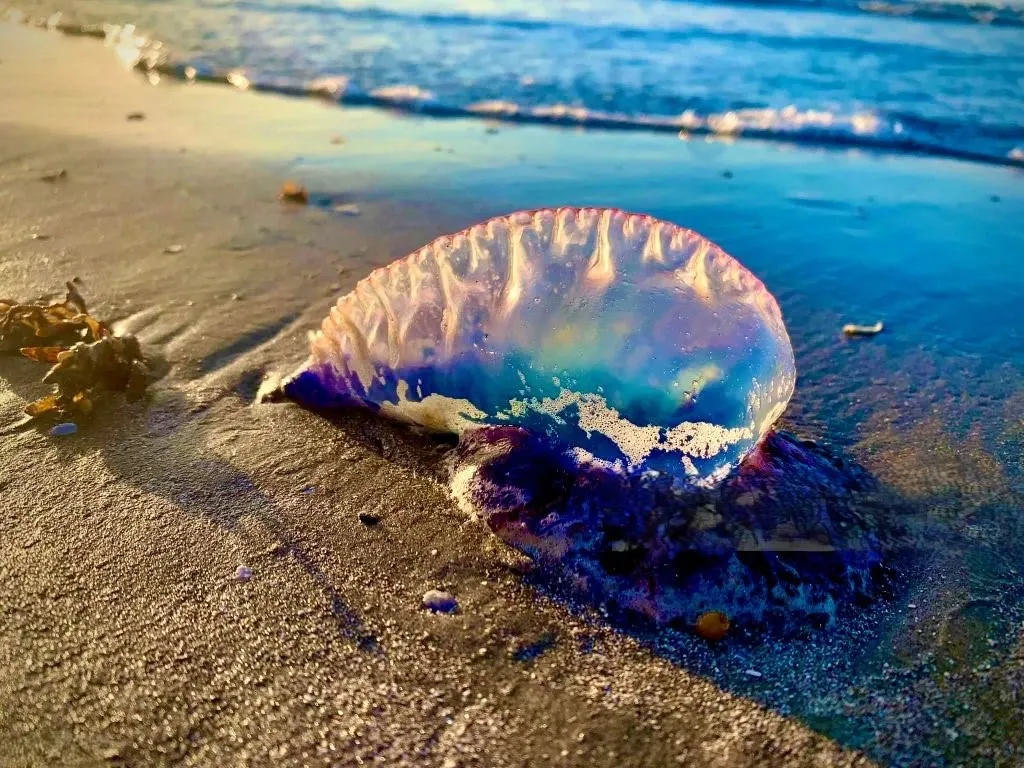
The Portuguese man o' war has countless thin tentacles hanging down beneath a transparent float, and it is very striking to come across one in the sea.
However, the powerful toxin in its tentacles can cause intense pain and blisters on contact with people, and in some cases whole-body symptoms, so caution is needed.
Divers and snorkelers are encouraged to learn in advance how to give first aid in case they are stung.
Appearance by season and location
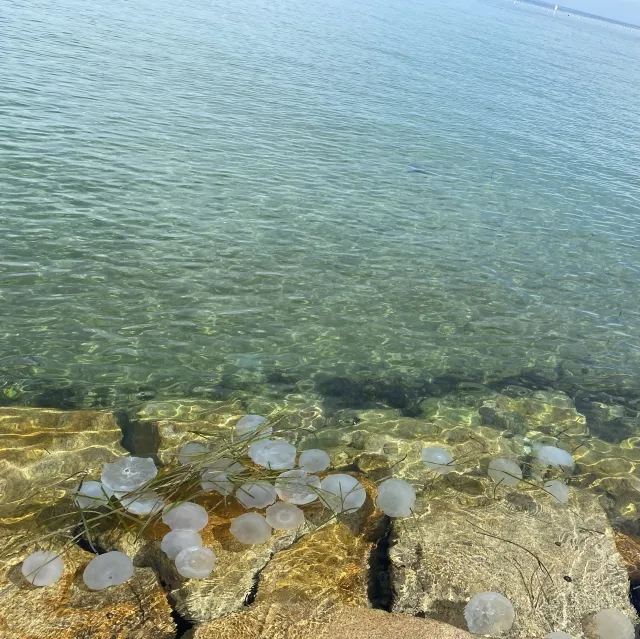
How jellyfish appear in Okinawa changes greatly under the influence of seasonal variation, ocean currents and temperature.
For example, from early summer through summer, rising water temperatures make jellyfish breeding more active, so the number of sightings tends to increase.
In addition, regular jellyfish outbreak information is announced for certain waters, and tourists and divers are alerted in advance.
The table below is an example of typical jellyfish appearance in each area of Okinawa.
| Area | Appearance season | Main types of jellyfish | Points to note |
|---|---|---|---|
| Northern waters (around Nago) | Early summer to summer | Habu box jellyfish, Portuguese man o' war | Watch for changes in wind direction and tidal flow |
| Central waters (around Onna Village and Yomitan Village) | Summer to early fall | Portuguese man o' war, other small jellyfish | Some waters are protected areas with restricted access |
| Southern waters (near Ishigaki Island and Miyako Island) | Summer to fall | A wide variety of jellyfish | Information is provided for tourists |
Appearance trends in each area vary with the weather conditions and ocean conditions of each year, so it is essential to check the latest information on site.
For warning information for each area, it is a good idea to refer to actual sea-condition information sites and announcements from the local police and the Japan Coast Guard.
Jellyfish ecology and habits
Jellyfish living in Okinawan waters play an important role as part of the marine ecosystem within their own ecosystem.
By preying on plankton and small fish, they also contribute to maintaining the balance of the food chain.
They are also known to appear in large numbers during the breeding season, and detailed research is under way on their breeding cycles, living environments and relationships with predators.
Notably, jellyfish are also drawing attention as environmental indicator organisms.
Because they react sensitively to changes in water temperature, salinity and nutrient conditions, they are sometimes used as a barometer of the health of the marine environment.
For this reason, marine research institutions and universities in Okinawa carry out long-term monitoring of the marine environment through the distribution and ecology of jellyfish.
Jellyfish precautions for diving and snorkeling
Okinawa's sea has high visibility, and many divers and snorkelers visit because of its beauty.
However, along with the appealing underwater environment, there is also a risk of encountering jellyfish.
By carefully checking advance preparation and points to watch on site, you can have a safe and fulfilling underwater experience.
Preparing in advance to enjoy yourself safely
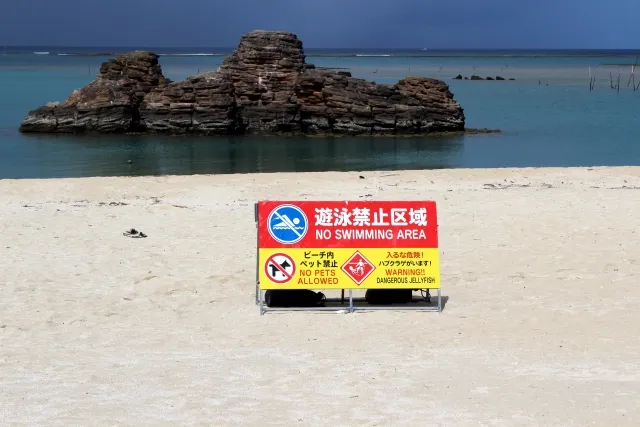
To enjoy diving and snorkeling, preparation before you leave is extremely important.
Please go through the preparation items below thoroughly and work on raising your safety awareness.
| Preparation item | Details and benefits |
|---|---|
| Gathering local information | Get information on jellyfish sightings, currents and weather from dive shops around Okinawa, tourist information centers and reliable websites. |
| Checking and preparing equipment | Wearing a wetsuit with good protective effect, a special rash guard or a suit designed for jellyfish protection keeps skin contact to a minimum. It is also essential to check that your diving equipment and snorkeling gear work properly. |
| Confirming the dive plan | Hold a thorough briefing in advance with the local dive shop or instructor, and confirm the route, dive depth and what to do in an emergency. This kind of careful planning is the foundation of safe underwater activity. |
| Setting up emergency measures | In case you are stung by a jellyfish, check your first-aid kit, necessary medicines and the contact information of the nearest medical facility. It also helps to decide in advance with your companions or instructor who will do what in an emergency. |
With this kind of thorough advance preparation, you can respond quickly to any trouble that may arise and enjoy the charm of the underwater world with peace of mind.
Points to note on site and preventive measures.
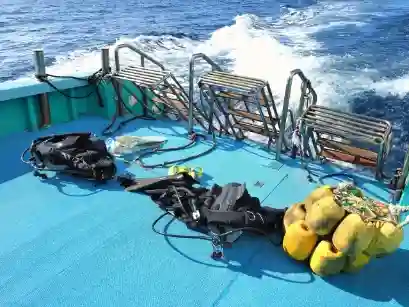
Once you arrive on site, you need to respond flexibly to the situation. To lower the risk of contact with jellyfish while you are out there, please take the following preventive measures.
| Measure | Specific method |
|---|---|
| Observing your surroundings | From underwater visibility and the flow of the water, detect early any area where a group of jellyfish is present and act to avoid it. It is important to always share information with the instructor and the divers around you. |
| Wearing appropriate protective gear | Wear the protective gear provided on site or prepared by yourself to prevent direct contact with your skin. Clothing made of a material with a barrier function against jellyfish stinging cells is especially effective. |
| Checking water temperature and currents | Water temperature and currents affect jellyfish activity patterns. Based on the latest information from the local dive shop or instructor, avoid high-risk areas and times. |
| Carrying out emergency response | If you are stung by a jellyfish, quickly return to the surface, tell your companions or instructor what happened, and then begin first aid. It is necessary to follow the first-aid methods you have learned in advance to keep symptoms from getting worse. |
To enjoy diving in Okinawa safely, it is also essential to receive a careful briefing on arrival and to fully understand the region's particular currents and weather conditions.
First aid if you are stung by a jellyfish
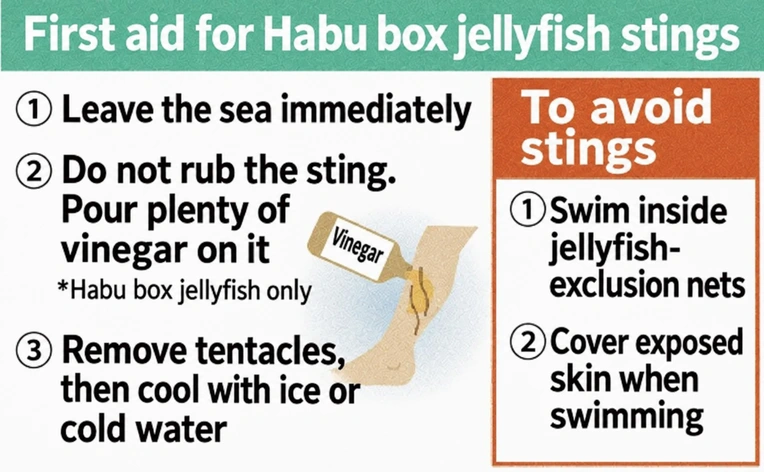
First aid for jellyfish stings in Okinawa
Let me start with the conclusion!
Most jellyfish injuries in Okinawa are caused by the 『Habu box jellyfish』, and the next most dangerous is the 『Portuguese man o' war』. Treatment differs depending on which of these two jellyfish stung you.
If stung by a Habu box jellyfish, pour plenty of vinegar on the area.
For a Portuguese man o' war, vinegar will make symptoms worse, so do not use it.
For both, rinse with seawater, not fresh water. Because of osmotic pressure, fresh water can cause more venom to be discharged.
Precautions
- Do not rub when removing jellyfish tentacles
- After removing the tentacles, cool the area with ice or cold water
- Give first aid, then get treatment at a medical facility
Initial response after being stung
When you are stung by a jellyfish, it is important first to stay calm and respond quickly.
Before touching the affected area directly, once you have secured a reasonable level of safety around you, rinse off the stinging cells with seawater.
Fresh water may activate the stinging cells, so never use it.
If stinging cells are stuck to the skin, it is recommended to remove them carefully with special tweezers, a credit card or the like.
The table below summarizes the basic initial steps to take right after being stung.
| Step | What to do | Notes |
|---|---|---|
| 1 | Rinse the affected area thoroughly with seawater | Rubbing with fresh water or a towel may reactivate the stinging cells |
| 2 | Remove the stinging cells | Use gloves or a special tool, and take care not to damage the skin |
| 3 | Cool the affected area | Apply a cold pack or ice pack over a towel; do not put ice directly on the skin |
These measures are effective for mild stings, but if symptoms progress, you need to move on to the next steps right away.
Over-the-counter medicine and how to use it
After the initial response, using a commercially available medicine for jellyfish stings alongside it can be expected to help reduce pain and inflammation.
Pharmacies and drugstores carry topical antihistamine creams, pain-relief gels, cooling sprays and similar products.
Before use, be sure to check the directions and dosage, and follow the precautions printed on the package.
| Type of medicine | How to use | Expected effect |
|---|---|---|
| Antihistamine cream | Apply a thin layer to the affected area and let it absorb naturally without rubbing | Relief from itching and mild inflammation |
| Pain-relief gel | Spread an appropriate amount over the painful area | Reduces localized pain |
| Cooling spray | Spray directly onto the affected area to enhance the cooling effect | Reduces inflammation and eases pain |
In addition, if symptoms do not improve even after using medicine, or if you notice an unexpected reaction, it is important to stop using it immediately and consult a medical facility.
When to see a medical facility
Symptoms of jellyfish stings vary greatly from person to person, and depending on how severe they are, prompt medical treatment may be necessary.
If any of the following symptoms appear, we recommend that you see a medical facility immediately.
| Symptom | When to seek care |
|---|---|
| Rash or redness spreading across the body | Immediately after symptoms appear |
| Difficulty breathing, tightness in the chest | Seek emergency care (go to the emergency room) |
| Severe pain or impaired consciousness | Call an ambulance right away |
| The sting is near the face or neck | See a doctor even if the initial symptoms are minor |
Also, if you have a history of allergic reactions, it is advisable to respond carefully even to mild symptoms and to contact a medical facility whenever necessary.
Jellyfish-protection gear and rental information
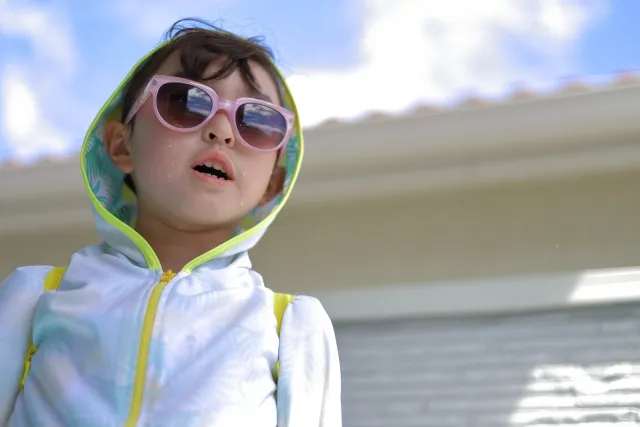
Protective items you can buy locally
Dive shops and marine sports stores in Okinawa carry a wide selection of protective wear and accessories that are effective against jellyfish.
In particular, rash guards designed for jellyfish protection and protective gloves that guard against jellyfish stings are popular with many customers.
Portable first-aid kits are also sold so that you can give quick first aid in an emergency.
Commercially available first-aid kits include over-the-counter medicine, disinfectant and a leaflet with carefully written instructions, so even beginners can use them with confidence.
The table below summarizes the main jellyfish-protection items you can buy locally, their features and where to get them.
| Product | Purpose | Features | Where to get it |
|---|---|---|---|
| Jellyfish-protection rash guard | Protection for the whole body | Treated with a special water-repellent finish and an antibacterial treatment for high protection | Okinawa dive shops, marine sports specialty stores |
| Jellyfish-protection gloves | Preventing stings to the hands | Made of a material with excellent sting resistance, while remaining easy to move in | Sporting goods stores, dive shops |
| Portable first-aid kit | Initial treatment if stung | Comes with disinfectant, pain-relief cream and instructions, for a reassuring set of contents | Drugstores nationwide (e.g., Matsumotokiyoshi, Sundrug) |
If you prepare these protective items before going out to sea, you can respond quickly and appropriately if trouble does occur.
For details on each product and the latest information, we recommend asking the staff directly at each store or checking the official website.
How to make use of rental services
In Okinawa, rental services are available in various places, so you can use jellyfish-protection items without buying them.
Rental services bundle jellyfish-protection wear and first-aid kits that are easy for beginners to handle, which is very convenient for short-term visitors and first-time diving or snorkeling customers.
When using a rental service, it is reassuring to check in advance the availability, the rental fees and the list of items that can be rented.
Many rental providers also explain in detail how to use the protective items and what to watch out for, so we recommend getting an explanation from the staff before you actually go out to sea.
In addition, rental items are managed according to the latest hygiene standards and are always provided in a clean condition.
Rental fees are generally set per day, but discounts may apply for long-term use or group use.
Please also check the terms of use and coverage in advance, and choose a service you can use safely.
As specific examples of rental services, dive shops in Okinawa offer the following services.
| Service | Details | Approximate price | Provided by |
|---|---|---|---|
| Jellyfish-protection wear rental | Rental of a rash guard and a set of gloves | About 2,000 to 4,000 yen per day | Dive shops around Okinawa |
| First-aid kit rental | Comes with disinfectant, cream and a first-aid manual | About 1,000 to 2,000 yen per day | Marine sports specialty stores in Okinawa |
For details on rental services and the latest promotions, you can find out by contacting the local store directly.
To enjoy the sea safely, make good use of rental jellyfish-protection gear and head out fully prepared.
Summary
Okinawa's sea is an appealing spot for diving and snorkeling, but we need to remember once again that the risk of jellyfish stings lurks there.
In this article, we explained in detail the types and characteristics of jellyfish living in Okinawan waters, focusing in particular on dangerous species such as the Habu box jellyfish and the Portuguese man o' war, along with preventive measures to avoid being stung and points to note on site.
We also offered practical measures by giving specifics on the initial response if you are stung by a jellyfish, how to treat it with commercially available first-aid products (for example, reliable medicines handled by Rohto Pharmaceutical and Taisho Pharmaceutical), and when to see a medical facility.
This information clearly shows how important the knowledge and preparation are for enjoying marine sports with peace of mind in Okinawa's clear waters.
By understanding solid protective measures and first-aid methods in advance, you can respond quickly and appropriately to any trouble that may arise, and we can conclude that this makes safe and comfortable ocean leisure possible.