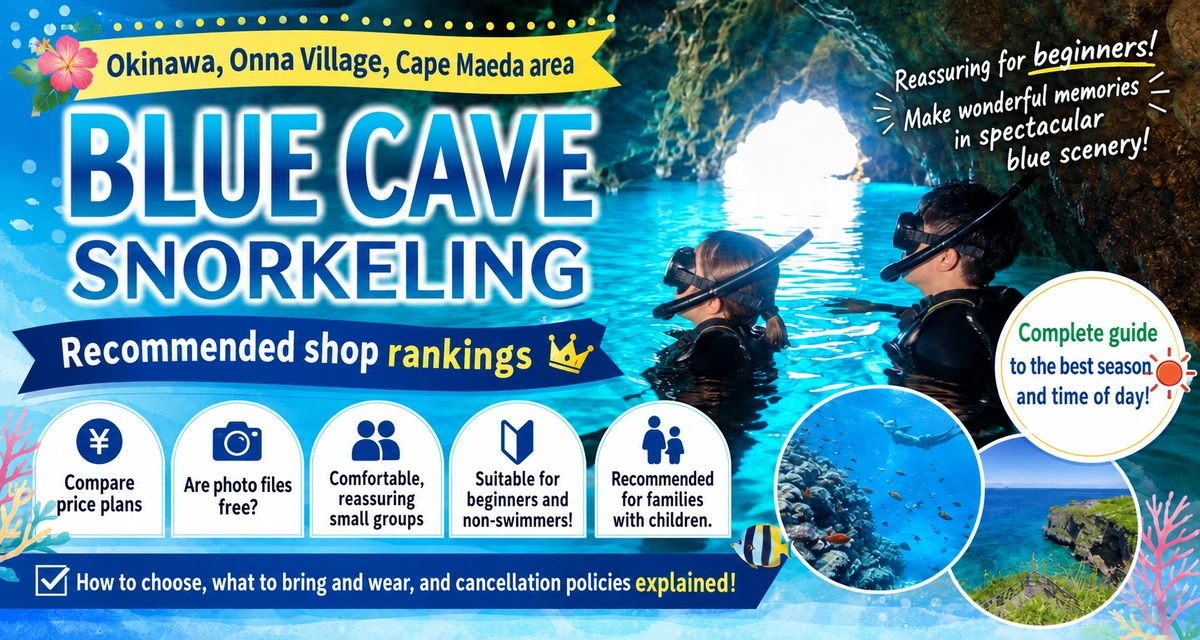
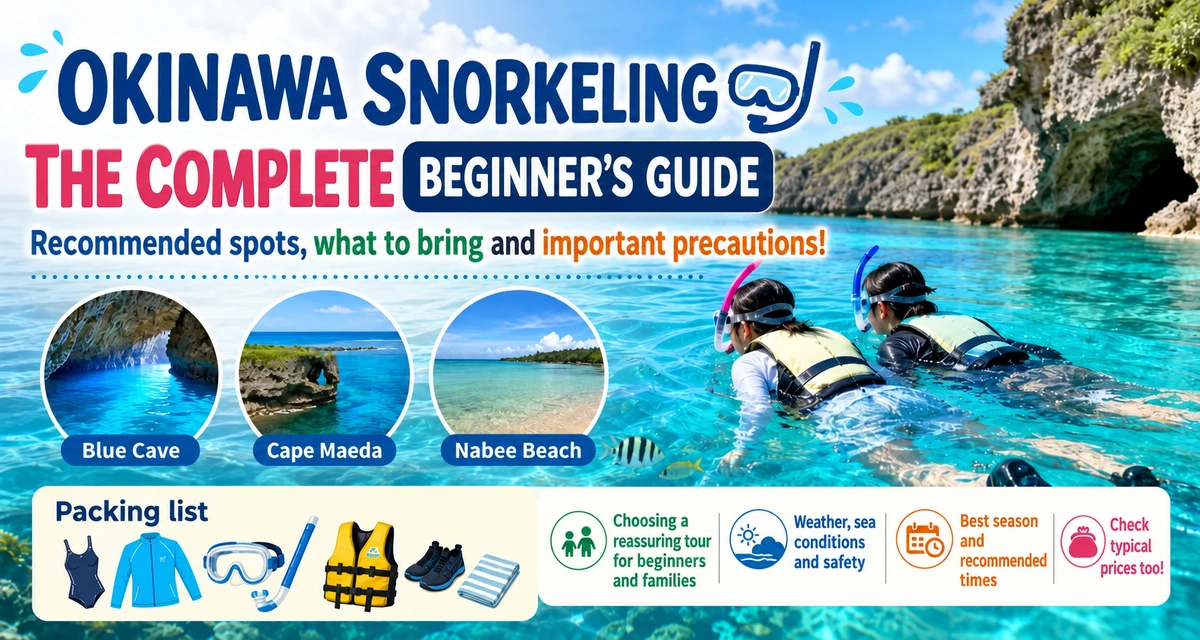
If you want to try snorkeling in Okinawa but feel unsure about which spots are safe for beginners or what you need to bring, you are not alone. This article focuses on Onna Village, one of the most popular areas in Okinawa for first-timers, and introduces recommended snorkeling spots with outstanding water clarity, such as the Blue Cave, Cape Maeda, and Navi Beach, in detail. We have also put together a complete packing list of everything to prepare before the day, including swimwear, a rash guard, a snorkel set, and a life jacket. In addition, we explain how to choose a tour that beginners and families with children can join with peace of mind, how to check tour prices, how to judge the weather and sea conditions, and how to look after your health, along with other safety tips, as well as the best season and the best time of day. After reading this article, even first-time snorkelers in Okinawa will have a clear picture of everything from preparation to the day itself, and will be able to enjoy the ocean with confidence. Be sure to read to the end for information that will help you make the most of the beautiful sea in Onna Village.
Why snorkeling in Okinawa is so popular with beginners
The clarity and beauty of Okinawa's ocean
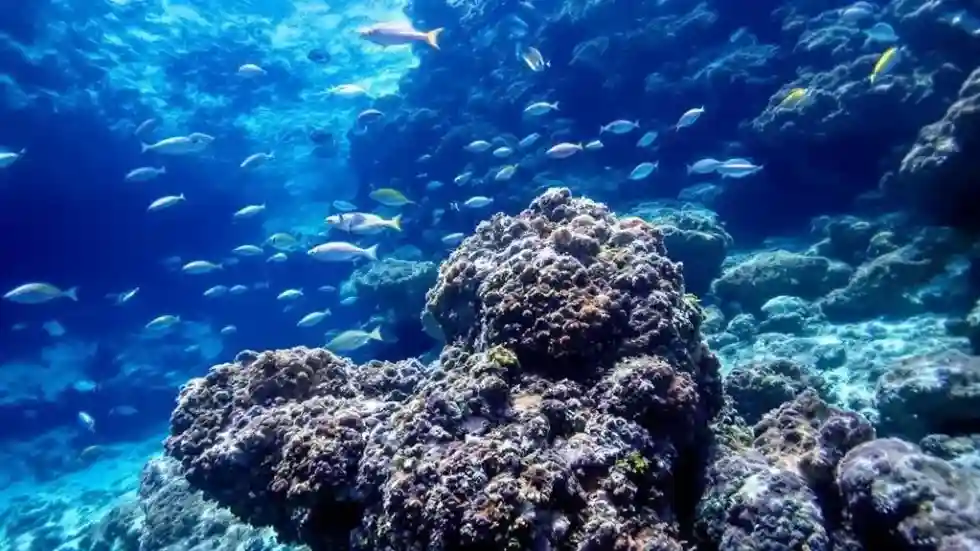
Okinawa's ocean is known for its high clarity and good underwater visibility, which makes it easy for beginners to enjoy with confidence. Many areas have shallow, gently sloping coral reefs, and the setting lets you observe colorful tropical fish and reef-building corals up close. Around the main island in particular, the Kuroshio Current helps keep the water quality stable throughout the year, so conditions are well suited to snorkeling.
In calm inner bays and areas inside the reef, you can enjoy the underwater scenery even in shallow water where you can stand, so the psychological hurdle is low even for beginners who feel unsure about keeping their balance in the water.
| Item | Features |
|---|---|
| Clarity | Good visibility, letting you see several meters down |
| Depth | Many shallow, gently sloping areas that suit beginners |
| Marine life | Abundant tropical fish and coral reefs |
| Water temperature | Relatively warm all year round |
Why Onna Village is chosen as a snorkeling spot
Onna Village is known as an area that is easy to reach, about an hour by car from Naha Airport, and where many snorkeling tours for beginners are held. Resort hotels and marine leisure facilities are clustered along the coastline, and the fact that facilities such as changing rooms and showers are available is also reassuring for people trying snorkeling for the first time.
In addition, because nationally famous spots such as the Blue Cave and Cape Maeda are concentrated here, there are many shops with experienced instructors on site, and the support system is well developed, from equipment rental to safety management. There are also beaches in bays that are less affected by waves, so you can choose a spot depending on the weather. This flexibility is another reason why this area is chosen.
5 recommended Onna Village spots for beginner snorkelers in Okinawa
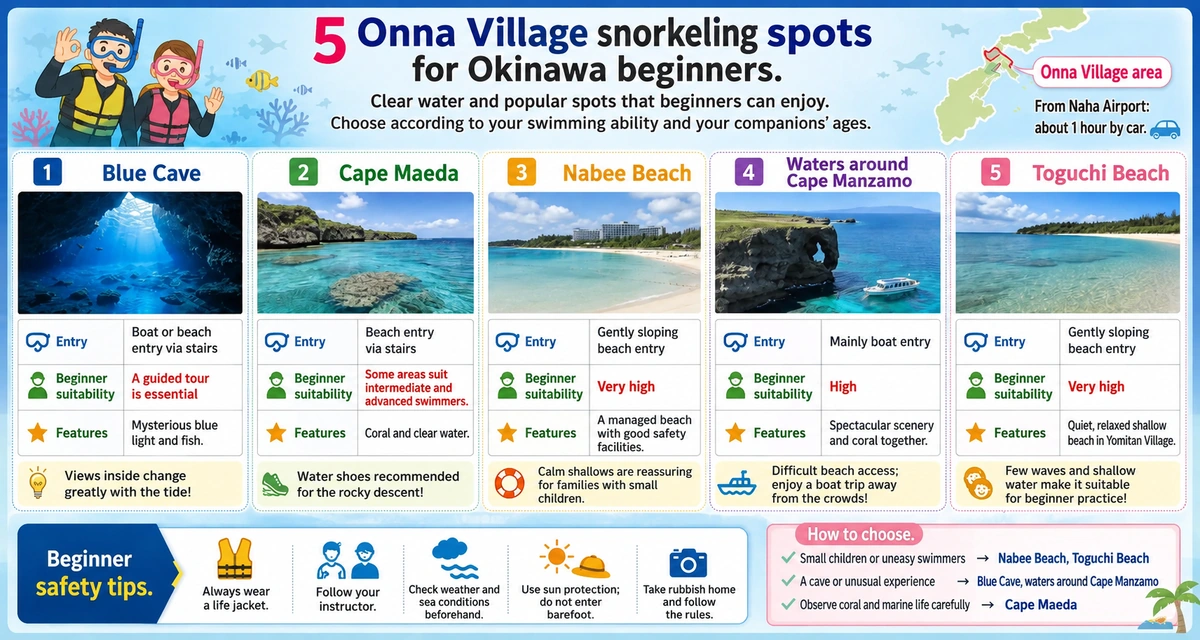
The Onna Village area, which boasts some of the best water clarity on the main island of Okinawa, has plenty of spots where even beginners can enjoy snorkeling with confidence. For those trying snorkeling in Okinawa for the first time, here are five carefully selected popular spots, centered on Onna Village. Each has different features and difficulty levels, so the key to avoiding disappointment is to choose according to your own swimming ability and the ages of the people with you.
| Spot | Entry method | Beginner-friendliness | Features |
|---|---|---|---|
| Blue Cave | By boat, or beach entry via stairs | Joining a tour is a prerequisite | Magical blue light and schools of fish |
| Cape Maeda | Beach entry via stairs | Some zones are better suited to more experienced swimmers | Coral reefs and highly transparent water |
| Navi Beach | Beach entry from a gently sloping shore | Very high | An artificial beach with a high level of safety |
| Waters around Manzamo | Mainly boat entry | High | Enjoy spectacular scenery and coral reefs at the same time |
| Tonuchi Beach | Beach entry from a gently sloping shore | Very high | A calm, shallow beach in Yomitan Village |
Blue Cave
The Blue Cave is a snorkeling spot famous throughout Japan, located in Maeda, Onna Village, Okinawa Prefecture. It got its name because sunlight entering the cave reflects off the seawater and creates a magical blue space. How the inside of the cave looks changes greatly between high tide and low tide, so by joining a guided tour you can visit at the most beautiful time. The water is clear all the way to the seafloor, and being able to see schools of tropical fish up close is another attraction. However, getting to the cave requires going down stairs, and depending on wave conditions you may travel by boat, so it is important for beginners to always follow the guide's instructions.
Cape Maeda
Cape Maeda is a cape also known as the gateway to the Blue Cave, and the surrounding area has swimming zones that even beginners can enjoy. Near the tip of the cape the water is deep and the currents can change easily, so the key to staying safe is to wear a life jacket and always stay with your instructor. The coral reefs are well developed, and you may encounter colorful tropical fish and sea turtles. Because you enter by going down stairs in a beach style, wearing marine shoes will ease the strain on your feet.
Navi Beach
Navi Beach is an artificial beach in front of a resort hotel in Onna Village. Because it is shallow and the waves are calm, it is also popular with families with small children. You can enter slowly from the sandy beach, so it is also a suitable setting for snorkeling beginners to practice getting used to the water. Lifeguards are on duty during many hours of the day, and a high sense of safety is another of its features. Many of the beaches also have snack stands and shower facilities, so it is an easy spot to drop by and is recommended for your first snorkeling experience in Okinawa.
Waters around Manzamo
Manzamo is known as one of the most representative scenic spots on the main island of Okinawa, and the waters around it are also highly popular as snorkeling spots. You can enjoy the luxury of observing coral reefs and tropical fish in clear water while gazing at the spectacular sheer cliffs. In many cases, tours are organized so that you travel by boat out to sea before entering the water, and because it is harder to reach from the beach, you can avoid the crowds and enjoy a quiet sea. Since this is an area where the tidal current changes, it is important to follow the tour company's instructions and enjoy yourself within a comfortable range.
Tonuchi Beach
Tonuchi Beach is located in Yomitan Village, next to Onna Village, and is characterized by its shallow, calm water. It is also loved by local families, and it offers an environment where snorkeling beginners can practice with confidence. Because it is a short drive from the Onna Village area, quite a few people combine it with other spots. With many areas that have few waves and shallow water, it is well regarded as a spot where even small children and people who are not strong swimmers can observe sea creatures without strain.
Packing list for beginner snorkelers in Okinawa
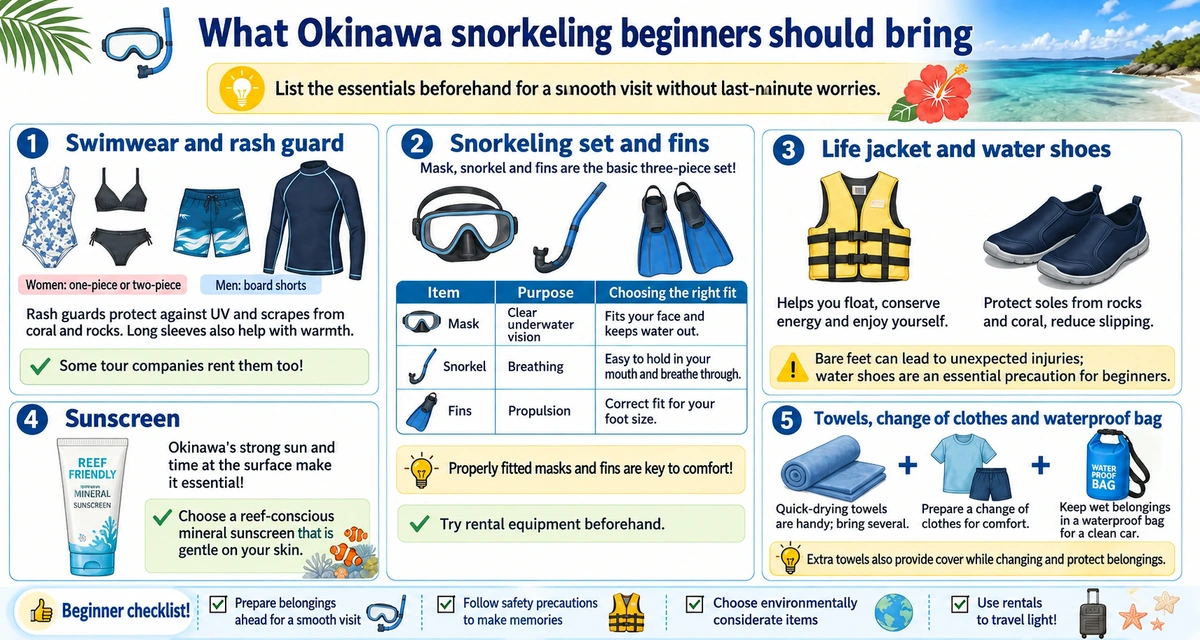
To enjoy snorkeling in Okinawa, preparing what you bring in advance greatly affects both comfort and safety. Beginners in particular can enjoy their time in the ocean smoothly, without panicking on site, by listing the items they need beforehand. Here, we explain in detail, item by item, the things you cannot do without for snorkeling in Okinawa.
Swimwear and a rash guard
Swimwear is the basis of snorkeling gear. Women may want to choose a one-piece or two-piece style, putting ease of movement first. For men, board-short-style swim trunks are popular.
A rash guard not only protects your skin from Okinawa's strong ultraviolet rays but also helps prevent scrapes from coral and rocks, so it is an especially recommended item for beginners. If you choose a long-sleeved type, you can expect both sun protection and warmth. Many tour companies also rent rash guards, so you are covered even if you cannot bring one.
Snorkel set and fins
A snorkel set generally consists of three items: a mask, a snorkel, and fins. If you choose a mask that fits your face, water is less likely to get in and it is comfortable to use.
| Item | Role | Tips for choosing |
|---|---|---|
| Mask | Secures your underwater vision | A size that fits your face and does not leak |
| Snorkel | Secures your breathing | A shape that is easy to hold in your mouth and easy to breathe through |
| Fins | Improve propulsion | A fit that matches your foot size |
For beginners, choosing a mask and fins that fit you well is the key to a comfortable snorkeling experience. If you are unsure about buying, renting on a tour has the advantage of letting you check how the gear feels beforehand.
Life jacket and marine shoes
For beginners who are not confident swimmers, and for those with children, wearing a life jacket is extremely important for safety. Because it provides buoyancy, you can enjoy snorkeling with peace of mind while conserving your energy.
Marine shoes protect the soles of your feet from rocks and coral when entering from the beach. Walking barefoot can lead to unexpected injuries, so wearing marine shoes is one of the safety measures that beginners cannot do without. If you choose shoes with non-slip soles, you can move around with even more confidence.
Sunscreen and towels
Okinawa's sunshine is very strong compared with mainland Japan, and you expose your body at the water's surface for a long time while snorkeling, so sunscreen is an essential item. However, considering the impact on coral reefs, it is recommended to choose an environmentally friendly non-chemical type or a sunscreen with coral-friendly ingredients.
Quick-drying sports towels and microfiber towels are handy. If you prepare several, you can use them for many purposes, not only to dry off but also as a cover when changing clothes and to protect your belongings. It is also a good idea to bring a waterproof bag for a change of clothes and wet items, which makes managing your belongings easier when you are on the move.
How to choose a snorkeling tour for beginners in Okinawa
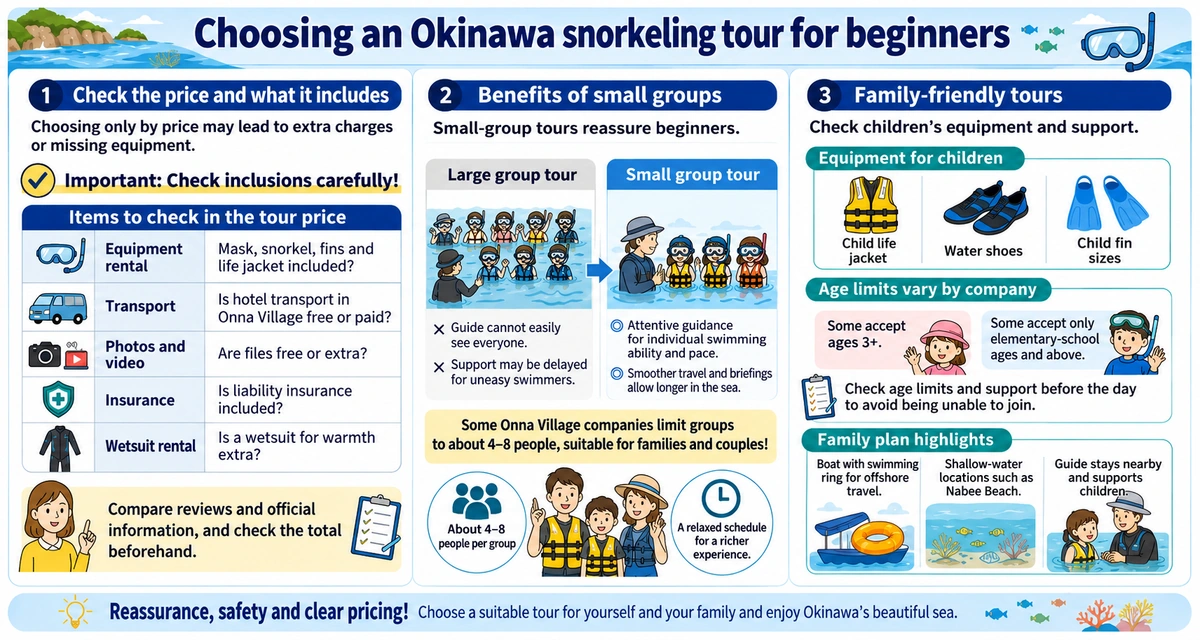
How to check tour prices and what is included
When joining a snorkeling tour in Okinawa, prices vary widely, from the 3,000 yen range up to around 8,000 yen, and the amount changes greatly depending on what is included. If you choose based on low price alone, there are cases where extra fees arise or the necessary equipment is not provided, so it is important to check carefully in advance what is included in the price.
What you especially want to check is whether the price includes equipment rental fees, facility usage fees, insurance, the provision of photo and video data, and a pickup and drop-off service from your accommodation. If these are charged separately, the total on the day may turn out higher than expected.
| Item to check | What to look for |
|---|---|
| Equipment rental fee | Whether the snorkel set, fins, and life jacket are included in the basic price |
| Pickup and drop-off service | Whether pickup from hotels around Onna Village is free or paid |
| Photo and video data | Whether the footage taken is provided free or costs extra |
| Insurance | Whether accident insurance coverage is included in the price |
| Wetsuit rental | Whether a wetsuit for keeping warm costs extra |
By comparing review sites and the tour companies' official information, and finding out in advance how much the total will come to, you can enjoy snorkeling on the day with peace of mind.
Benefits of small-group tours
For beginner snorkelers in Okinawa, a small-group tour is a big source of reassurance. On tours with many participants, it is harder for the guide to keep an eye on everyone, and support for people who are anxious about swimming can end up thin. On the other hand, with a small-group tour you can receive careful guidance tailored to each person's swimming ability and physical condition, so even people trying snorkeling for the first time can approach it calmly.
In addition, with small groups, travel and lectures tend to go smoothly, and you tend to get more time actually spent in the ocean. Some tour companies around Onna Village limit each group to about 4 to 8 people, which also suits families and couples.
Features of tours that are reassuring even with children
When taking small children snorkeling in Okinawa, it is important to check whether the tour has equipment for children and a support system in place. Many tour companies offer children's life jackets, marine shoes, fins, and more in a range of sizes, so you can borrow equipment that fits your child's build.
The minimum age for participation also differs by tour company, ranging from tours that accept children from age 3 to those intended for elementary school students and older. Checking the age limit and the necessary support system in advance helps you avoid the trouble of not being able to participate on the day.
Furthermore, family-oriented tours include plans where you travel out to sea on a boat equipped with flotation rings, and courses held mainly in shallow places like Navi Beach, designed so that even children who are not used to swimming can observe the underwater world with peace of mind. Whether the guide checks on the children frequently as the tour proceeds is also a point to consider when choosing.
Tips for enjoying snorkeling in Okinawa safely
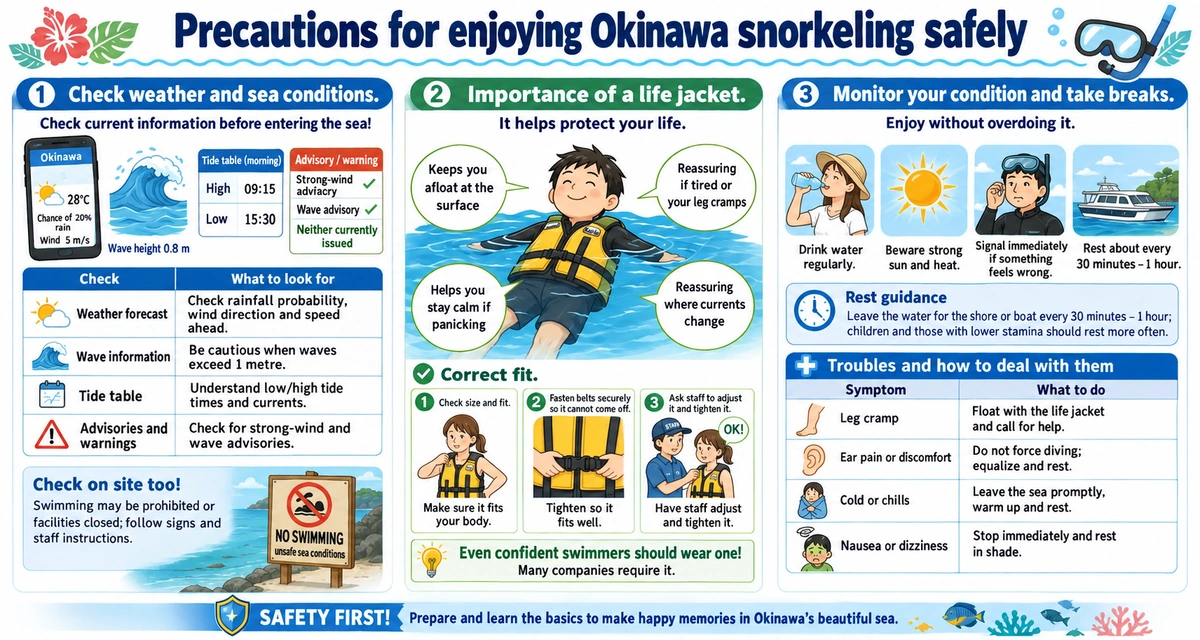
How to check the weather and sea conditions
Okinawa's ocean is beautiful, but its character changes greatly with the weather and sea conditions, so it is important to always check the latest weather information and sea conditions before you go snorkeling. Especially during typhoon season and times of year prone to the influence of weather fronts, wind speed and wave height can change rapidly, so do not neglect to gather information in advance.
The high wave advisories and strong wind advisories issued by the Okinawa Meteorological Observatory are important indicators for deciding whether snorkeling is possible. Also, at popular spots such as Cape Maeda and the Blue Cave, swimming bans or facility closures may be put in place depending on sea conditions, so you need to pay attention to signs on site and staff announcements.
When joining a tour, it is common for the guide to judge the sea conditions on the day and decide whether to change the course or cancel. The basics of staying safe are to always follow the guide's instructions and never enter dangerous waters on your own judgment.
| Item to check | Checkpoints |
|---|---|
| Weather forecast | Check the chance of rain, wind direction, and wind speed in advance |
| Wave information | Caution is needed if wave height exceeds 1 meter |
| Tide table | Know the times of low and high tide, and take the tidal flow into account |
| Advisories and warnings | Check whether any strong wind advisory or high wave advisory has been issued |
The importance of wearing a life jacket
For snorkeling beginners, wearing a life jacket is an essential element of staying safe. Many tour companies in Okinawa Prefecture require life jackets as a safety measure, and wearing one is recommended even for people who are confident in their swimming ability.
Wearing a life jacket lets you stay afloat at the surface even if you run out of energy or get a cramp in your leg, which makes it easier to prevent panic. In particular, because some waters around Onna Village have changeable tidal currents, the peace of mind from wearing one is a major benefit for beginners.
When putting one on, be sure to check that the size fits your body, and it is important to fasten the straps firmly so that there is no slack. If the size does not fit, it may not perform as intended when you really need it, so ask the staff to adjust it when you rent one.
Managing your health and when to take breaks
Snorkeling is an activity that uses more energy than you might imagine. Unlike swimming at the beach, you move across the surface while constantly being mindful of your breathing, so fatigue builds up without you realizing it. The basics of staying safe are to avoid taking part when you are feeling unwell or sleep-deprived, and not to push yourself.
Under Okinawa's strong sun in particular, the risk of dehydration and heatstroke also rises. Make a point of drinking fluids frequently before and after snorkeling, and drink before you feel thirsty. Also, if you experience discomfort from water getting into your ears or nose, or symptoms such as cramping legs, it is important not to push through and to signal the guide or people around you right away.
As a guideline for rest, it is recommended to get out onto land or the boat about every 30 minutes to 1 hour to rest your body. Children and people who are not confident in their stamina can prevent accidents caused by fatigue by taking breaks at shorter intervals.
| Symptom | What to do |
|---|---|
| Leg cramp | Secure your buoyancy with the life jacket and call for help from those around you |
| Ear pain or discomfort | Do not force yourself to dive; take a break while equalizing your ears |
| Chills or shivering | Get out of the water right away, warm up, and rest |
| Nausea or dizziness | Stop the activity immediately and rest quietly in the shade |
The best time of year and time of day for snorkeling in Okinawa
When is the best season?
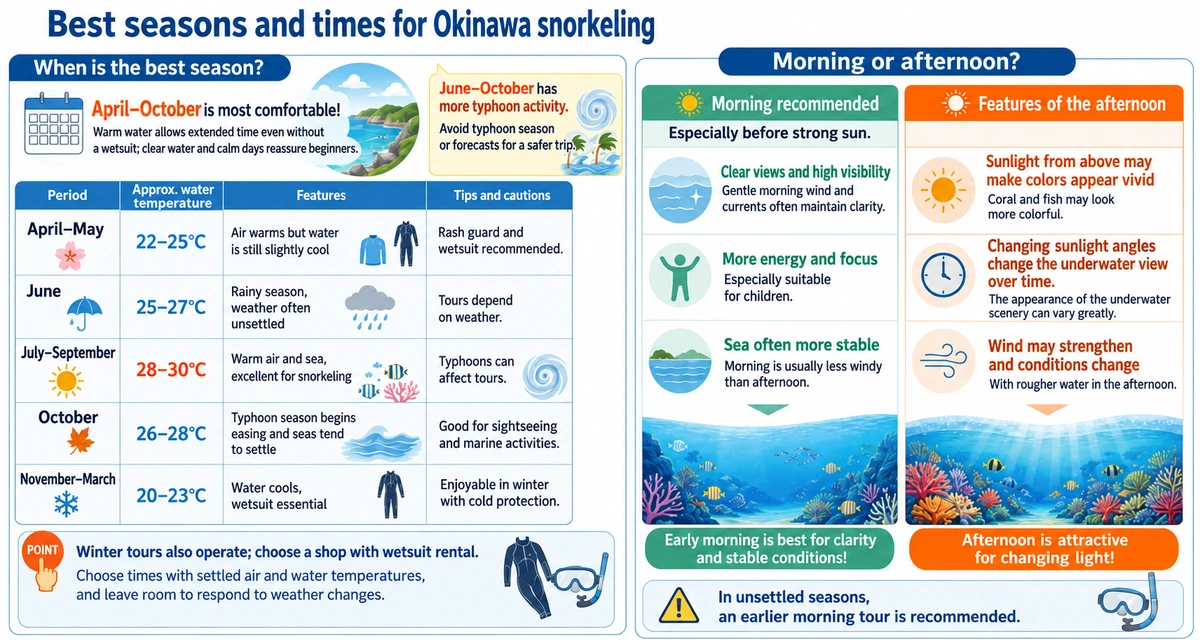
If you want to enjoy snorkeling in Okinawa, April through around October is considered the most comfortable season. During this period the sea temperature stays high, and you can stay in the water for a relatively long time even without a wetsuit. Around Onna Village in particular, there are times when high water clarity and calm sea conditions coincide, creating conditions where even beginners can have an experience with confidence.
On the other hand, from June through October is also the time when typhoons approach more often, so whether a tour runs is easily affected by the weather. When planning your trip, it is reassuring to avoid typhoon season or set aside a spare day. July through September, after the rainy season ends, is popular as the period when the sea temperature is at its highest and you can spend time comfortably in the water.
| Period | Approximate sea temperature | Features |
|---|---|---|
| April to May | Around 22 to 25 degrees | Air temperatures start to rise, but the sea temperature is a bit low. Wearing a rash guard or wetsuit is reassuring |
| June | Around 25 to 27 degrees | The weather tends to be unstable because of the rainy season |
| July to September | Around 28 to 30 degrees | Both sea and air temperatures are high, making it ideal for snorkeling. Typhoons are more likely to affect plans |
| October | Around 26 to 28 degrees | Typhoon season starts to calm down, and sea conditions tend to be stable |
| November to March | Around 20 to 23 degrees | The water temperature drops, so a wetsuit is a must. You can enjoy it even in winter, but cold-weather protection is important |
Snorkeling tours are held around Onna Village even in winter, but choosing a shop that can rent wetsuits to prepare for the drop in water temperature is the key to enjoying yourself comfortably. For your first snorkeling trip in Okinawa, choosing a time when both the water temperature and the climate are stable lets you reduce unnecessary worry and focus on the scenery of the sea.
Morning or afternoon: which is better?
As for the time of day to go snorkeling in Okinawa, the morning, especially the period before the sun gets too strong, is recommended for good visibility. In the morning the wind is often calm and the sea surface is still, so underwater clarity also tends to stay high.
Joining in the morning also has the advantage of letting you enjoy snorkeling while you still have plenty of energy. Especially when you have children with you, fatigue tends to set in as the afternoon goes on, so a morning tour is also suitable when you consider the physical burden.
On the other hand, in the afternoon the sunlight tends to shine straight down from above, and depending on the light, the colors of the coral reefs and fish can look even more vivid. How the underwater scenery looks changes with the angle of the sunlight, so knowing the differences between times of day can help you choose a tour.
However, the afternoon is also a time when the wind picks up and sea conditions change more easily, so you need to be aware that the sea tends to get rougher than in the morning. In seasons when the weather and sea conditions tend to be unstable, choosing a shop that schedules its tours early in the morning lets you enjoy snorkeling under more stable conditions.
Summary
For snorkeling in Okinawa, Onna Village, with its clear and beautiful sea, is an area especially recommended for beginners. With plenty of spots that even beginners can enjoy with confidence, such as the Blue Cave, Cape Maeda, and Navi Beach, you can choose according to your goals and level, which is a big part of the appeal.
As for what to bring, preparing swimwear and a rash guard, plus a snorkel set, fins, a life jacket, marine shoes, and sunscreen, will lead to a comfortable and safe experience.
Also, first-timers are encouraged to use a tour. By checking in advance what is included in the price and choosing a small-group tour with careful guidance, even families with children can take part with peace of mind.
To enjoy snorkeling safely, it is important to follow basic precautions such as checking the weather and sea conditions, wearing a life jacket, and taking frequent breaks.
Furthermore, being mindful of the best season and time of day lets you enjoy snorkeling even more comfortably. With thorough preparation and safety measures, make the most of snorkeling in the beautiful sea of Onna Village, Okinawa.