Are you tired of stressful everyday life and wanting to refresh yourself?
Blue seas, blue skies, and beautifully clear water!
The marine world is truly wonderful.
Marine activities are highly recommended for sweeping away everyday fatigue.
Snorkeling and diving in particular both let you fully enjoy the sea's appeal.
Snorkeling uses goggles and a snorkel to observe fish and coral reefs underwater, so you can enjoy it together even with small children.
Diving, meanwhile, takes you deep into the sea to thoroughly appreciate the underwater world.
Underwater is truly mysterious! Many people become hooked after trying it once.
However, a frequent concern with snorkeling and diving is seasickness.
Quite a few people feel unwell from boat travel or their body's rocking motion while snorkeling.
People normally prone to motion sickness are very likely to become seasick while snorkeling or diving too!
But you want to enjoy your special experience without seasickness.
This article therefore introduces ways to address seasickness while diving and snorkeling, along with the strongest recommended motion sickness medicines for prevention and symptom relief.
Whether this is your first time or you previously suffered seasickness, reading this is sure to make your next snorkeling and diving experience more enjoyable!
What is seasickness during snorkeling and diving?

Many people experience seasickness while enjoying snorkeling or diving.
Seasickness is a form of feeling unwell caused by movement on boats or underwater.
While rocking with the waves at sea can feel pleasant, it can also cause motion sickness.
Becoming seasick during snorkeling or diving makes you feel nauseated and spoils your enjoyable time.
Why do waves make you sick?
Here, we examine the basic mechanisms and causes of seasickness in detail.
What is seasickness? Understanding causes and symptoms
What causes it?
The main cause is poor coordination between your eyes, ears, and the functions that maintain your body's balance.
Did you know that when we normally walk or run, balance is adjusted using information from our eyes and our inner ear's sense of equilibrium?
On a boat or underwater, however, the scenery you see rocks while your body cannot match that movement.
Incorrect signals are therefore sent to the brain.
This mismatch between visual and physical sensations causes seasickness and makes you feel nauseated.
During snorkeling and diving in particular, both the water's surface and the boat rock.
The movements your body senses become complex and the brain cannot adjust quickly enough, making seasickness more likely.
What symptoms does seasickness cause?
Seasickness symptoms vary from person to person.
The main symptoms include
Nausea
Dizziness
Cold sweats
Headache
Fatigue
and similar complaints.
These often begin as mild discomfort, but if you leave them thinking you will probably be okay, they gradually worsen and eventually lead to vomiting.
Nausea is seasickness's most typical symptom, and the stronger it becomes, the more difficult it is not just to snorkel or dive but even to remain at sea.
At sea, you keep rocking and have nowhere to escape.
Cold sweats make it easier to use up your energy, and dizziness or headaches may occur too.
Taking early measures against seasickness is therefore important.
While diving in particular, worsening seasickness can interfere with underwater movement and create safety problems.
Do not dismiss it as mere seasickness; taking proper care is important!
Seasickness while snorkeling

Do you think snorkeling happens in shallow water where your feet touch the ground, so you will not get seasick?
Certainly, snorkeling is easier to try than diving.
But actually, seasickness is overwhelmingly more common while snorkeling than diving.
Wave effects are strongest at the surface, where your body is rocked by them.
Especially on days with strong waves and substantial surface movement, the likelihood of seasickness while snorkeling increases greatly.
Why can snorkeling make you sick too?
Reason 1: Surface waves constantly rock your body!
That means your semicircular canals are continuously stimulated.
Feeling nauseated when your body keeps rocking is the same as car sickness.
Reason 2: You frequently lift your face out of the water! → Each time you do this, your field of vision moves significantly up and down, encouraging motion sickness.
Seasickness while diving
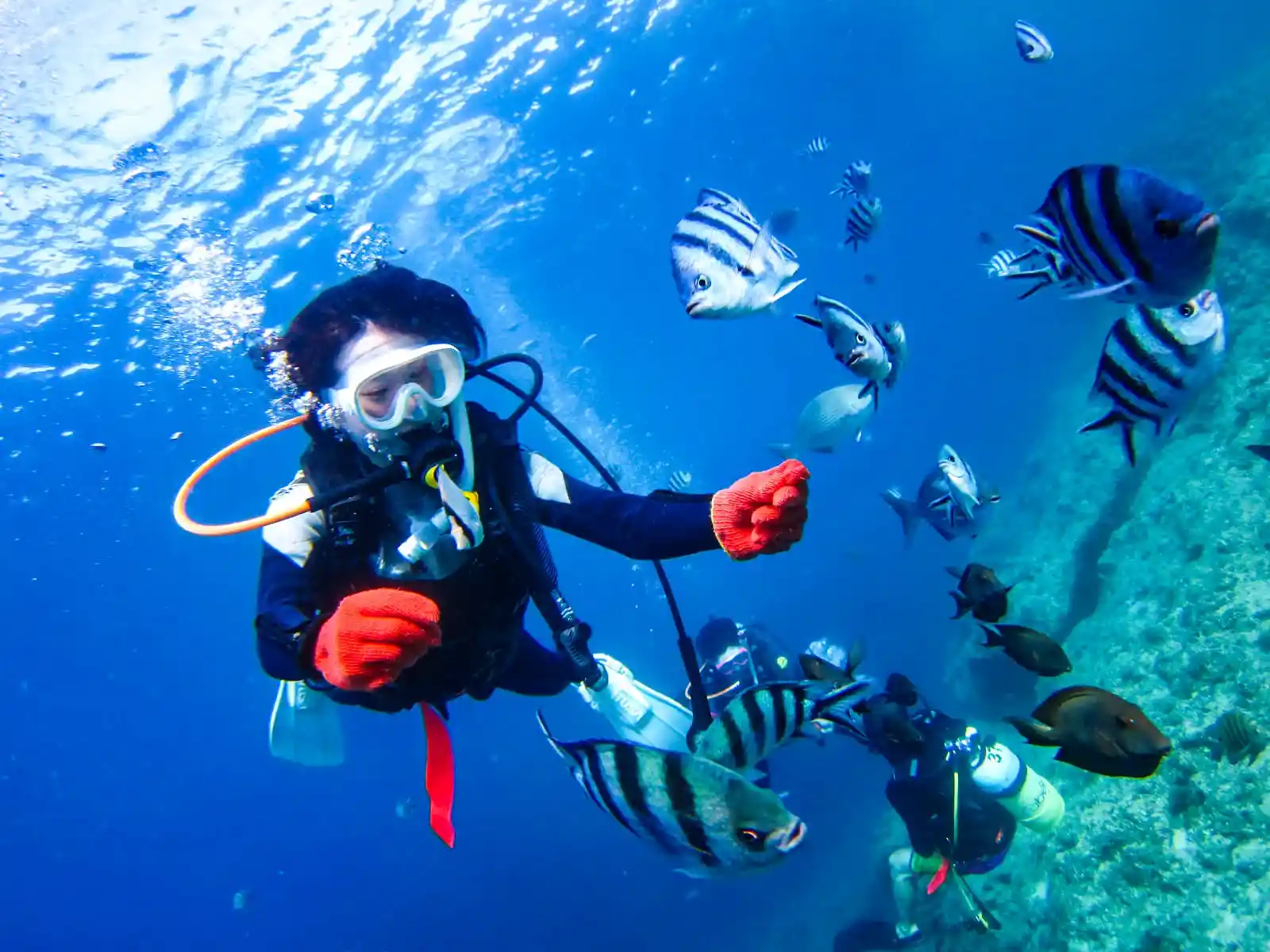
Do you think diving deep into the sea should be fine because waves do not affect you?
Diving causes motion sickness for reasons different from snorkeling.
Why can diving make you sick too?
Reason 1: You ride a boat! → In many cases, you travel to the diving location by boat.
The boat's rocking causes motion sickness.
Reason 2: Water pressure affects you!
→ The deeper the water, the more water pressure acts on your ears.
If you cannot equalize properly, changing water pressure disrupts the inner ear's balance sensations and causes motion sickness.
Reason 3: There is movement underwater too!
→ Even in deep water, waves and currents affect you, so rocking still occurs.
Quite a few people actually become sick watching seaweed sway while diving.
Ways to address seasickness while snorkeling and diving
‘If I get seasick, I cannot enjoy my special snorkeling experience. What can I do to prevent it?’
We understand. We want you to fully enjoy your special snorkeling or diving experience without regrets.
Prepare thoroughly against seasickness so that it does not become a disappointing memory of feeling nauseated and having to stop!
There is also a Must-check Seasickness Prevention Checklist at the end of the article, so please use it.
Now, let's introduce preventive measures.
Take good care of your condition the day before!
Managing your condition from the previous day is very important for addressing seasickness.
If you are not in good condition, you become sensitive to rocking while snorkeling or diving, making seasickness symptoms more likely.
Here are specific ways to manage your condition.
Get plenty of sleep!
Disruption of the autonomic nervous system
Insufficient sleep prevents the autonomic nervous system from working fully and reduces resistance to stress.
Your body consequently cannot adapt to boat rocking or irregular wave movement, making seasickness more likely.
A dulled sense of balance
Sleep directly affects the inner ear's function in controlling balance.
A lack of sleep is said to increase inner ear sensitivity.
In other words, you become more sensitive to rocking and tilting.
Your body therefore overreacts to boat and wave movement, increasing seasickness risk.
•Your mind does not work well
When you lack sleep, your mind feels foggy. Insufficient sleep reduces concentration and judgment like this, making seasickness harder to notice. Seasickness keeps worsening unless you respond as soon as symptoms begin. Get enough sleep so that you can notice and respond early.
Fatigue
Without sufficient sleep, immunity may decrease and tiredness and fatigue may increase.
After an all-nighter, your body feels terribly heavy and sluggish. Becoming seasick while feeling that way worsens your condition further, preventing enjoyment of diving or snorkeling.
Do you now understand the importance of plenty of sleep?
For these reasons, make sure to get sufficient sleep the night before to prevent seasickness!
Avoid drinking alcohol!
Your body becomes dehydrated
Alcohol has a diuretic effect and risks dehydrating your body.
Dehydration worsens your sense of balance and makes seasickness symptoms more likely.
Dehydration also causes another condition called decompression sickness.
To prevent decompression sickness, drinking alcohol is prohibited the day before diving.
To protect yourself, avoid alcohol and maintain sufficient hydration.
Increased sensitivity to rocking
Alcohol acts on the central nervous system, dulling judgment and reflexes.
Your legs sometimes feel unsteady when drunk.
This effect makes balance harder to maintain aboard a boat or with irregular wave movement, potentially causing seasickness.
If alcohol also causes shallow sleep and leaves fatigue the next day, your body may become more sensitive to rocking.
Stomach discomfort
Alcohol also affects the digestive system and may cause stomach discomfort.
With a hangover, nausea or an unsettled stomach can continue for a while.
Becoming seasick in that condition increases nausea, making snorkeling or diving impossible to enjoy.
Resist the urge to drink while feeling cheerful!
Avoid alcohol the day before planned snorkeling or diving.
Beware of overeating!

There are no particular dietary restrictions the day before.
Get plenty of nutrition.
But take care not to overeat!
An upset stomach
If overeating upsets your stomach, diarrhea may cause dehydration.
As explained earlier, dehydration adversely affects your body, so take care.
Incomplete digestion
If food is not fully digested by the day of the activity, water pressure compresses your stomach and makes you feel unwell.
Enjoying delicious food while traveling is fine, but stop before you are completely full.
Snorkeling and diving use your body and consume considerable calories, so you become really hungry afterward.
Enjoy delicious foods to the fullest then!
Things to watch on the day!
‘I took care of everything yesterday, so now all I have to do is enjoy myself!’
That is true, but there are actually many things we particularly want you to watch on the day.
Here, we introduce seasickness measures for the day of snorkeling or diving.
Eat lightly
Eating until full on the day of snorkeling or diving is obviously unhelpful, but quite a few people eat nothing because they worry about getting sick.
We understand, but absolutely avoid going hungry.
Avoid both an empty and an overfull stomach on the day and have a light meal.
What you eat also affects you, so consider meal contents as well as quantity.
Foods best avoided include
Fatty foods, such as fried foods and ramen
Foods that irritate the stomach, such as pickled plums, garlic, and citrus
Recommended foods are
Easily digested foods, such as apples and jelly
Ginger and carbonated water are said to have motion sickness prevention effects.
Eat lightly and finish at least 1 hour before boarding the boat.
Take motion sickness medicine
Taking motion sickness medicine is, of course, effective for snorkeling and diving too.
Depending on the medicine, take it around 30 minutes to 1 hour before boarding.
Motion sickness medicine is generally taken before becoming sick, but products that work after symptoms begin or can be taken without water are also sold now.
Choose motion sickness medicine suited to you.
We will introduce recommended products later!
Sit in the center of the boat
When riding a boat, always sit in its center.
The reasons are as follows.
The left and right edges directly transmit wave motion and rock more.
An engine is often at the rear, and depending on wind direction, exhaust fumes may make you nauseated.
Do not look down
Looking down while rocking makes motion sickness more likely.
Diving in particular often involves looking down while putting on equipment, but take care to avoid looking directly downward as much as possible.
Looking into the distance and taking big, deep breaths is also effective.
Do not wear restrictive clothes
Avoid overly constricting your body with a wetsuit or underlayers.
A constricted neck makes seasickness more likely, so if possible, taking off at least the upper half of your wetsuit is a good idea.
Stay relaxed
Stress is the enemy of seasickness prevention!
You may feel nervous or anxious, but relax both mind and body.
Ways to relax include
Talking with friends
Listening to favorite music
Deep breathing and stretching
Simply going to sleep
When nervous, your breathing becomes shallow, making it difficult to breathe or causing nausea.
To prevent this, make a point of remaining calm.
Enjoy locations with fewer waves
Snorkeling takes place at the surface, so it is strongly affected by waves.
Beginners and people prone to motion sickness should choose a location with fewer waves.
Choose equipment suited to you
The mask and snorkel used for snorkeling can also cause seasickness.
If they do not fit properly, you may feel wave motion more strongly, causing seasickness.
For diving too, choose equipment that fits your body closely.
What to do if you still become seasick
If you become seasick despite thorough measures, respond immediately.
Leaving it untreated lets your condition worsen, making continued snorkeling or diving impossible.
Stop and take a break
Stop immediately and rest.
When early seasickness symptoms appear, lying quietly or taking slow, deep breaths can ease them.
Stretch

Light stretching is also effective.
Relaxing your body through gentle movement and improving circulation can ease seasickness symptoms.
Hydrate
Stay well hydrated.
Carbonated water or sports drinks are good choices.
Alkaline components in carbonated water keep your body's balance normal.
Sports drinks also replenish electrolytes, offering the prospect of faster recovery.
Take motion sickness medicine
Some motion sickness medicines work even after you become sick.
Bringing some offers reassurance if you forget to take it beforehand or unexpectedly become sick.
Unsure which medicine to choose? The 3 strongest motion sickness medicines

Taking motion sickness medicine is extremely effective against seasickness when snorkeling or diving. Many types are sold, and honestly there are so many that choosing can be difficult. Here, we introduce the top 3 particularly popular medicines that work effectively.
Aneron Niscap: SSP Co., Ltd.
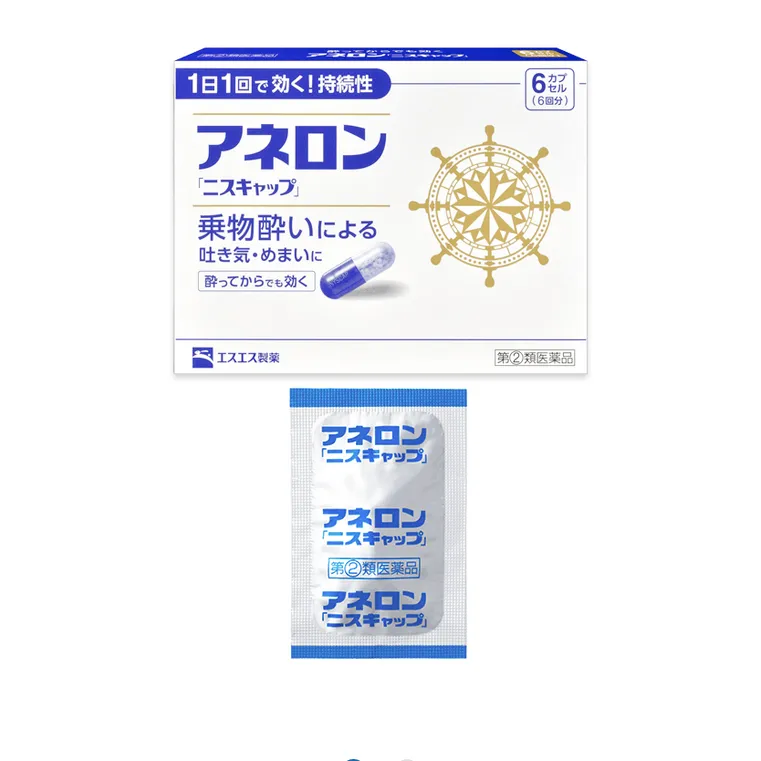
The first motion sickness medicine we introduce is Aneron Niscap.
Aneron Niscap prevents and relieves nausea, dizziness, and headaches caused by motion sickness and is popular with many divers.
Features
Long-lasting effects: 1 capsule per 1 day maintains the effect
Can be taken before or after meals
Works even after you become sick
Acts directly on the stomach, promising excellent effects
Less likely to cause drowsiness
Aneron Niscap has excellent lasting power, making it perfect for extended diving or boat travel.
Being less likely to cause drowsiness is another characteristic.
Drowsiness inevitably makes maintaining concentration difficult while snorkeling or diving and is very dangerous.
Many divers favor this medicine because it allows them to withstand extended sea movement and approach snorkeling and diving in excellent condition.
It truly is a perfect motion sickness medicine for snorkeling and diving!
Activities can be hectic, making it easy to forget medicine.
With this medicine, taking it before departure lets the effect continue, offering reassurance.
Senpaa QT: Taisho Pharmaceutical Co., Ltd.
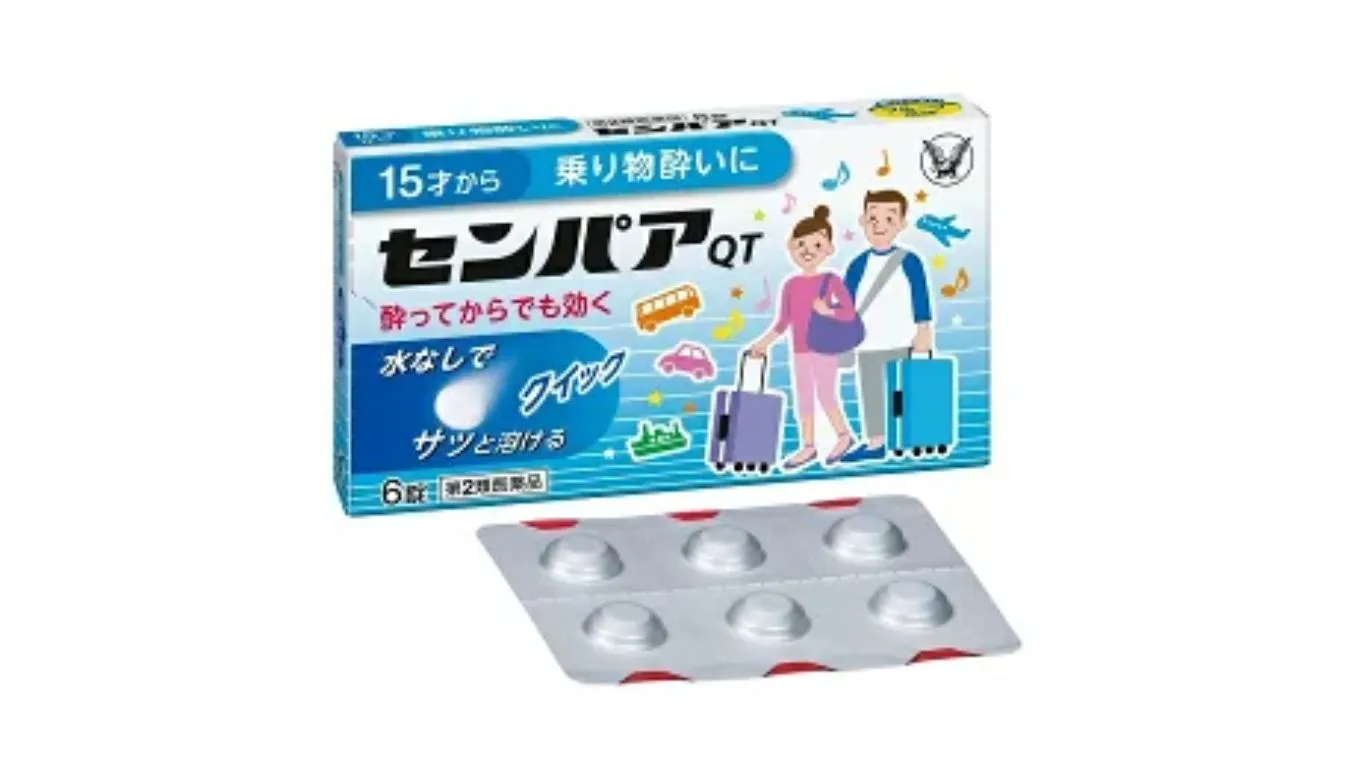
The next motion sickness medicine we introduce is Senpaa QT.
Senpaa QT is a tablet-type motion sickness medicine that can be taken without water or chewing.
Features
Can be taken without water or chewing
Works after you become sick
Dissolves quickly
Fast acting
Easy-to-take fruit flavor
The active ingredient diphenidol hydrochloride acts directly on the vomiting center, making it fast acting; relatively low likelihood of drowsiness is another recommended point.
Even if you think you do not get sick, you may suddenly find yourself nauseated.
At such times, even water may be difficult to swallow. Senpaa QT dissolves quickly just by placing it in your mouth and is easy to take immediately, making it an ideal medicine after motion sickness begins.
It tastes like orange juice and is easy to take.
Because this medicine dissolves easily, take care not to touch the tablet directly with wet hands.
Travelmin 1: Eisai Co., Ltd.
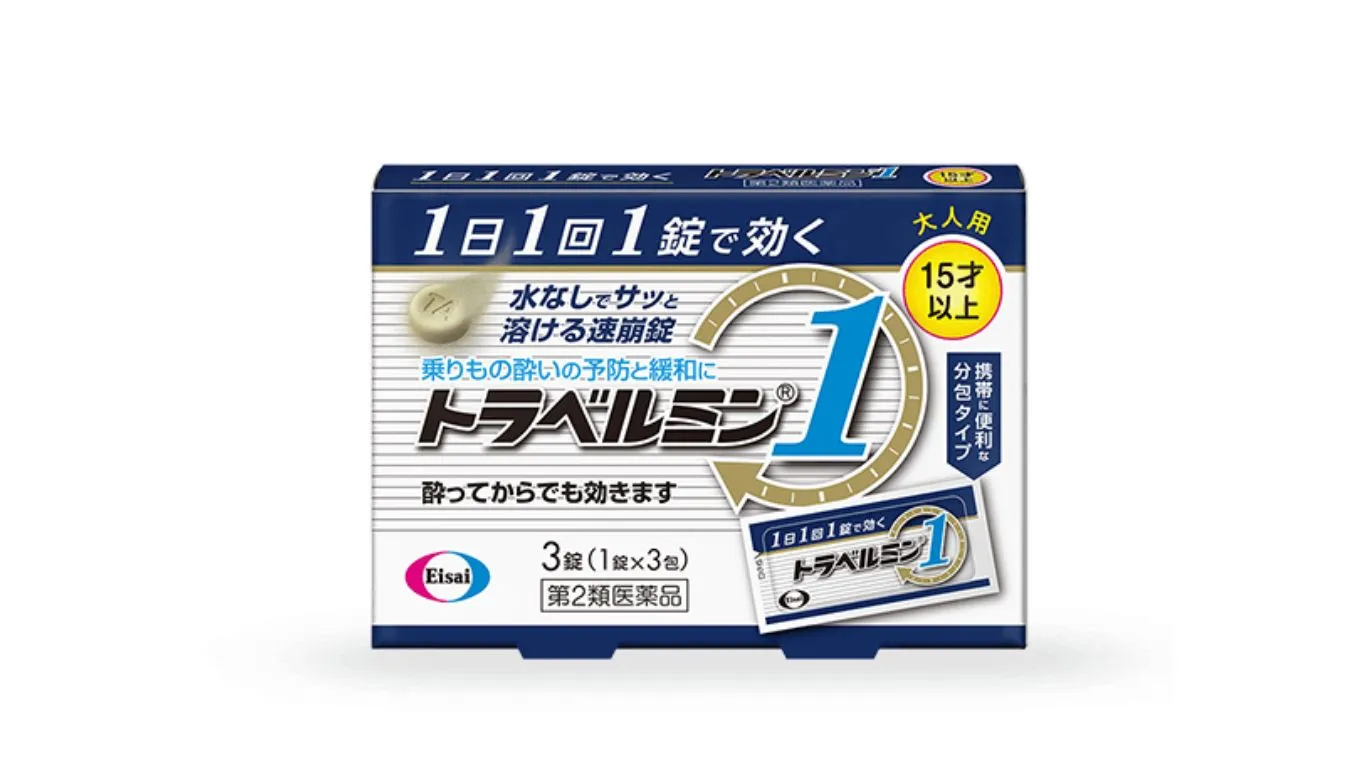
Travelmin 1 is a motion sickness medicine trusted and chosen by many people for years.
Above all, its fast action is a major characteristic, and anyone who has taken Travelmin may understand its effectiveness.
Children's motion sickness medicine is sold as well as adult products.
Features
Fast acting
Can be taken without water or chewing
Lasting effect with 1 tablet per 1 day
Works after you become sick
Dissolves quickly
This is another motion sickness medicine that needs no chewing.
It dissolves smoothly in your mouth like a ramune candy and acts quickly, making it highly popular.
Travelmin 1 contains an antihistamine ingredient that acts on the brain's vomiting center to prevent motion sickness.
Because this medicine takes effect particularly quickly, it is said to handle sudden seasickness too.
However, it may cause drowsiness in some people, so take care when alertness is needed, such as before driving, snorkeling, or diving.
Taking it 30 minutes beforehand is best, but in such cases taking it somewhat earlier is a good idea.
Travelmin also sells children's products, allowing use by families.
Taking plenty of fluids and relaxing your body when taking it is a good idea.
Effects and side effects differ by individual, so find a motion sickness medicine that suits you!
If unsure, a pharmacist at a drugstore will offer attentive advice.
Read the precautions carefully and make a point of taking motion sickness medicine appropriately.
Have you heard of motion sickness bands? A simple explanation
We introduced recommended motion sickness medicines for snorkeling and diving, but motion sickness bands have recently attracted attention.
These prevent seasickness without concern about side effects associated with motion sickness medicines.
How do these bands produce their effects?
Effects of motion sickness bands
Motion sickness bands stimulate a pressure point on the wrist called Neiguan, regulating your condition and working against seasickness and motion sickness.
They work not only for vehicles but for all forms of sickness caused by rocking, including snorkeling and diving.
Neiguan is a pressure point that improves internal organ function, and apparently also works for nausea and vomiting due to morning sickness or hangovers, stress, and loss of appetite.
Other listed effects include pain relief and relief of stomach bloating.
How to put them on and take them off
When using one, accurately position and attach it so that the raised part on the inside of the band presses on Neiguan.
Insufficient pressure weakens its effect, so fit it securely.
Wearing bands on both wrists maximizes their effects, so we recommend using them on both wrists.
There are mainly 3 types of bands.
Stretchy wristband type
Hook-and-loop type
Watch-like belt type
Among them, the wristband type stretches, making it easy to put on and take off, and also has the benefit of being washable when dirty.
Using it for snorkeling or diving immerses it in seawater, so washing it with dirty clothes is hygienic and very convenient.
How to choose motion sickness bands
Check your size
They do not work unless they firmly stimulate Neiguan, so choose a size that fits your wrist securely.
Children's bands are also sold, so choose a children's version for small children.
Choose the material
Materials differ by band type. Since they are generally worn for a long time, choose material that does not strain your wrist.
Choosing according to use is also good. Outdoors, sweat and dirt accumulate, so washable materials are hygienic and recommended.
Special nylon that feels less stuffy is also good for children who sweat a lot.
Find your favorite color
Recently, many motion sickness bands have stylish designs and can also be used as fashion items.
Subdued colors such as black or white blend well with clothes, but slightly brighter colors may be nice when going to the sea.
Unlike medicine, motion sickness bands have no side effects.
There is no need to worry about side effects or drug interactions, and everyone from children to adults can use them with peace of mind.
If you want to try a natural motion sickness remedy without relying on medicine, try a motion sickness band.
Comparing motion sickness bands
Let's compare popular motion sickness bands.
| Product | Material | Colors | Other |
|---|---|---|---|
| Sukkiri Band (R)Presby Co., Ltd. | Acrylic, nylon, polyurethane, plastic | Adults: gray/black/navy/red Children: pink/blue/green Pregnant women: lilac | Washable: yes Morning sickness relief: yes Stretchy Contains 2 bands |
| Medical acupressure band OSTO Bitatto Japan Co., Ltd. | Silicone rubber, iron | Dusty pink, ice blue, off-white, sand beige | Washable: yes Morning sickness relief: yes 12 adjustment levels fit children through adults Contains 2 bands |
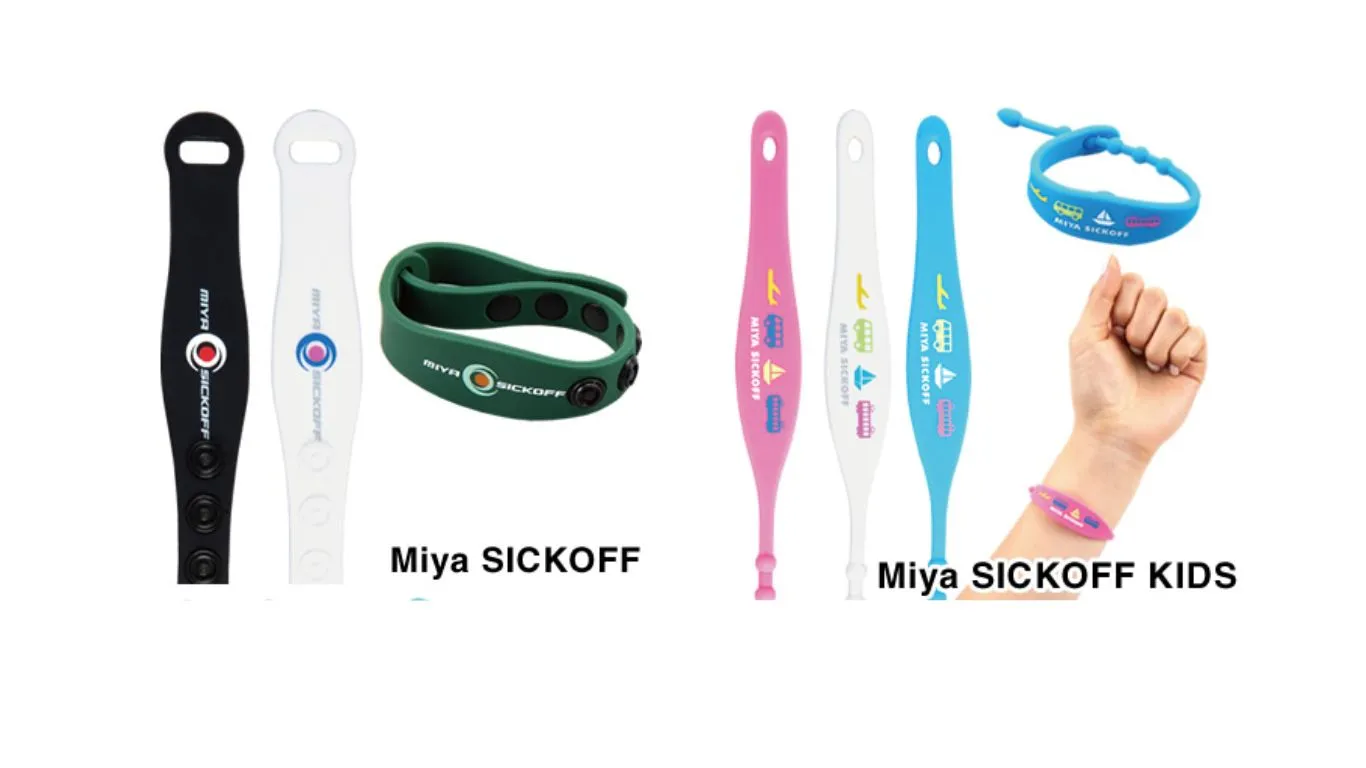
| Miya SICKOFF Miyamae Co., Ltd. | Silicone rubber | Adults: black/white/dark green Children: blue/pink/white | Rinsable: yes Morning sickness relief: yes Children's size available Contains 1 band |
Sukkiri Band (R): Presby Co., Ltd.
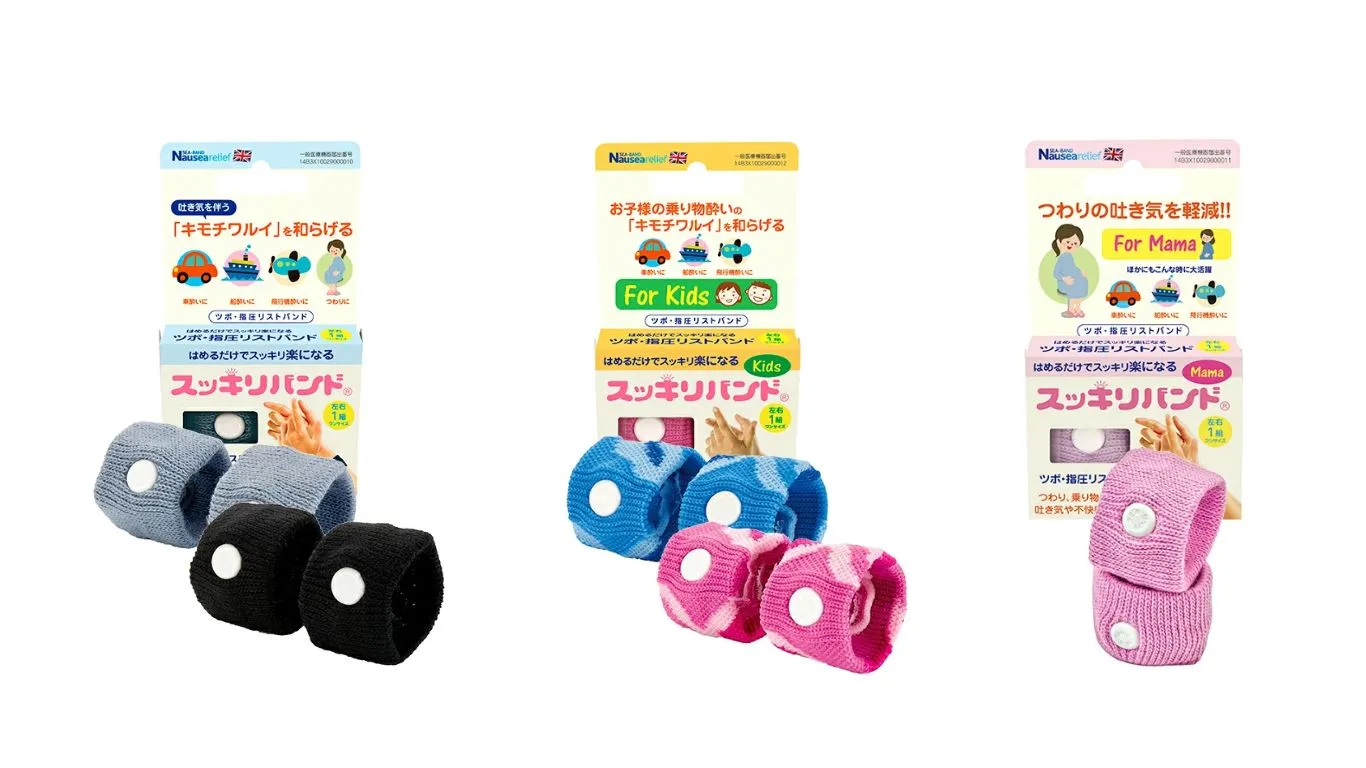
First is Presby Co., Ltd.'s Sukkiri Band (R).
Manufactured by Britain's Sea-Band company, Sukkiri Band is sold in more than 50 countries.
It has even received international safety standard certification as a textile product meeting the world's highest safety standards.
Made of acrylic, nylon, and polyurethane, it has the advantage of remaining less stuffy even during extended wear.
It is hygienic because it can be washed if dirtied by sweat. Unlike silicone, it does not shift with sweat and is an excellent product usable as a wristband too.
Its subdued color selection makes any color match your clothes.
Medical acupressure band OSTO: Bitatto Japan Co., Ltd.
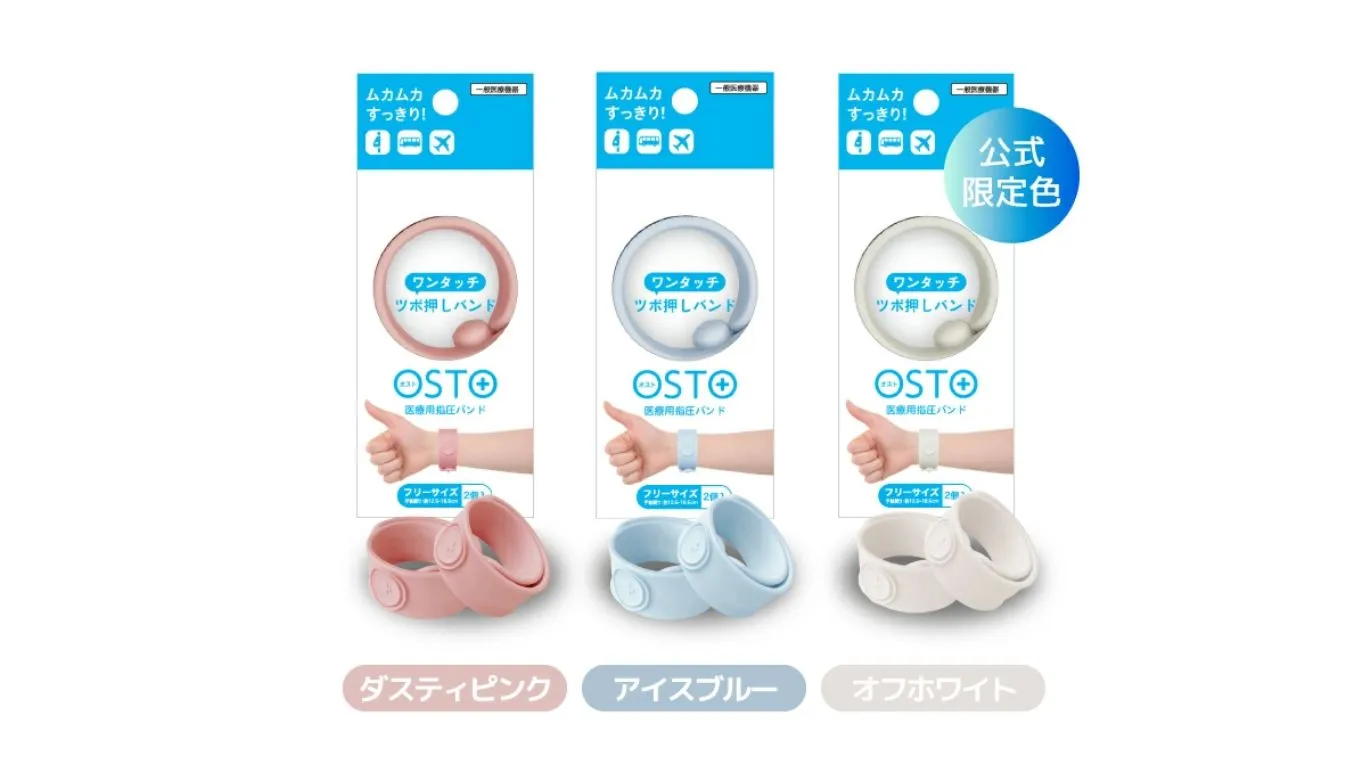
Next is Bitatto Japan Co., Ltd.'s medical acupressure band OSTO.
The band is made of silicone rubber and has 12 adjustment levels.
Both adults and children can therefore adjust it to their own size.
Its colors incorporate popular muted shades, making it particularly popular with women.
Miya SICKOFF: Miyamae Co., Ltd.
The final motion sickness band we introduce is Miyamae Co., Ltd.'s Miya SICKOFF.
Miyamae sells fishing equipment, so its motion sickness band immediately seems trustworthy.
Compared with other motion sickness bands, this one has a narrower design.
It looks stylish and would suit sporty clothing.
A children's version is also sold.
The children's motion sickness bands have soft, very cute colors that children are sure to enjoy wearing.
Because the band is narrow, it puts less strain on children's wrists.
Size adjustment is as easy as threading it through a hole and pulling, so even small children can put it on themselves.
As you can see, motion sickness bands come in various types.
For long-lasting comfort, Presby's Sukkiri Band (R) is recommended; for a cute design with a perfectly fitted size and effects, choose Bitatto Japan's medical acupressure band OSTO; for stylish, discreet wear, choose Miyamae's Miya SICKOFF.
Not every product necessarily contains 2 bands, so check the quantity carefully when buying.
Motion sickness bands apparently also reduce morning sickness.
They are excellent products that work not only for seasickness, car sickness, and wave-related sickness during snorkeling or diving, but also for nausea due to hangovers or morning sickness.
Summary: must-check seasickness prevention checklist

So far, we have explained ways to address seasickness while snorkeling and diving.
We made an at-a-glance seasickness prevention checklist, so please use it.
Whether you feel anxious about your first snorkeling or diving experience or hesitant because of previous seasickness, putting the measures described here into practice is sure to make it an enjoyable 1 day!
Prepare thoroughly and enjoy snorkeling or diving to the fullest!
| Take good care of your condition the day before! | Things to watch on the day! | What to do if you still become seasick |
|---|---|---|
| Get plenty of sleep | Eat lightly | Stop and take a break |
| Get plenty of sleep | Take motion sickness medicine | Stretch |
| Beware of overeating | Sit in the center of the boat | Hydrate |
Do not look down | Take motion sickness medicine | |
Avoid restrictive clothes | ||
| Stay relaxed | ||
Enjoy locations with fewer waves | ||
Choose equipment suited to you |